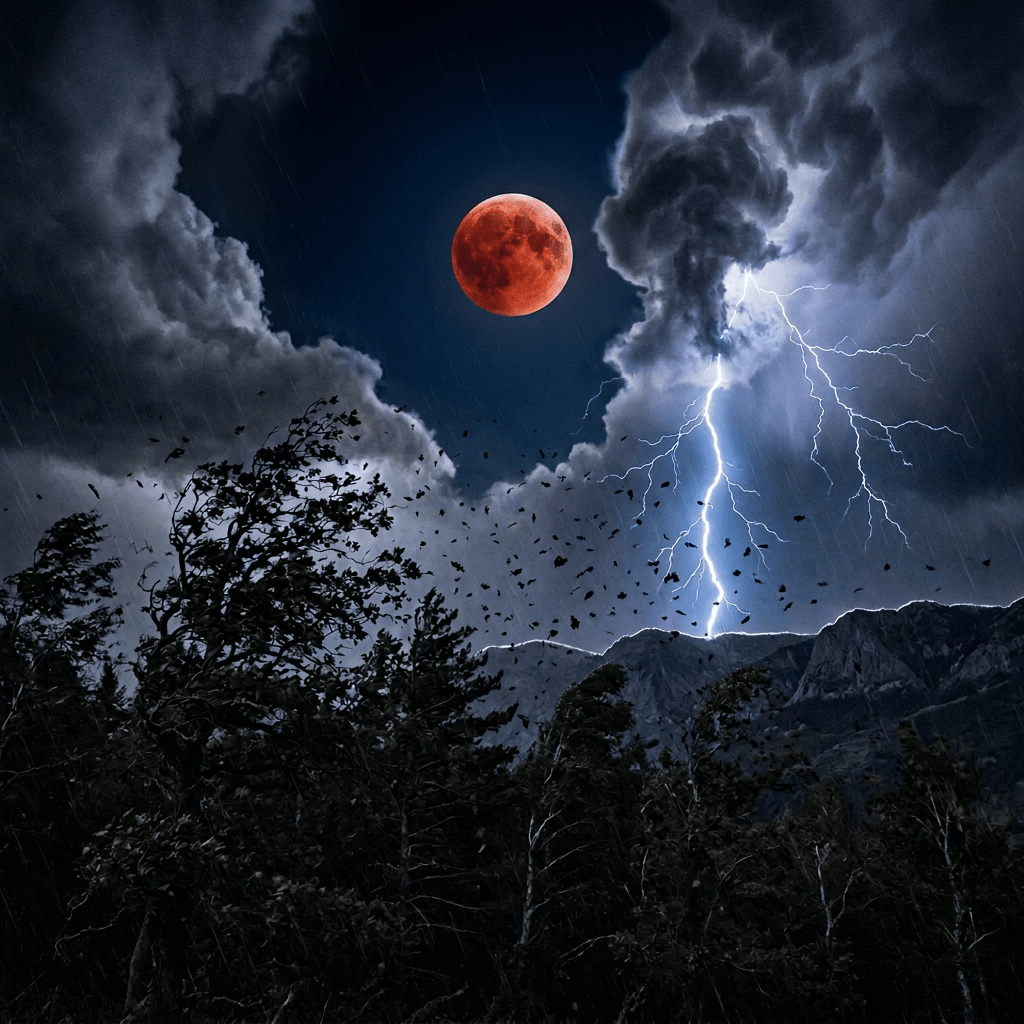
The blood moon

Red moon above storm clouds, lightning, mountains, and windblown trees

This lunar eclipse is a remarkable threshold, and the astronomy itself gives it unusual weight. At 06:12 CEST on 28 August, Earth places its shadow across the Full Moon, with about 96 percent of the lunar disc entering the darkest part of Earth’s shadow. In tropical astrology the Moon is at 4°51 Pisces opposite the Sun at 4°51 Virgo, with Mercury close to the Sun and Uranus in Gemini squaring the eclipse axis. Pisces, Virgo and Gemini create a powerful pattern of perception, discernment and information. We are living through an extraordinary flood of information, misinformation, revelations and competing realities, while old explanations are increasingly being challenged. Uranus brings disruption and sudden insight, Pisces asks us to listen beyond the obvious, and Virgo demands that what we perceive is examined carefully.

The eclipsed Moon sits almost exactly upon Fomalhaut, one of the four ancient Royal Stars, associated with the Southern Watcher, vision, spiritual perception and the necessity of distinguishing illumination from illusion. This feels particularly significant now. Human beings are not detached observers of Earth but living systems embedded within its electromagnetic, gravitational and environmental fields, while the planet itself is experiencing extremes of heat, drought, fire and sudden inundation. At the same time, people are questioning old political structures, inherited beliefs and the narrow definitions of what constitutes legitimate knowledge. Pisces represents permeability and sensitivity, Virgo discrimination and Gemini the vast information network through which humanity now communicates. The eclipse therefore asks us not simply to acquire more information, but to become better listeners and more discerning perceivers.

Beyond the visible planets, Pluto in Aquarius continues the transformation of collective power and civilisation, while Haumea brings regeneration, Makemake creation and relationship with the living world, Eris the excluded voice demanding recognition, and distant Gonggong the mythology of water and overturned cosmic order. These long orbital bodies add a remarkable mythological layer to the eclipse. The larger story is one of dissolution and regeneration, ecological consequence, changing power structures and the widening of human perception. This does not require us to abandon science; rather, it asks whether science itself can become sufficiently open to investigate the full range of human experience. We may be approaching a period in which intuition, embodied awareness, subtle perception and forms of consciousness previously dismissed are examined with new seriousness. The eclipse marks the closing of a long Pisces cycle and asks humanity to learn the art of listening: neither believing everything nor dismissing everything, but becoming capable of seeing what is actually there.
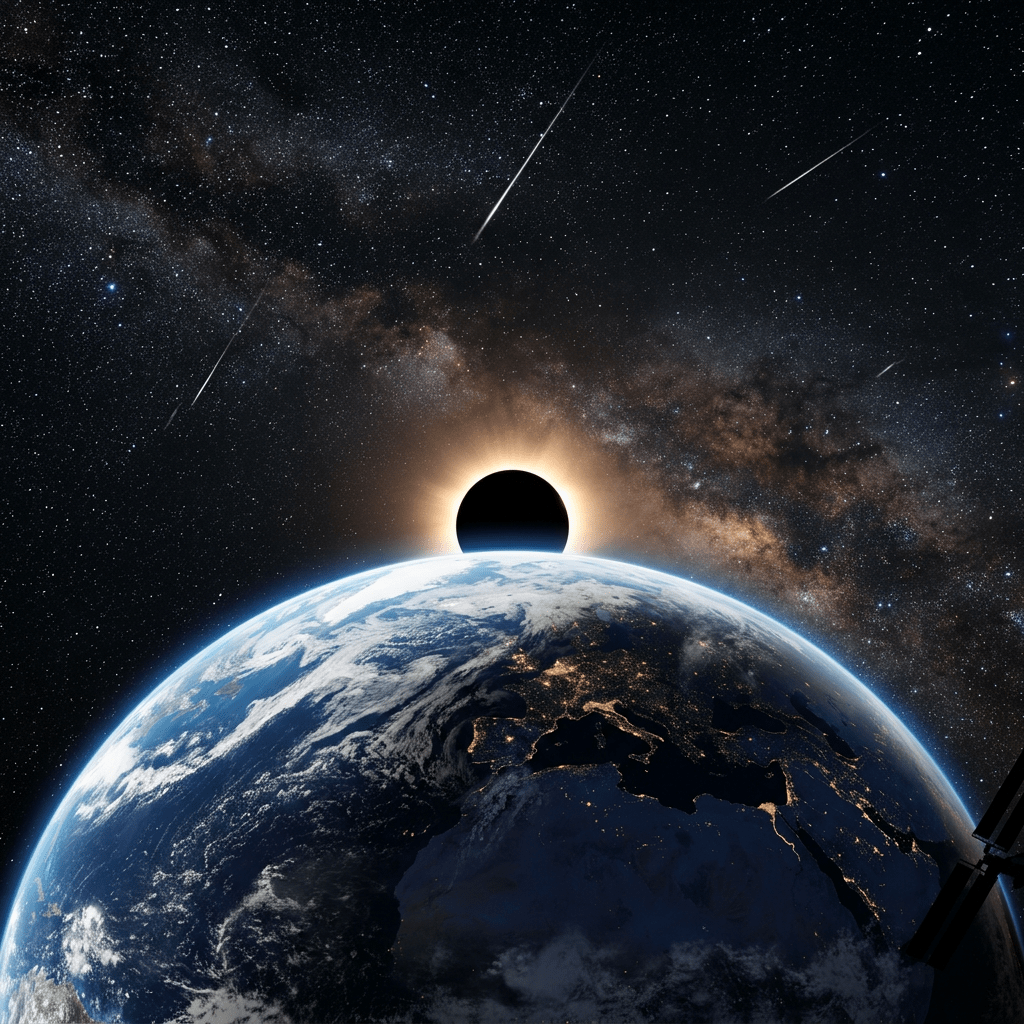
The Eclipse and the Perseids

Solar eclipse above Earth with visible stars and meteor streaks

This week we should get the most spectacular skies, not only is the sun showing some volatile activity leading to northern lights, We also have the solar eclipse in Leo, and space itself is very interesting right now as we travel through the Perseid stream

The space we are travelling through is itself also worth distinguishing from the Perseid stream. The Solar System is moving through the local interstellar medium, within the very low-density region surrounding the heliosphere; the heliosphere is continually interacting with that external plasma and magnetic environment while the Sun and planets move through it.
At the same time, Earth is travelling around the Sun at about 30 km/s, carrying us through a much more local stream of material: the Perseid meteoroid trail. The Perseids are not a cloud arriving at Earth from Perseus; Earth is crossing the elongated orbital debris stream of Comet 109P/Swift–Tuttle. The comet’s orbit is highly elongated and retrograde, with an inclination of about 113°, so its debris travels through the Solar System in the opposite direction to the planets.
That makes our encounter unusually fast and nearly head-on, producing the Perseids which enter the atmosphere at roughly 59 km/s.
Around 10–16 August 2026, Earth is moving through the densest part of this debris corridor, with the Perseid peak around 12–13 August, precisely alongside the solar eclipse. The stream itself is much broader than the visible meteors suggest at roughly 0.1 AU wide, and Earth takes days to cross it, which is why the shower builds before the peak and continues afterwards.
The apparent trajectory is therefore particularly interesting: the particles are travelling along the ancient orbit of Swift–Tuttle, while Earth cuts across that orbit; from Earth they appear to radiate outward from Perseus, but their actual paths through space are almost parallel to the comet’s retrograde trajectory.
So this week we have three different spatial encounters layered together: the Solar System moving through the local interstellar environment, Earth moving through the Sun’s changing solar-wind and magnetic environment, and Earth physically crossing the ancient Swift–Tuttle debris stream. Then the 12 August eclipse occurs at the centre of that passage, with the darkened sky making the Perseid encounter unusually visible. That is quite an extraordinary piece of celestial geometry for the Geo-Zenith picture.
It goes almost without saying that every single one of us will be affected by this – everyone.

Pisces 3 – 9 August 2026

Pisces constellation night sky with blue eclipse

or Pisces, the week of 3–9 August 2026 brings a quiet but powerful period of inner awareness as the world moves towards the total solar eclipse on 12 August. Astronomically, the Sun continues through Leo while the Moon advances towards its alignment between Earth and the Sun, creating a growing celestial focus. From a Geo-Zenith perspective, this eclipse build-up reflects the delicate relationship between cosmic cycles and Earth’s living systems, with increasing attention on climate, oceans, collective emotions and humanity’s connection with nature. Pisces, as the sign most attuned to the unseen currents of life, may sense these changes before they become fully visible.

Astrologically, this is a week for compassion, healing and quiet preparation rather than forcing direction. The approaching eclipse may bring awareness of old emotional patterns, dreams that have been waiting for attention and the need to release what has quietly become a burden. Pisces can sometimes absorb the fears and confusion of the wider world, but this period asks you to return to your own centre and distinguish intuition from overwhelm. Your sensitivity is not a weakness; it is a way of understanding what needs care, healing and renewal.

Way through: Protect your inner peace, trust your deeper knowing, and turn your compassion into gentle actions that create healing for yourself and the world around you.

Before the eclipse

From 3–9 August 2026 the astrological atmosphere feels like the gathering of a tide before a major wave. The Sun continues its journey through Leo, emphasising leadership, identity and the creative expression of purpose, while Mercury’s movement encourages reassessment of plans rather than impulsive decisions. Although the total solar eclipse does not occur until 12 August, its influence is already building. Eclipses have long been regarded as periods when events accelerate and hidden situations move rapidly towards revelation, and many astrologers consider the days leading into an eclipse to be as significant as the eclipse itself. Collectively this week may bring increasing political tension, market uncertainty, environmental concerns and sudden announcements that have been developing behind the scenes for months. Individuals may experience a growing feeling that an important chapter is ending and another is preparing to begin. Rather than forcing outcomes, this is a week for careful observation, completing unfinished business and listening to intuition before decisive action becomes necessary.

From an astronomical perspective, the approaching eclipse is a precise alignment of the Sun, Moon and Earth, with the Moon moving directly between Earth and the Sun on 12 August. Totality will be seen best across Greenland, Iceland and northern Europe, with a small portion of Portugal also lying within the path of totality. Much of Europe, including the Netherlands, will experience a deep partial eclipse of around ninety per cent, while large parts of North America, Canada and north-west Africa will also witness a partial eclipse. As the Moon’s shadow races across Earth at thousands of kilometers per hour, scientists will study the Sun’s corona, atmospheric changes and subtle effects on Earth’s upper atmosphere, while sky-watchers experience one of nature’s rarest spectacles. Astrologically, eclipses symbolise moments when familiar patterns are interrupted, allowing new directions to emerge. Whether viewed through astronomy or astrology, this week invites us to recognise that change often begins quietly before it becomes unmistakably visible.

The ring of fire

On 17 February 2026 the Sun and Moon meet at the final degree of Aquarius in an annular solar eclipse — a New Moon that does not merely begin a cycle, but completes one. The anaretic degree carries the weight of culmination: systems stretched to exhaustion, ideologies at their limit, networks revealing their fractures. Aquarius governs the collective field — technology, governance, movements, shared narratives — and this eclipse lands precisely where those themes are most visibly strained. Around us: political aggression, protests, instability, disclosures, the sense that old authorities are losing coherence. An eclipse at 29° does not whisper. It closes a chapter.

What makes this one structurally unique is timing. Saturn and Neptune converge at 0° Aries — the zodiac’s ignition point. Zero degrees is not a continuation; it is emergence. Saturn brings form, boundary, law. Neptune dissolves and re-mythologises. Their meeting at the Aries Point marks the reset coordinate of a new collective storyline. The eclipse at the end of Aquarius clears the field; 0° Aries begins the next assertion of identity, leadership and direction. The sky is architecturally precise: finish, then initiate.

In the midst of visible chaos — aggression, ideological fragmentation, institutional fatigue — this configuration suggests not collapse but reorganisation. When systems lose stability, human choice becomes amplified. Eclipses expose where we are reactive; Aries demands conscious action. The reset is not imposed from above; it is enacted through decisions made under pressure. What we defend, what we build, what we refuse to perpetuate — these become the scaffolding of the next cycle.

Working through this eclipse means resisting reflex and choosing clarity. Aquarius asks: what collective are you feeding? Aries asks: what are you initiating? The human Earth is not ending; it is recalibrating. Old frameworks are dissolving because they cannot carry the next phase. The 17 February eclipse is a threshold — not into chaos, but into responsibility. Zero degrees signal the beginning, but the beginning depends on us.

October 2025

As October unfolds, the world stands at a precipice, balancing on the edge of significant transformation and escalating turmoil. The convergence of celestial events and global developments paints a picture of a month where the forces of change are both challenging and illuminating.

The humanitarian crises in Northern Africa and the Horn of Africa continue to deepen. In Sudan, the city of El Fasher remains under siege, with over 260,000 residents trapped and facing extreme shortages of food and medical supplies. Despite international efforts, access for aid remains severely limited. Concurrently, countries such as Ethiopia, Somalia, and Kenya are experiencing severe droughts, leading to widespread famine. The FAO and WFP have issued early warnings about escalating food insecurity in these regions. These dire circumstances are compounded by the global shipping industry’s volatility, as reported by UNCTAD, which highlights disruptions due to rising geopolitical tensions and trade policies. The war in Ukraine, heightened Middle East conflicts, and rerouting ships around the Cape of Good Hope due to Red Sea disruptions are contributing to the instability, affecting the delivery of humanitarian aid.

Politically, the United States faces internal and external challenges. President Donald Trump is scheduled to meet with Australian Prime Minister Anthony Albanese on October 20 in Washington. Discussions are expected to focus on the AUKUS security pact, particularly the provision of nuclear-powered submarines to Australia amid regional tensions with China. Meanwhile, the European Union grapples with internal divisions and external pressures. The European Political Community will convene on October 2 in Denmark, bringing together leaders from across the continent to discuss pressing issues such as migration, energy security, and economic stability. These political events coincide with significant astrological transits, including Mercury’s entry into Scorpio on October 6, which may intensify communication and uncover hidden truths, and the Full Moon in Aries on the same day, heightening emotions and bringing issues to a head.

In the realm of space and science, October offers moments of awe and wonder. The appearance of Comet C/2025 A6 (Lemmon) symbolizes hope and renewal. Its brightness amidst the darkness serves as a reminder that even in challenging times, there is light to guide us forward. The Orionid meteor shower, peaking on October 20, provides opportunities for reflection and connection with the cosmos. These celestial events encourage us to pause and reflect on our place in the universe, offering moments of clarity and perspective.

Astrologically, October is a month of introspection and transformation. Mercury’s transit through Scorpio encourages deep introspection and transformation, favoring uncovering hidden truths and engaging in meaningful conversations that can lead to personal and collective growth. The Aries Full Moon brings heightened emotions and a desire for independence, urging us to release what no longer serves us and to embrace courage in the face of adversity. Venus’s entry into Libra on October 13 promotes harmony, balance, and cooperation, offering a chance to mend fences and build bridges. Pluto’s direct motion in Aquarius on October 13 signifies a shift towards collective transformation, urging us to adapt and innovate as societal structures and systems undergo significant changes.

In these turbulent times, it’s essential to find balance and hope. Engaging in community efforts, practicing mindfulness and reflection, and staying informed and involved can provide clarity and peace amidst chaos. By embracing these practices, we can navigate the challenges of October with resilience and optimism, fostering a sense of unity and purpose in the face of adversity.

The astrology of the Lunar eclipse

The total lunar eclipse of 7 September 2025 falls at about 15° Pisces, a mutable water sign that dissolves boundaries and exposes the porousness between fact and imagination. Astronomically this is a deep eclipse, with the Moon fully immersed in Earth’s shadow for over an hour, visible across Europe, Africa, Asia and Australia. In astrology, eclipses on this axis tend to signal endings and closures, particularly of emotional, spiritual, or collective narratives that have outlived their function. Pisces colours the event with themes of compassion, sacrifice, and the pull between dream and disillusion.

What sharpens the tone of this eclipse is Saturn’s strong involvement in Pisces alongside it. Saturn insists on accountability and structure, so the otherwise fluid Piscean themes are given a stern, even karmic edge. Loose boundaries and sentimental evasions will not hold; decisions about what to release or where to draw a line may feel final, and the consequences tangible. In practice, this looks like institutions of care, religion, art, and humanitarian work facing calls to take responsibility, while individuals with mutable sign placements between 13° and 17° will be asked to let go of outdated roles and commitments.

Uranus adds another layer by stationing retrograde just the day before. This sudden electric jolt can bring surprises, reversals, or revelations around information and technology, transforming the eclipse from an inner tide into external disruption. It suggests that what dissolves in Pisces may swiftly be exposed in public space, through leaks, shifts in networks, or shocks to systems we assumed were stable. The combination of Saturn’s gravity with Uranus’s shocks makes this eclipse a threshold moment: endings that are not just private but structural, with wider collective reverberations.

For personal and collective navigation, the eclipse marks a point of closure and clarity. It is a moment to acknowledge what has run its course, to take responsibility for boundaries, and to prepare for sudden adjustments. The overarching lesson is that compassion without structure becomes enabling, and structure without compassion becomes brittle. In the weeks and months after, as the dust of Uranus’s reversals settles, the Saturn-Pisces demand will remain: to bring integrity, accountability and clarity into those spaces of imagination and empathy where boundaries have long blurred

The lunar eclipse

image by Martin Adams
Image by Martin Adams

On the night of September 7, 2025, Earth’s only satellite, our moon, will glide into alignment with the Sun and our planet, entering a grand total lunar eclipse. As Earth casts its darkest shadow – the umbra – fully across the lunar surface, the full September Moon will take on a haunting, coppery-red glow, the phenomenon is commonly known as a “Blood Moon.” Unlike a solar eclipse that flashes by in minutes, this lunar event will unfold with dignified duration and atmospheric depth, inviting quiet contemplation rather than breathless exclamation.

The eclipse will commence with the penumbral phase as Earth’s faint outer shadow begins to dim the Moon, starting around 15:28 UTC. Gradually moving deeper, the Moon enters partial eclipse a little before 16:27 UTC, until at roughly 17:30 UTC, totality begins. At this moment, the Moon will be fully immersed in Earth’s umbra and its glowing face transformed by sunlight filtered through our atmosphere. This total phase will reach its apex at approximately 18:11 UTC and will linger for about eighty-three minutes, finally ending near 18:52 UTC, as the Moon emerges and begins the reverse shadow dance—partial eclipse until about 19:56 UTC and penumbral retreat completed by 20:55 UTC.

This eclipse is striking not only for its beauty but also for its astronomical rhythm. It belongs to the venerable Saros series 128, being the 41st of seventy-one eclipses, each spaced by approximately 18 years. It occurs when the full Moon lies near the ascending node of its orbit, slightly southward, with a gamma value of about –0.275, denoting the Moon passing somewhat south of the central line of Earth’s shadow. Its umbral magnitude, roughly 1.36, indicates that the Moon delves well into the shadow’s core.

In practical terms, this eclipse will be observed fully across vast expanses of our planet. Viewers in Europe, Africa, Asia, and Australia will witness the entire spectacle, while those in the Americas will unfortunately miss it altogether – this is an Eclipse of the Eastern Hemisphere. Astronomical visibility is generous: around 85 percent of the global population will see at least part of the total phase, with roughly 76 percent able to catch the entirety of totality, and about 60 percent afforded the full run of every phase from beginning to end.

For observers, the sight will be marvelously safe and accessible – no special eyewear is needed, unlike solar eclipses. With clear Eastern horizons, one might witness the waning silver face of the Moon darken gently and then deepen into burnished red as if glowing from within, before slowly emerging again into ordinary twilight.

And as an astronomical encore, this cosmic choreography is framed by an eclipse season: two weeks later, on September 21, 2025, Earth will experience a partial solar eclipse, neatly bookending the lunar event

The void moon

The moon the moon
Though the moon has been right out there – all void of course
the Moon is having a party with all the other planets while the sun is out on it’s own

So everything is a communication, a chat
an aspect
a conjunction
pan psychic party it is – Specially the Venus- Jupiter party –
We can have a bit of fun with that -while we watch the chaos around us.
Launch your ships by lunchtime and we can all sail across the milky way
A lucky aspect

Can’t stop thinking about what the stars are up to
Can’t stop thinking about what all the planets are doing – as they sail across the night sky

Look now pre-dawn
The beautiful view before sunup of Venus and Jupiter – close as they are to Sirius
The star of ancient Egypt, the Nile flood, water, agriculture, the fall of kings and emperors.
Love the astrology, love the astronomy, love the mythology –
I love the night sky, the moon, the milky way, the twinkling stars, the meteors as the his across the night
there and there – look –
and the dawn – as stars make way for the colours of the sky and clouds and
Our beautiful sun

Good morning – enjoy the day everyone!