The blood moon

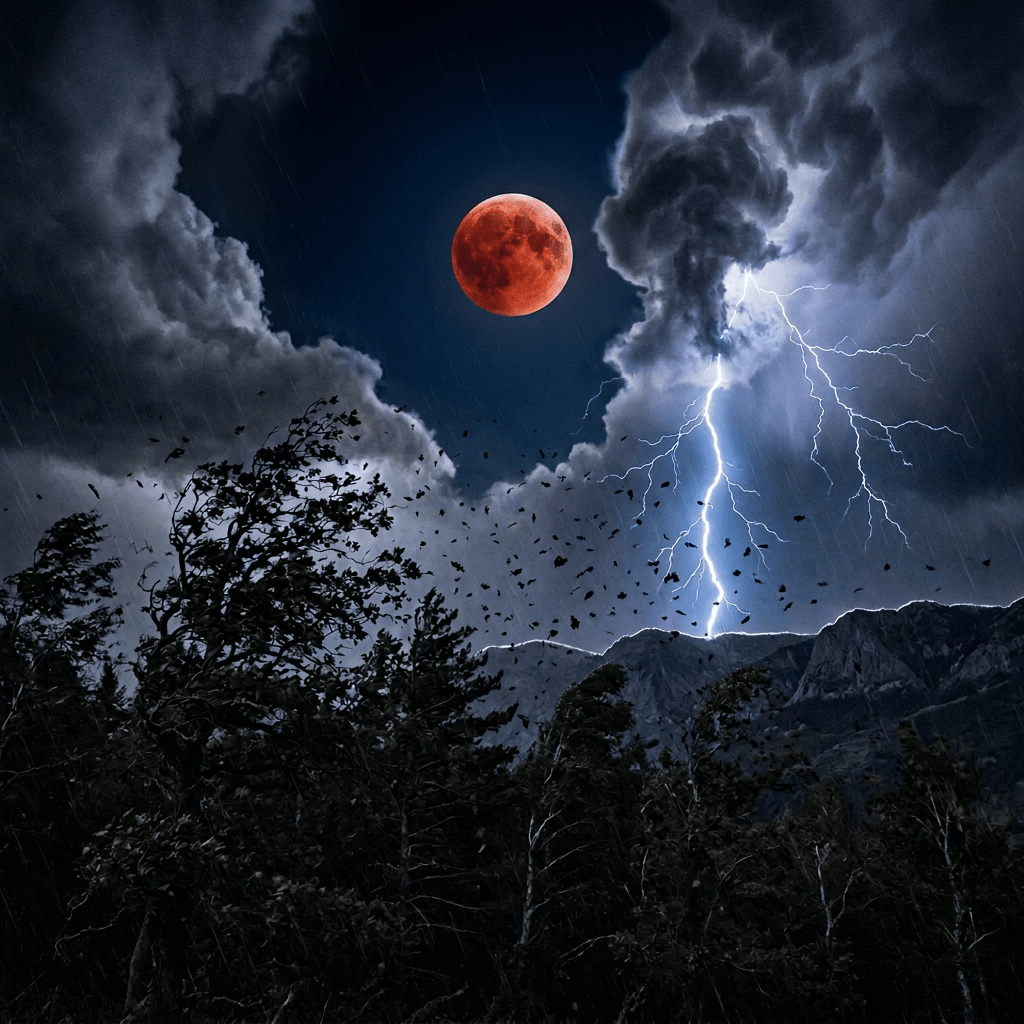
Red moon above storm clouds, lightning, mountains, and windblown trees

This lunar eclipse is a remarkable threshold, and the astronomy itself gives it unusual weight. At 06:12 CEST on 28 August, Earth places its shadow across the Full Moon, with about 96 percent of the lunar disc entering the darkest part of Earth’s shadow. In tropical astrology the Moon is at 4°51 Pisces opposite the Sun at 4°51 Virgo, with Mercury close to the Sun and Uranus in Gemini squaring the eclipse axis. Pisces, Virgo and Gemini create a powerful pattern of perception, discernment and information. We are living through an extraordinary flood of information, misinformation, revelations and competing realities, while old explanations are increasingly being challenged. Uranus brings disruption and sudden insight, Pisces asks us to listen beyond the obvious, and Virgo demands that what we perceive is examined carefully.

The eclipsed Moon sits almost exactly upon Fomalhaut, one of the four ancient Royal Stars, associated with the Southern Watcher, vision, spiritual perception and the necessity of distinguishing illumination from illusion. This feels particularly significant now. Human beings are not detached observers of Earth but living systems embedded within its electromagnetic, gravitational and environmental fields, while the planet itself is experiencing extremes of heat, drought, fire and sudden inundation. At the same time, people are questioning old political structures, inherited beliefs and the narrow definitions of what constitutes legitimate knowledge. Pisces represents permeability and sensitivity, Virgo discrimination and Gemini the vast information network through which humanity now communicates. The eclipse therefore asks us not simply to acquire more information, but to become better listeners and more discerning perceivers.

Beyond the visible planets, Pluto in Aquarius continues the transformation of collective power and civilisation, while Haumea brings regeneration, Makemake creation and relationship with the living world, Eris the excluded voice demanding recognition, and distant Gonggong the mythology of water and overturned cosmic order. These long orbital bodies add a remarkable mythological layer to the eclipse. The larger story is one of dissolution and regeneration, ecological consequence, changing power structures and the widening of human perception. This does not require us to abandon science; rather, it asks whether science itself can become sufficiently open to investigate the full range of human experience. We may be approaching a period in which intuition, embodied awareness, subtle perception and forms of consciousness previously dismissed are examined with new seriousness. The eclipse marks the closing of a long Pisces cycle and asks humanity to learn the art of listening: neither believing everything nor dismissing everything, but becoming capable of seeing what is actually there.
After the eclipse

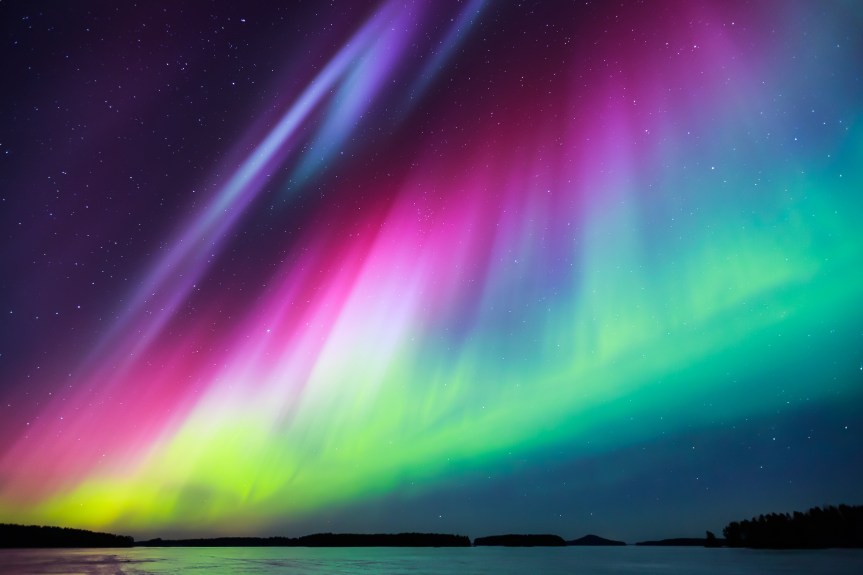
Image from internet – lovely aurora borealis (please tell me who made this)

The eclipse has passed, but the week of 17 to 23 August is not a return to ordinary skies. We are now living in the aftermath of the 12 August Leo solar eclipse, with the newly changed Aquarius–Leo nodal axis still setting the direction and the Sun completing its passage through Leo before entering Virgo on 23 August. Mercury and Jupiter remain together in Leo, carrying forward the great question of the eclipse: what kind of leadership, creativity and collective future are we actually prepared to build? Pluto is retrograde in Aquarius and has now gone out of bounds, adding an unusually powerful, unruly quality to the transformation of collective systems, while Uranus in Gemini continues to break open old assumptions about information, communication and intelligence. The eclipse was the fulcrum; this week begins the process of living with what it revealed. The Perseids are still active until 24 August, although their peak has passed, so Earth is still moving through the debris stream of Swift Tuttle while the sky gradually changes from the darkness of eclipse week towards a waxing Moon.

The physical heavens remain unusually active. A magnetic filament erupted from the Sun on 14 August and launched a CME towards Earth, with models predicting a glancing encounter around 17 August and possible G1 geomagnetic storm conditions; the Met Office likewise expects CME arrival on the 17th, followed from the 18th by coronal hole high speed solar winds. This means the week opens with Earth still inside a disturbed solar environment, with the possibility of auroral activity at northern latitudes as the solar wind changes. Astrologically, the same layering continues: Saturn retrograde in Aries asks us to reconsider what we are building, Neptune retrograde in Aries dissolves old certainties, Pluto retrograde in Aquarius turns the collective transformation inward, and Chiron retrograde in Taurus keeps returning us to the wound of land, resources and physical security. Mars in Cancer brings the question of protection, water, home and nourishment into the foreground. On 17 August Mercury trines Saturn and Venus sextiles Jupiter, offering something the eclipse week lacked: a chance to give the new vision structure, while Venus in Libra seeks cooperation rather than conflict.

Then comes the grounding. The First Quarter Moon arrives on 20 August and passes through Scorpio before moving into Sagittarius, bringing increasing emotional intensity followed by a need to understand the larger picture; on 19–20 August it passes close to Antares, the red heart of Scorpius, while later on 22–23 August it moves through Sagittarius towards the centre of the Milky Way. On 21 August Venus opposes retrograde Saturn, asking what relationships, agreements and values can actually withstand reality, while the Sun approaches the end of Leo and finally enters Virgo on 23 August, bringing the enormous symbolic fire of the eclipse down into practical earthly work. This is the crucial movement now: from revelation to application, from seeing the future to doing something about it. The world may still feel suspended between what is ending and what has not yet fully arrived, but the direction is changing. The eclipse opened the door; this week asks us to walk through it, take stock of what remains, and begin the painstaking work of making the new world habitable.

The Eclipse and the Perseids

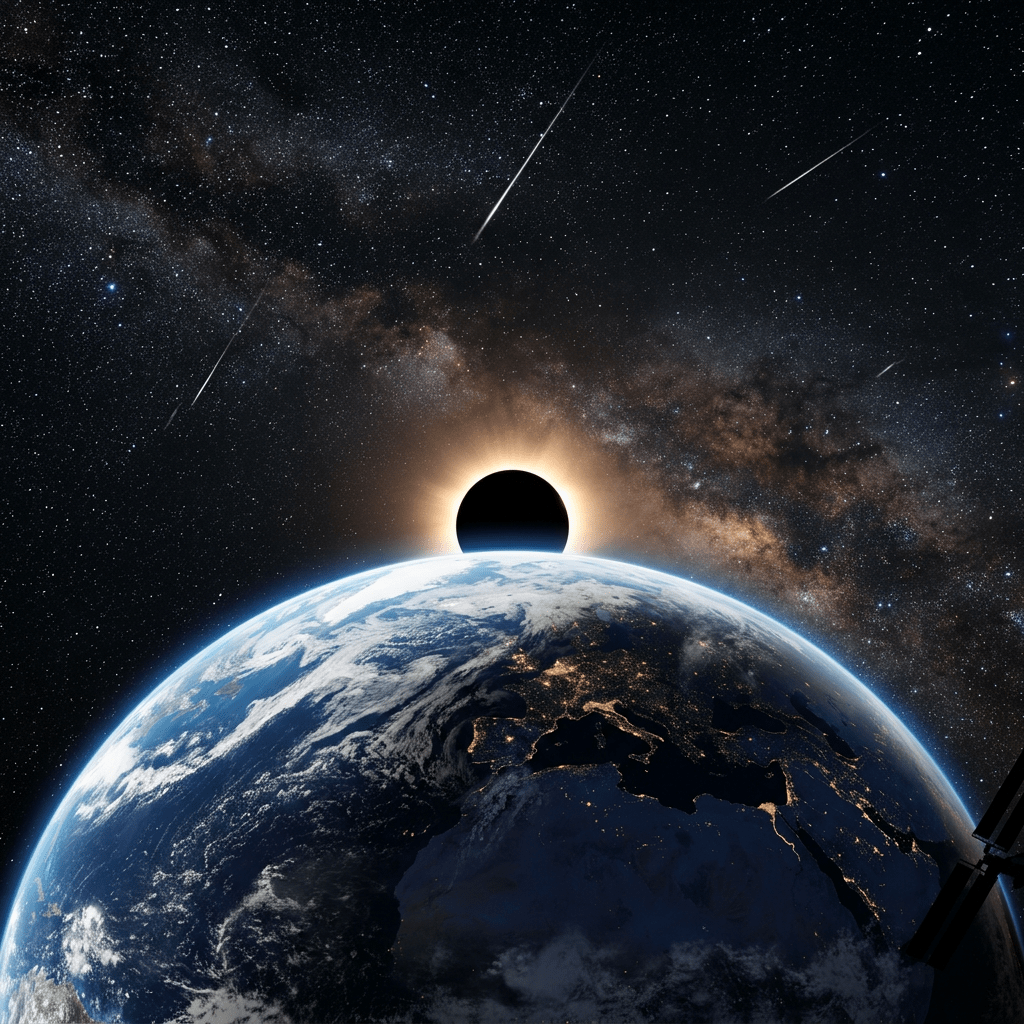
Solar eclipse above Earth with visible stars and meteor streaks

This week we should get the most spectacular skies, not only is the sun showing some volatile activity leading to northern lights, We also have the solar eclipse in Leo, and space itself is very interesting right now as we travel through the Perseid stream

The space we are travelling through is itself also worth distinguishing from the Perseid stream. The Solar System is moving through the local interstellar medium, within the very low-density region surrounding the heliosphere; the heliosphere is continually interacting with that external plasma and magnetic environment while the Sun and planets move through it.
At the same time, Earth is travelling around the Sun at about 30 km/s, carrying us through a much more local stream of material: the Perseid meteoroid trail. The Perseids are not a cloud arriving at Earth from Perseus; Earth is crossing the elongated orbital debris stream of Comet 109P/Swift–Tuttle. The comet’s orbit is highly elongated and retrograde, with an inclination of about 113°, so its debris travels through the Solar System in the opposite direction to the planets.
That makes our encounter unusually fast and nearly head-on, producing the Perseids which enter the atmosphere at roughly 59 km/s.
Around 10–16 August 2026, Earth is moving through the densest part of this debris corridor, with the Perseid peak around 12–13 August, precisely alongside the solar eclipse. The stream itself is much broader than the visible meteors suggest at roughly 0.1 AU wide, and Earth takes days to cross it, which is why the shower builds before the peak and continues afterwards.
The apparent trajectory is therefore particularly interesting: the particles are travelling along the ancient orbit of Swift–Tuttle, while Earth cuts across that orbit; from Earth they appear to radiate outward from Perseus, but their actual paths through space are almost parallel to the comet’s retrograde trajectory.
So this week we have three different spatial encounters layered together: the Solar System moving through the local interstellar environment, Earth moving through the Sun’s changing solar-wind and magnetic environment, and Earth physically crossing the ancient Swift–Tuttle debris stream. Then the 12 August eclipse occurs at the centre of that passage, with the darkened sky making the Perseid encounter unusually visible. That is quite an extraordinary piece of celestial geometry for the Geo-Zenith picture.
It goes almost without saying that every single one of us will be affected by this – everyone.

Aquarius 3 – 9 August 2026

Remove extra text, small star labels, colorful foreground

For Aquarius, the week of 3–9 August 2026 opens a window of reflection on humanity’s direction and the future we are collectively creating. Astronomically, the Sun continues through Leo while the Moon moves towards the total solar eclipse of 12 August, creating a powerful Sun–Moon–Earth alignment that has long been associated with moments of transition and awareness. From a Geo-Zenith perspective, this eclipse build-up highlights the connection between celestial cycles and Earth’s changing patterns, with societies facing questions around technology, environment, cooperation and the evolution of human consciousness. Aquarius is naturally attuned to the future, and this period may bring strong insights into where old systems are reaching their limits and where new possibilities are beginning to emerge.

Astrologically, Aquarius is being called to hold the vision while remaining connected to the present reality. The approaching eclipse encourages a deeper examination of ideals, communities and the role each person plays in shaping a more balanced world. Your gift is seeing beyond current difficulties and imagining alternatives, but the challenge is turning inspiration into practical steps that others can understand and follow. This is a time for spiritual intelligence, collective thinking and recognising that true progress comes not only from innovation but from compassion and shared responsibility.

Way through: Keep your eyes on the future, but ground your vision in practical actions that help people, communities and the planet move forward together.

Capricorn 3 – 9 August 2026

Capricorn with eclipse, constellation, night landscape foreground

For Capricorn, the week of 3–9 August 2026 is a period of reassessment, responsibility and preparing for a significant shift. Astronomically, the Sun continues through Leo while the Moon moves towards the total solar eclipse on 12 August, bringing the Sun–Moon–Earth alignment into sharper focus. From a Geo-Zenith perspective, this eclipse build-up highlights pressure on global systems, resources and structures, reflecting Capricorn’s own themes of governments, institutions, long-term planning and the foundations that hold society together. The coming days favour the careful observer: seeing where systems are weakening, where authority needs reform and where stronger foundations must be built.

Astrologically, Capricorn is being asked to balance determination with adaptability. The traditional Capricorn instinct is to endure, organise and carry responsibility, but this period suggests that some old strategies may no longer serve the future. The approaching eclipse can reveal where commitments need restructuring, particularly around career, reputation, finances and personal goals. Rather than trying to control every outcome, Capricorn’s strength lies in patience, strategic thinking and the ability to create lasting change through practical action. Progress comes from knowing what must be preserved and what must finally be released.

Way through: Work steadily, choose your priorities carefully, and use your discipline to build a future that is stronger rather than simply more familiar.

Virgo 3 – 9 August 2026

Gentle Virgo with constellation and upcoming eclipse

For Virgo, the week of 3–9 August 2026 brings a period of careful adjustment as the Earth prepares for the total solar eclipse on 12 August. Astronomically, the Sun continues through Leo while the Moon moves steadily towards its alignment between Earth and the Sun, creating the conditions for one of nature’s most dramatic celestial events. From a Geo-Zenith perspective, this eclipse build-up highlights the relationship between cosmic cycles and Earth systems, with attention drawn towards environmental balance, changing weather patterns, resources and the practical challenges of managing a rapidly shifting world. Virgo’s natural ability to analyse, organise and improve systems becomes especially valuable during a time when many structures appear unsettled.

Astrologically, many modern astrologers view this period as one of preparation, clearing and refinement rather than rushing into new commitments. For Virgo, the focus is on health, daily routines, work patterns and the small but important choices that create long-term stability. The approaching eclipse may reveal where your careful planning needs to adapt, where perfectionism has become a burden, and where simplifying your life can restore energy. Your gift this week is not dramatic change but intelligent adjustment: seeing what is no longer useful and quietly creating something better.

Way through: Keep your feet on the ground, trust your practical wisdom, and make steady improvements that support both yourself and the wider world.

April planet stack

a view of planets

This part of April 2026 is not subtle. Between 15–27 April, Aries becomes heavily activated: Venus entered Aries on 5 April, Mercury follows around 16–18 April after its inferior conjunction phase on 4–5 April, the Moon passes through Aries 15–17 April, and the Sun reaches Aries ingress on 19–20 April, culminating in the New Moon in Aries on 27 April. Alongside these, Chiron and Eris remain in Aries, creating a concentrated field of identity, rupture, and initiation. This is not simply “energy” – it is a compression of timing. Multiple bodies converge in the same sector, removing delay and forcing action. The effect is immediate: decisions accelerate, tensions surface, and events move beyond negotiation into execution. We are in for a wild two weeks – and need to pay attention.

This pattern has clear historical precedents. In 44 BC, during the Assassination of Julius Caesar, the Sun, Mercury, and Venus clustered in Aries in the spring window, coinciding with this decisive act that shattered the Roman Republic’s balance almost overnight. Also during such a configuration, in 221 BC, during the Qin unification of China, the Aries-season concentration aligned with the final campaigns that ended centuries of fragmentation by force – only for that unity to later fracture again. Around 193–197 AD, leading into the instability of 190–210 AD, Saturn’s passage through Aries combined with inner planet cycles to trigger repeated power struggles within Rome; power was seized quickly, held rigidly, and began its long structural failure. In each case, the Aries concentration did not build systems – it broke deadlock, forced outcomes, and initiated irreversible transitions – not always for the better.

The parallel with what is happening now is obvious. Across global politics and conflict zones, leadership structures are hardening while simultaneously losing legitimacy. The Aries concentration does not create this condition- it accelerates it. What has been building behind the scenes is now out in the open and we are all aware of every move: confrontations replace diplomacy, decisions override process, and systems that cannot adapt begin to fracture. We can watch it all happen and are all caught up in it. Historically, this phase is always described as instability or collapse, but structurally it is the same mechanism repeating – pressure released through action, followed by fragmentation, and then reorganisation into a different cultural and political form. The old order does not evolve during these periods; it breaks or snaps causing untold destruction and chaos as it does so. Then, something else begins to assemble from the pieces, we can create something else from these pieces depending on how aware and organised we are – before it hardens into a structure we all know we don’t want.

April 2026 – sort your planet out –

April 2026 opens in a highly charged astronomical corridor rather than a single event. We have just come through the March eclipse window, which already destabilises equilibrium, and move directly into a dense cluster of planetary interactions—Mercury restoring forward motion, Jupiter amplifying outcomes, and Pluto continuing its long restructuring arc. That “breakthrough window” from roughly April 2–18 is not mystical language; it reflects a real transition from latency to execution, where decisions that have been building since late 2025 suddenly become actionable and visible . Set against a Saturn–Pluto cazimi framework, this reads as compression followed by release: pressure does not dissipate, it converts into decisive movement. The Libra lunation at the start of the month adds a veneer of balance and negotiation, but it is a thin veneer—Venus–Pluto tensions running simultaneously point to power struggles in finance and relationships, both personal and geopolitical

Astronomically, the sky itself mirrors this clustering. April carries a rare pre-dawn alignment of Mercury, Mars, and Saturn tightening and shifting over successive days, effectively creating a visible “stacking” of planetary influence . At the same time, meteor activity increases as Earth moves into seasonal debris streams, with the Lyrids—one of the oldest recorded showers—building toward a peak later in the month

.This matters less for spectacle than for pattern: Earth is moving through particulate fields while the inner planets cluster tightly along the ecliptic. Historically, such periods coincide with heightened observational awareness—ancient records of the Lyrids go back over 2,700 years, often noted during times of upheaval or transition. Add to this a rising solar cycle, and you have a background condition of increased electromagnetic and atmospheric variability—not catastrophic, but enough to introduce friction into technological systems and climate patterns.

On Earth, the translation is already visible. The culture war intensifies not because opinions are diverging, but because underlying structures—media, governance, finance—are being forced into explicit positions. Financial systems show signs of strain and reconfiguration, with volatility not as a spike but as a sustained condition: currencies pressured, debt structures questioned, and policy responses becoming more interventionist. Geopolitically, tensions harden into blocs rather than dissolving; conflicts that were previously ambiguous become defined, even if not formally declared. This is consistent with Saturn–Pluto history: the period does not immediately produce resolution, but it removes the possibility of pretending that contradictions can coexist indefinitely.

The most practical forecast for April, then, is not dramatic collapse but accelerated sorting. Early April brings realisations and decisions; mid-April locks those decisions into motion; late April begins to show consequences. Expect disclosures—political, financial, or institutional—that force rapid repositioning. Expect negotiations that appear conciliatory on the surface but are structurally zero-sum underneath. Expect intermittent disruptions—technical, environmental, logistical—that reinforce a sense of systemic strain rather than causing singular crises. The useful stance is neither alarm nor passivity, but precision: act when clarity appears (and it will, briefly, in that early–mid April window), reduce reliance on unstable structures, and assume that whatever stabilises by the end of the month is not the old system returning, but the early outline of the next one.

Talking of war

Where we stand now is not simply “astrology” but a measurable celestial configuration. On 20 February 2026 at 11:54 UTC, Saturn and Neptune met at 0°45′ Aries, initiating a cycle associated historically with ideological restructuring and the dissolution of existing political narratives. Two weeks later, on 3 March 2026 at 06:37 UTC, a total lunar eclipse at 12°53′ Virgo forced a global moment of exposure—systems, supply chains, health structures and governance weaknesses laid bare. Meanwhile Jupiter stationed direct at 15°05′ Cancer on 10 March 2026, while Mercury stationed direct at 8°29′ Pisces on 20 March, the same day the Sun crossed the Aries equinox. Astronomically, these events coincide with an unusual clustering of planets along the ecliptic and the recent six-planet alignment of 28 February 2026, when Mercury, Venus, Jupiter, Saturn, Uranus and Neptune appeared along the same arc of sky.

The immediate sky picture continues to tighten through April. Mars enters Aries on 9 April 2026 at 15:36 UTC, followed by a series of sharp interactions: Mars conjunct Neptune on 13 April (00:29 UTC) and Mars conjunct Saturn on 19 April (17:43 UTC). In the physical sky this corresponds with a visible alignment of Mercury, Mars, Saturn and Neptune around 18 April, appearing low before sunrise. At the same time a potentially bright visitor—comet C/2025 R3 (PANSTARRS)—is predicted to become visible toward the end of April 2026, adding another symbolic marker in the heavens. Astronomically these objects are simply following orbital mechanics, but historically such compressions of planetary motion tend to coincide with periods when political structures strain under their own contradictions.

From a geo-zenith perspective the sky is pointing toward restructuring rather than collapse. The Saturn–Neptune cycle dissolves illusions while demanding new forms, yet those forms are not visible yet; they tend to emerge years after the conjunction. The difficulty lies on Earth, not in the sky: ageing leadership classes, ideological rigidity and the tendency of governments to double down on propaganda precisely when transparency is required. Under Mars activating the Saturn–Neptune conjunction through April, anger, confusion and misdirection easily combine. This is the phase where misinformation multiplies and where the most disciplined response is restraint: observe carefully, verify information, and resist the urge to fall into the simplistic binaries that geopolitical narratives demand.

By mid-July 2026, the planetary field spreads slightly, offering a temporary window of relative breathing space. Astronomically the sky features calmer configurations such as the Moon–Mars–Pleiades grouping on 11 July 2026, a quieter geometric arrangement compared with the compressed April sky. Yet the larger cycle remains active. The Saturn–Neptune conjunction marks the beginning of a long restructuring of global systems—financial, political and ideological. What replaces the present order cannot yet be clearly seen, because such structures tend to emerge gradually from collective necessity rather than deliberate design.

The practical message is simple. This period requires patience, compassion and clear thinking. Some people will be in positions where they can act; others will feel powerless while watching events unfold. Both experiences are part of the same cycle. In such periods the most rational response is to care for one’s immediate circle, question every narrative, avoid taking reflexive sides, and allow the planetary pattern itself to show when genuine windows of opportunity appear. Historically these cycles are remembered not only for crisis but also for the quiet emergence of new moral frameworks—often built by ordinary people long before governments notice them.

The long view

A longer historical view shows that these planetary compressions repeat with striking regularity. The Saturn–Neptune conjunction, which occurred on 20 February 2026 at 0°45′ Aries, repeats roughly every 36 years, and each appearance tends to coincide with periods when ideological systems dissolve and new ones struggle to form. The previous cycle in 1989 unfolded across three exact conjunctions — 3 March 1989 (10:47 UTC), 24 June 1989 (03:10 UTC), and 13 November 1989 (11:42 UTC) — during the extraordinary year that saw the fall of the Berlin Wall on 9 November 1989, the beginning of the collapse of the Soviet bloc, and the reshaping of the global political order. A similar pattern appeared earlier in 1917, when Saturn and Neptune again converged during the final phase of the First World War and the Russian Revolution of October 1917, events that destroyed one imperial system and created another ideological framework that shaped the twentieth century.

Moving further back through the cycle reveals the same pattern of upheaval and reorganisation. The 1952–1953 conjunction in Libra (21 November 1952, 17 May 1953, and 22 July 1953) coincided with the sharpening of the Cold War, the Korean War armistice negotiations, and the early construction of the ideological blocs that would dominate the second half of the twentieth century. Earlier still, the 1846–1848 conjunction coincided with the revolutionary wave that swept across Europe and the publication of Marx’s Communist Manifesto in February 1848, again marking the emergence of a powerful ideological narrative that reshaped global politics. Each appearance of the cycle seems to correspond not merely with conflict but with the birth or collapse of belief systems — political, economic, or spiritual — that define entire eras.

Extending the astronomical calculations thousands of years further back suggests how rare the present configuration may be. The 2026 conjunction occurs at 0° Aries, the astronomical “world point” marking the start of the zodiac and the spring equinox reference. Research indicates that the last time Saturn and Neptune were close to this same starting point was around 555 AD, and some ephemeris calculations suggest that an exact conjunction at this degree may not have occurred for several millennia before that. Whether or not one accepts the symbolic interpretation, the astronomical fact remains that planetary cycles repeatedly cluster around moments when human societies reorganise themselves after periods of intense pressure.

Seen in that longer arc — stretching from modern geopolitical transformations back through revolutions and ideological shifts — the present configuration appears less like an isolated crisis and more like another turning in a very old rhythm. The pattern does not dictate specific events, but it does describe the conditions under which old structures lose coherence and new ones begin to form. Historically those transitions are messy, confusing and emotionally charged, yet they are also the moments when entirely new social frameworks quietly begin to take shape beneath the surface of the visible turmoil.

The ring of fire

On 17 February 2026 the Sun and Moon meet at the final degree of Aquarius in an annular solar eclipse — a New Moon that does not merely begin a cycle, but completes one. The anaretic degree carries the weight of culmination: systems stretched to exhaustion, ideologies at their limit, networks revealing their fractures. Aquarius governs the collective field — technology, governance, movements, shared narratives — and this eclipse lands precisely where those themes are most visibly strained. Around us: political aggression, protests, instability, disclosures, the sense that old authorities are losing coherence. An eclipse at 29° does not whisper. It closes a chapter.

What makes this one structurally unique is timing. Saturn and Neptune converge at 0° Aries — the zodiac’s ignition point. Zero degrees is not a continuation; it is emergence. Saturn brings form, boundary, law. Neptune dissolves and re-mythologises. Their meeting at the Aries Point marks the reset coordinate of a new collective storyline. The eclipse at the end of Aquarius clears the field; 0° Aries begins the next assertion of identity, leadership and direction. The sky is architecturally precise: finish, then initiate.

In the midst of visible chaos — aggression, ideological fragmentation, institutional fatigue — this configuration suggests not collapse but reorganisation. When systems lose stability, human choice becomes amplified. Eclipses expose where we are reactive; Aries demands conscious action. The reset is not imposed from above; it is enacted through decisions made under pressure. What we defend, what we build, what we refuse to perpetuate — these become the scaffolding of the next cycle.

Working through this eclipse means resisting reflex and choosing clarity. Aquarius asks: what collective are you feeding? Aries asks: what are you initiating? The human Earth is not ending; it is recalibrating. Old frameworks are dissolving because they cannot carry the next phase. The 17 February eclipse is a threshold — not into chaos, but into responsibility. Zero degrees signal the beginning, but the beginning depends on us.

The Zero Point

I should have posted this a few days ago -as this alignment is so important – however it is up today – the day before the eclipse – which adds another layer – but that is another post – this is important enough for a single one. Saturn and Neptune are not enemies – they are parts of the whole, the balance, the new vision and need to be integrated as such –

At 0° Aries, Saturn and Neptune meet at the very threshold of the zodiac, forming a conjunction that is nothing short of remarkable. This is not a tension or struggle; it is a rare alignment where vision and structure, imagination and discipline, insight and action converge in perfect balance. Neptune offers the expansive, systemic view, the capacity to perceive what is possible beyond the limitations of the present, while Saturn provides the scaffolding, the material and ethical framework necessary to bring that vision into concrete reality. Together, they create a zero-point of initiation — a moment where the potential of humanity can be consciously anchored, where inspiration and execution are inseparable partners.

This conjunction is profoundly hopeful because it offers a working template for transformation. The cosmic currents encourage us to hold our dreams with clarity and to engage with the material world responsibly. It reminds us that the visions we carry — for communities, for the planet, for life itself — are not idle fantasies but blueprints waiting to be enacted. By integrating the lessons of Saturn’s discipline with Neptune’s insight, we can move beyond scattered aspiration into coherent, practical creation, aligning our actions with the highest potential for renewal.

What makes this conjunction truly beautiful is its invitation: to build consciously from the ground up while keeping the horizon in sight. It is a cosmic moment that validates the wisdom of combining care with courage, imagination with accountability. In the alignment of Saturn and Neptune, the universe offers not only possibility but a pathway, a structural embrace of the dreams we hold. It is a reminder that a more beautiful world is not only imaginable — it is possible, and it can be realized when vision and responsibility work together, hand in hand, at the very start of a new cycle.

Added Value 12 to 18 January 2026


This is a week where cosmic pressure and earthly volatility dovetail in ways that reward clarity, discipline, and foresight. On the astrological level, Mars continues its steady advance through Capricorn (roughly 21°–26°), reinforcing a collective drive for structured results and endurance but also amplifying tensions around authority and ambitions. Jupiter remains retrograde in Cancer, keeping themes of security, protection, and community under review rather than expansion. Saturn and Neptune both linger at the tail end of Pisces, heightening collective sensitivity and symbolic dissolution of old reference points while demanding responsibility and long‑term coherence. Lilith’s direct motion through late Scorpio brings deep questions about truth and ideology to the surface, and Pluto in early Aquarius continues its long structural transformation in social and power networks. Collectively, these transits frame the week as one where actions taken must be measured, purposeful, and rooted in structural understanding rather than impulse

Pressure Points to Watch
Internationally, tensions remain acute and unpredictable. The situation in Iran has escalated into one of the most sustained nationwide protest movements in years, with significant loss of life, mass arrests, and communication blackouts as the regime attempts to contain dissent; external pressures including potential U.S. support and threats of retaliation increase the risk of regional conflagration. In Europe and NATO circles, President Trump’s renewed interest in Greenland — framed as strategic necessity but widely condemned by Danish and Nordic leaders — continues to strain alliances, prompting discussions among Britain, Germany, and other NATO members about joint Arctic deployments to reaffirm collective defence commitments. The BRICS naval exercises involving Russia, China, and Iran off South Africa’s coast underline shifting geopolitical blocs and the challenge to U.S. influence, even if India opts out, reflecting fluid, multipolar tension. Financial markets are responding accordingly; bullion prices are holding firm amid geopolitical risk pricing.

Openings and Strategic Guidance
Under these conditions, the astrology encourages discerned action rather than reactivity. Mars in Capricorn supports disciplined efforts that build long‑term results; this is a time for structuring plans, stabilising resources, and solidifying alliances rather than charging ahead on impulse. Jupiter’s retrograde in Cancer highlights the value of strengthening foundational security — whether emotional, financial, or organisational — before seeking expansion. High collective sensitivity from late‑Pisces Saturn and Neptune suggests that empathetic leadership, careful listening, and measured communication will yield better outcomes than confrontation. This week’s New Moon in Capricorn (around 18 January) further emphasises the value of new beginnings rooted in responsibility and realistic strategy, offering a moment to reset intentions with long‑range coherence in mind. In practical terms, individuals and communities are best served by conserving energy, prioritising clarity over immediacy, and resisting the pull of polarised narratives — the calm centre, this week, will be the source of enduring influence.