The Eclipse and the Perseids

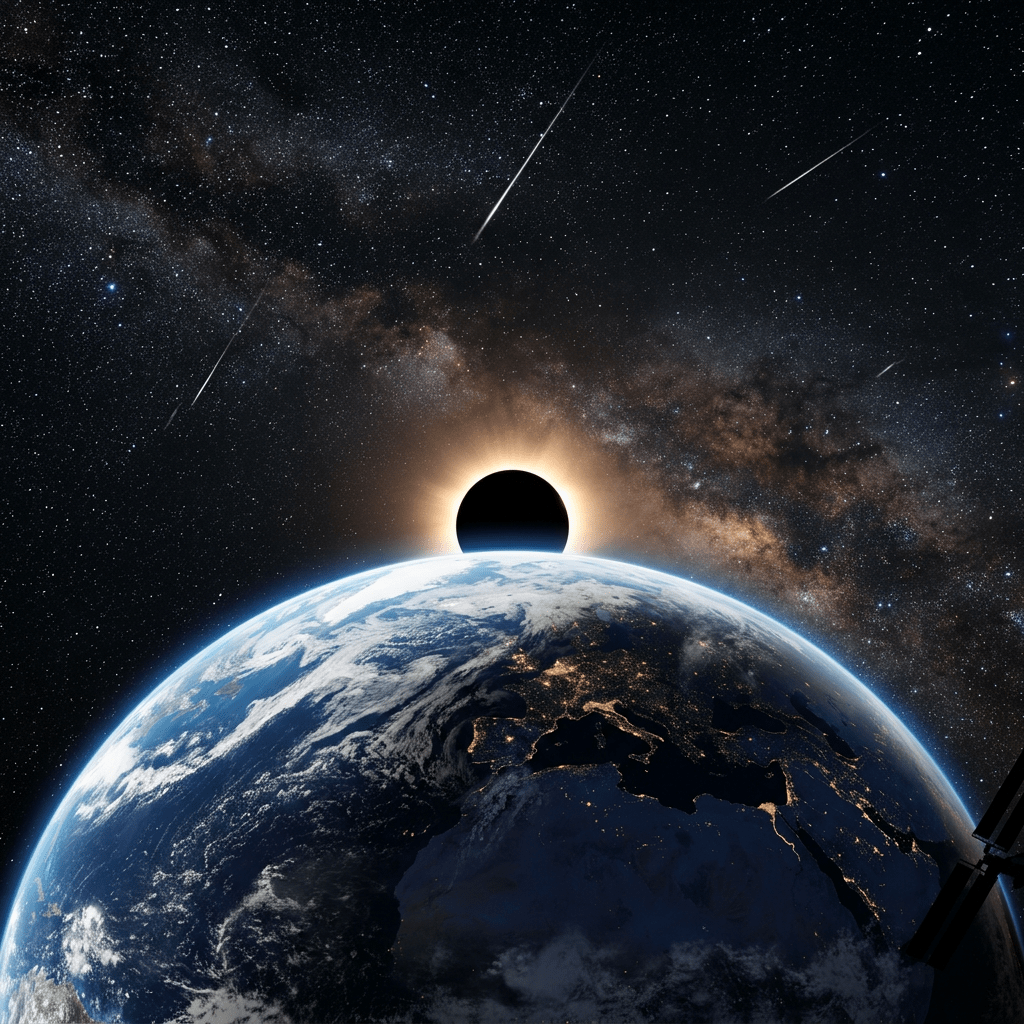
Solar eclipse above Earth with visible stars and meteor streaks

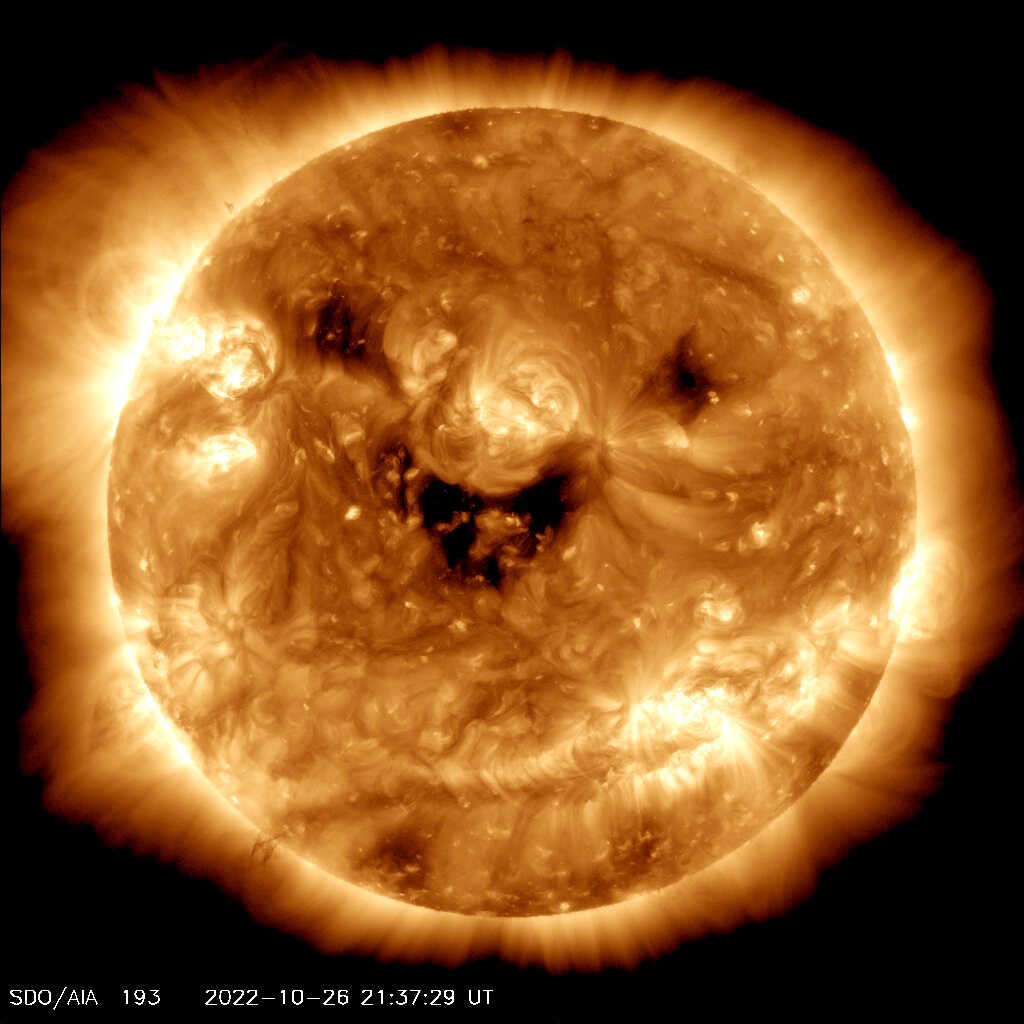
This week we should get the most spectacular skies, not only is the sun showing some volatile activity leading to northern lights, We also have the solar eclipse in Leo, and space itself is very interesting right now as we travel through the Perseid stream

The space we are travelling through is itself also worth distinguishing from the Perseid stream. The Solar System is moving through the local interstellar medium, within the very low-density region surrounding the heliosphere; the heliosphere is continually interacting with that external plasma and magnetic environment while the Sun and planets move through it.
At the same time, Earth is travelling around the Sun at about 30 km/s, carrying us through a much more local stream of material: the Perseid meteoroid trail. The Perseids are not a cloud arriving at Earth from Perseus; Earth is crossing the elongated orbital debris stream of Comet 109P/Swift–Tuttle. The comet’s orbit is highly elongated and retrograde, with an inclination of about 113°, so its debris travels through the Solar System in the opposite direction to the planets.
That makes our encounter unusually fast and nearly head-on, producing the Perseids which enter the atmosphere at roughly 59 km/s.
Around 10–16 August 2026, Earth is moving through the densest part of this debris corridor, with the Perseid peak around 12–13 August, precisely alongside the solar eclipse. The stream itself is much broader than the visible meteors suggest at roughly 0.1 AU wide, and Earth takes days to cross it, which is why the shower builds before the peak and continues afterwards.
The apparent trajectory is therefore particularly interesting: the particles are travelling along the ancient orbit of Swift–Tuttle, while Earth cuts across that orbit; from Earth they appear to radiate outward from Perseus, but their actual paths through space are almost parallel to the comet’s retrograde trajectory.
So this week we have three different spatial encounters layered together: the Solar System moving through the local interstellar environment, Earth moving through the Sun’s changing solar-wind and magnetic environment, and Earth physically crossing the ancient Swift–Tuttle debris stream. Then the 12 August eclipse occurs at the centre of that passage, with the darkened sky making the Perseid encounter unusually visible. That is quite an extraordinary piece of celestial geometry for the Geo-Zenith picture.
It goes almost without saying that every single one of us will be affected by this – everyone.

Pisces 3 – 9 August 2026

Pisces constellation night sky with blue eclipse

or Pisces, the week of 3–9 August 2026 brings a quiet but powerful period of inner awareness as the world moves towards the total solar eclipse on 12 August. Astronomically, the Sun continues through Leo while the Moon advances towards its alignment between Earth and the Sun, creating a growing celestial focus. From a Geo-Zenith perspective, this eclipse build-up reflects the delicate relationship between cosmic cycles and Earth’s living systems, with increasing attention on climate, oceans, collective emotions and humanity’s connection with nature. Pisces, as the sign most attuned to the unseen currents of life, may sense these changes before they become fully visible.

Astrologically, this is a week for compassion, healing and quiet preparation rather than forcing direction. The approaching eclipse may bring awareness of old emotional patterns, dreams that have been waiting for attention and the need to release what has quietly become a burden. Pisces can sometimes absorb the fears and confusion of the wider world, but this period asks you to return to your own centre and distinguish intuition from overwhelm. Your sensitivity is not a weakness; it is a way of understanding what needs care, healing and renewal.

Way through: Protect your inner peace, trust your deeper knowing, and turn your compassion into gentle actions that create healing for yourself and the world around you.

Before the eclipse

From 3–9 August 2026 the astrological atmosphere feels like the gathering of a tide before a major wave. The Sun continues its journey through Leo, emphasising leadership, identity and the creative expression of purpose, while Mercury’s movement encourages reassessment of plans rather than impulsive decisions. Although the total solar eclipse does not occur until 12 August, its influence is already building. Eclipses have long been regarded as periods when events accelerate and hidden situations move rapidly towards revelation, and many astrologers consider the days leading into an eclipse to be as significant as the eclipse itself. Collectively this week may bring increasing political tension, market uncertainty, environmental concerns and sudden announcements that have been developing behind the scenes for months. Individuals may experience a growing feeling that an important chapter is ending and another is preparing to begin. Rather than forcing outcomes, this is a week for careful observation, completing unfinished business and listening to intuition before decisive action becomes necessary.

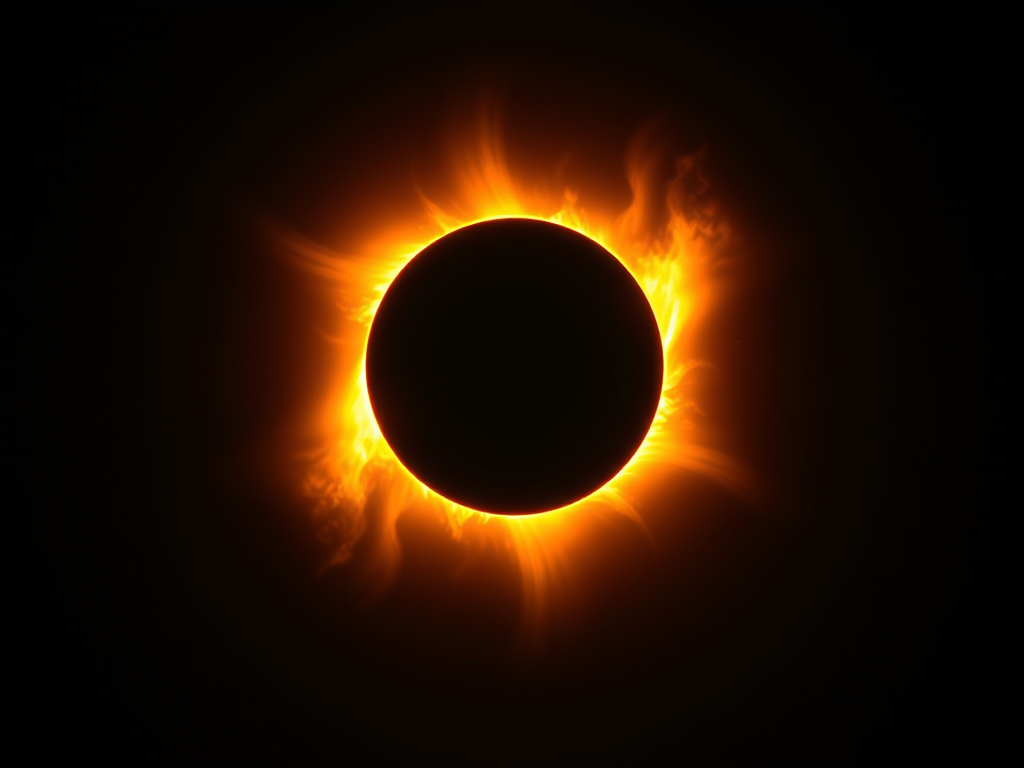
From an astronomical perspective, the approaching eclipse is a precise alignment of the Sun, Moon and Earth, with the Moon moving directly between Earth and the Sun on 12 August. Totality will be seen best across Greenland, Iceland and northern Europe, with a small portion of Portugal also lying within the path of totality. Much of Europe, including the Netherlands, will experience a deep partial eclipse of around ninety per cent, while large parts of North America, Canada and north-west Africa will also witness a partial eclipse. As the Moon’s shadow races across Earth at thousands of kilometers per hour, scientists will study the Sun’s corona, atmospheric changes and subtle effects on Earth’s upper atmosphere, while sky-watchers experience one of nature’s rarest spectacles. Astrologically, eclipses symbolise moments when familiar patterns are interrupted, allowing new directions to emerge. Whether viewed through astronomy or astrology, this week invites us to recognise that change often begins quietly before it becomes unmistakably visible.

The ring of fire

On 17 February 2026 the Sun and Moon meet at the final degree of Aquarius in an annular solar eclipse — a New Moon that does not merely begin a cycle, but completes one. The anaretic degree carries the weight of culmination: systems stretched to exhaustion, ideologies at their limit, networks revealing their fractures. Aquarius governs the collective field — technology, governance, movements, shared narratives — and this eclipse lands precisely where those themes are most visibly strained. Around us: political aggression, protests, instability, disclosures, the sense that old authorities are losing coherence. An eclipse at 29° does not whisper. It closes a chapter.

What makes this one structurally unique is timing. Saturn and Neptune converge at 0° Aries — the zodiac’s ignition point. Zero degrees is not a continuation; it is emergence. Saturn brings form, boundary, law. Neptune dissolves and re-mythologises. Their meeting at the Aries Point marks the reset coordinate of a new collective storyline. The eclipse at the end of Aquarius clears the field; 0° Aries begins the next assertion of identity, leadership and direction. The sky is architecturally precise: finish, then initiate.

In the midst of visible chaos — aggression, ideological fragmentation, institutional fatigue — this configuration suggests not collapse but reorganisation. When systems lose stability, human choice becomes amplified. Eclipses expose where we are reactive; Aries demands conscious action. The reset is not imposed from above; it is enacted through decisions made under pressure. What we defend, what we build, what we refuse to perpetuate — these become the scaffolding of the next cycle.

Working through this eclipse means resisting reflex and choosing clarity. Aquarius asks: what collective are you feeding? Aries asks: what are you initiating? The human Earth is not ending; it is recalibrating. Old frameworks are dissolving because they cannot carry the next phase. The 17 February eclipse is a threshold — not into chaos, but into responsibility. Zero degrees signal the beginning, but the beginning depends on us.

Solar flares – part two

The human brain is sensitive to electromagnetic fluctuations, particularly in the 0.5–40 Hz range of natural brainwave activity (delta through gamma). Piezoelectric-like calcite microcrystals in the pineal gland transduce environmental electromagnetic signals into electrical or chemical responses, influencing circadian rhythms, hormone production, and thus also cognitive or emotional states. While the effects are subtle, they are measurable under controlled conditions and explain some behavioural or mood changes during geomagnetic disturbances.

Researchers note that periods of heightened solar activity correlate with shifts in collective energy, decision-making, and societal tension. Astrologers similarly interpret strong solar events as times of increased emotional volatility and sensitivity, both individually and collectively. Individual responses vary, but global geomagnetic shifts appear to align with periods of systemic stress, unusual weather patterns, or heightened awareness.

Astronomers, space agencies, and observatories monitoring the Sun emphasise that solar events interact with Earth’s magnetic field, affecting satellite operations, communications, and navigation systems. When combined with ongoing seismic, volcanic, and extreme weather activity, there is a complex network of environmental signals to which humans are subtly attuned, both physiologically and behaviourally. As we are also electromagnetic beings, having an, aura or electromagnetic field.

All solar activity produces measurable geomagnetic effects that influence brainwave patterns, pineal gland activity, and human emotional states. Astrological and scientific observations converge on the conclusion that these periods of heightened solar activity are associated with heightened sensitivity and shifts in collective behaviour. So, there is change happening now during these extreme solar conditions. We can all feel it, we can see it, we know – and soon we will have the eclipse season, which will truly be noticeable events – both inner and outer.