Change is now

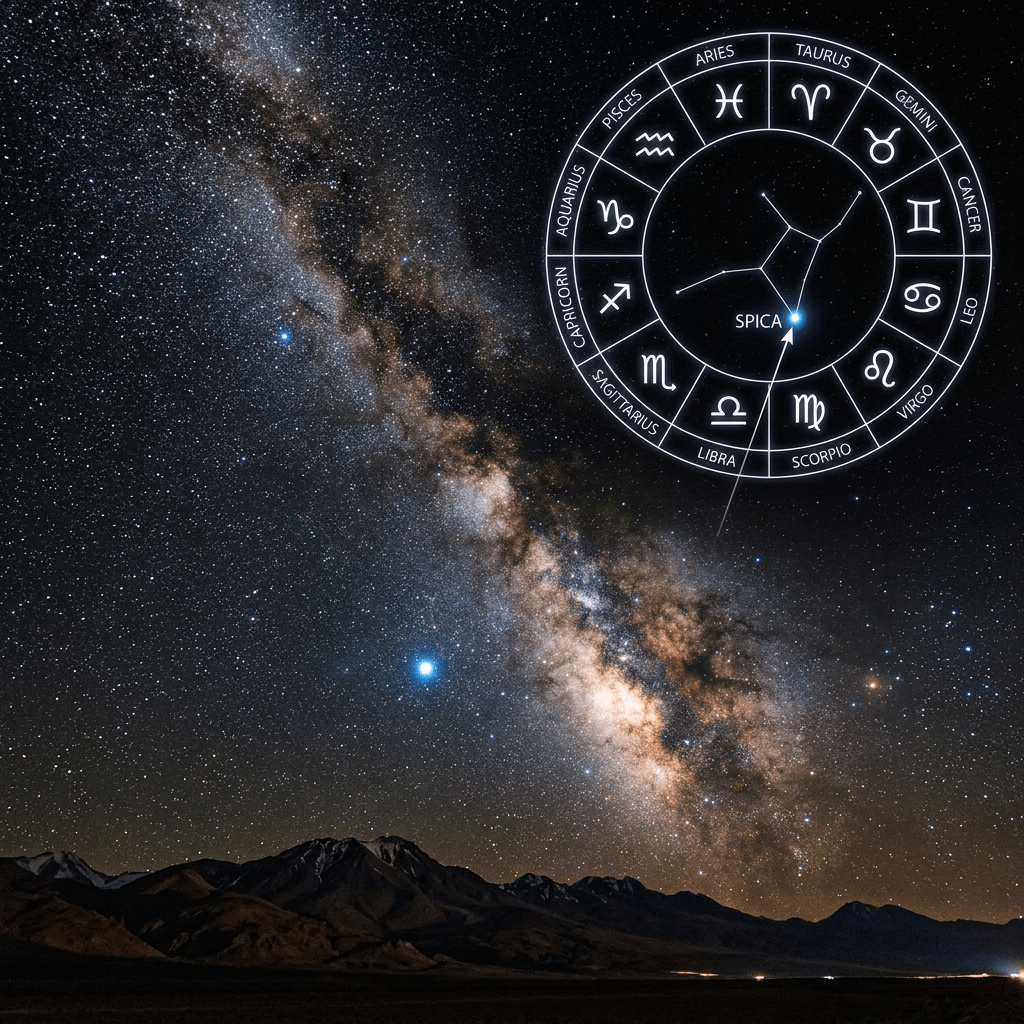
Milky Way over mountains with zodiac chart labeling Spica

The week of 31 August to 6 September opens with a striking mixture of consolidation and volatility. Jupiter at about 13° Leo makes an exact trine to retrograde Saturn at 13° Aries on 31 August, a fire trine that can turn vision into structure, while Mars in Cancer squares Saturn on 1 September, bringing the practical consequences of emotional, domestic and environmental pressures sharply into view. At the same time Mars and Uranus are moving through early Gemini territory, with their earlier conjunction still resonating: the nervous system, communications, transport, technology and the movement of information remain highly charged. The Sun moves from Virgo through the first degrees of the sign, Mercury is also in Virgo, Venus moves through late Virgo into Libra, Jupiter remains in Leo, Saturn and Neptune retrograde in Aries, Uranus in Gemini and Pluto retrograde in Aquarius, while the North Node has newly moved into Aquarius and the South Node into Leo.

In Geo-Zenith terms this is the great fire and air pattern meeting Earth and water: Leo wants expression, Aries initiation, Gemini rapid change and Aquarius systemic transformation, but Virgo asks what can actually be repaired, measured and made useful.

Astronomically, the sky reinforces that movement from spectacle towards discernment. Venus is exceptionally bright in the western evening sky and passes within about 2° of Spica, the principal star of Virgo, on 31 August and 1 September, with the closest passage on 2 September. Spica is therefore particularly relevant to the Geo-Zenith reading: traditionally associated with harvest, refinement and the gathering of what has been brought to maturity, it gives this week a very different tone from the fiery Leo eclipse season. The waning Moon moves away from the Pisces eclipse field, reaches Last Quarter on 4 September, and by 6 September begins the next sequence of close encounters with the planets. The deeper message is therefore not another explosion of events but integration: after the extraordinary eclipse and meteor activity of August, the heavens begin asking what remains when the spectacle has passed. Geo-Zenith sees this as a threshold between planetary acceleration and planetary accountability: the future is arriving rapidly, but the work now is to decide which parts of the old system are worth carrying into it.

The way through this configuration is to stop trying to carry the old into the new simply because it is familiar. Emotionally, allow grief, anger and uncertainty to move through without letting them dictate your choices; psychologically, question the patterns, beliefs and loyalties that keep repeating themselves and ask whether they still serve the person you are becoming. Practically, make small deliberate changes in what you buy, build, support, consume and give your time to, because the new is created through repeated action rather than wishful thinking. This is a week for choosing consciously: keep what has life in it, release what has become dead weight, and put your energy where you want the future to grow. Time to act.
The blood moon

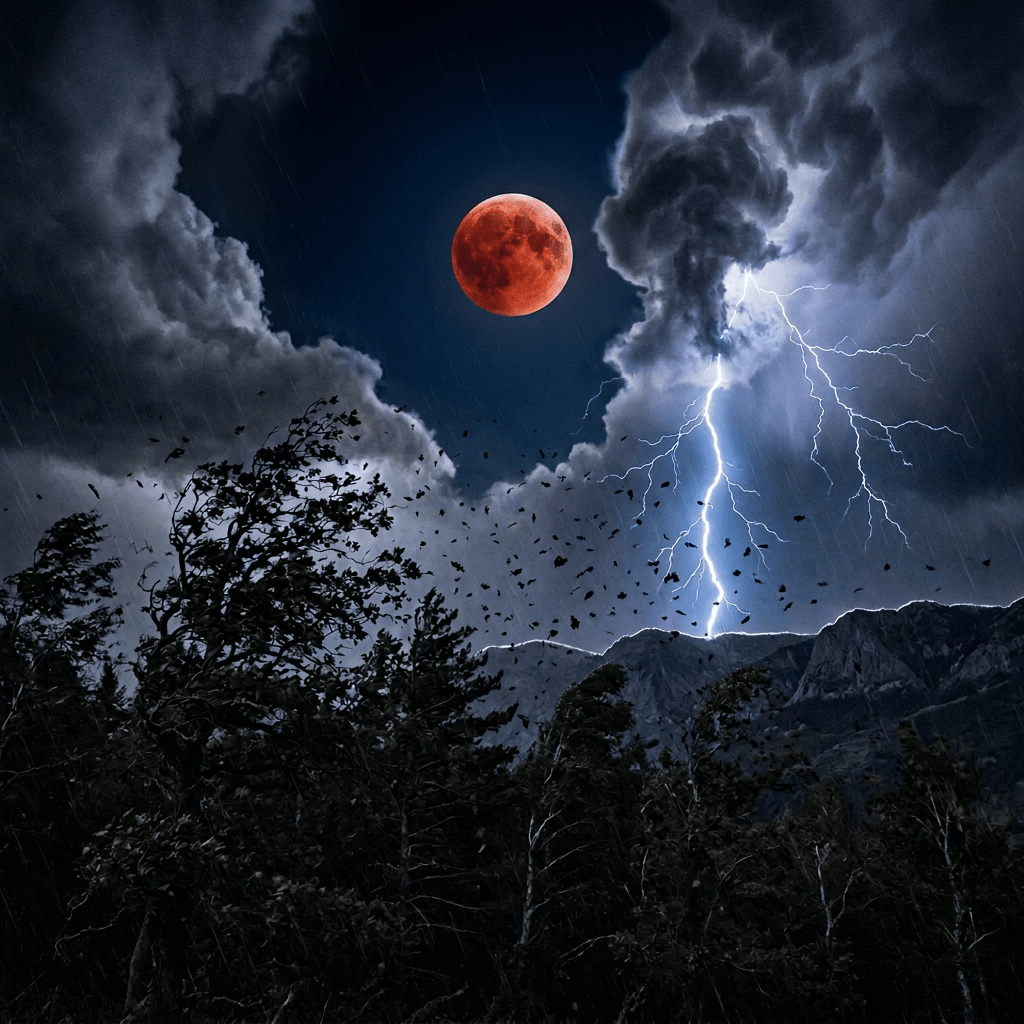
Red moon above storm clouds, lightning, mountains, and windblown trees

This lunar eclipse is a remarkable threshold, and the astronomy itself gives it unusual weight. At 06:12 CEST on 28 August, Earth places its shadow across the Full Moon, with about 96 percent of the lunar disc entering the darkest part of Earth’s shadow. In tropical astrology the Moon is at 4°51 Pisces opposite the Sun at 4°51 Virgo, with Mercury close to the Sun and Uranus in Gemini squaring the eclipse axis. Pisces, Virgo and Gemini create a powerful pattern of perception, discernment and information. We are living through an extraordinary flood of information, misinformation, revelations and competing realities, while old explanations are increasingly being challenged. Uranus brings disruption and sudden insight, Pisces asks us to listen beyond the obvious, and Virgo demands that what we perceive is examined carefully.

The eclipsed Moon sits almost exactly upon Fomalhaut, one of the four ancient Royal Stars, associated with the Southern Watcher, vision, spiritual perception and the necessity of distinguishing illumination from illusion. This feels particularly significant now. Human beings are not detached observers of Earth but living systems embedded within its electromagnetic, gravitational and environmental fields, while the planet itself is experiencing extremes of heat, drought, fire and sudden inundation. At the same time, people are questioning old political structures, inherited beliefs and the narrow definitions of what constitutes legitimate knowledge. Pisces represents permeability and sensitivity, Virgo discrimination and Gemini the vast information network through which humanity now communicates. The eclipse therefore asks us not simply to acquire more information, but to become better listeners and more discerning perceivers.

Beyond the visible planets, Pluto in Aquarius continues the transformation of collective power and civilisation, while Haumea brings regeneration, Makemake creation and relationship with the living world, Eris the excluded voice demanding recognition, and distant Gonggong the mythology of water and overturned cosmic order. These long orbital bodies add a remarkable mythological layer to the eclipse. The larger story is one of dissolution and regeneration, ecological consequence, changing power structures and the widening of human perception. This does not require us to abandon science; rather, it asks whether science itself can become sufficiently open to investigate the full range of human experience. We may be approaching a period in which intuition, embodied awareness, subtle perception and forms of consciousness previously dismissed are examined with new seriousness. The eclipse marks the closing of a long Pisces cycle and asks humanity to learn the art of listening: neither believing everything nor dismissing everything, but becoming capable of seeing what is actually there.

The Eclipse and the Perseids

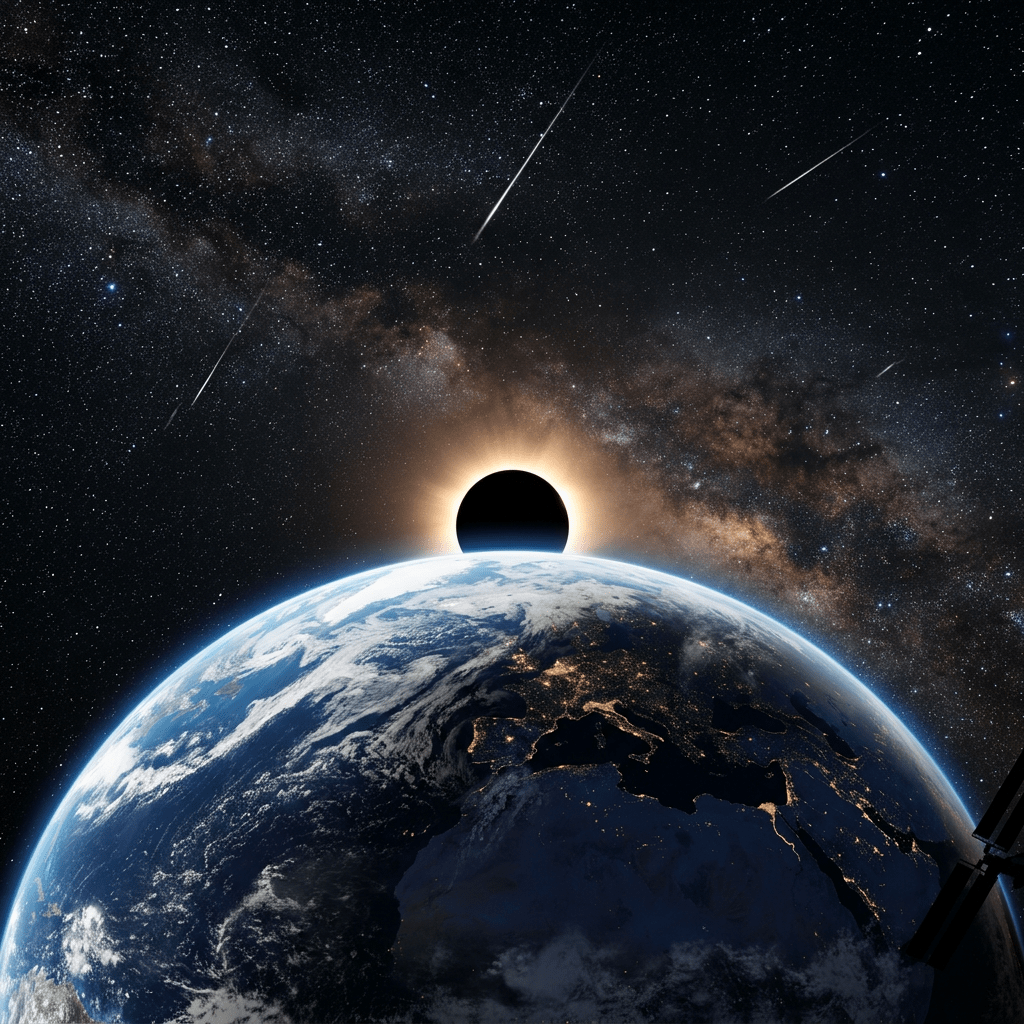
Solar eclipse above Earth with visible stars and meteor streaks

This week we should get the most spectacular skies, not only is the sun showing some volatile activity leading to northern lights, We also have the solar eclipse in Leo, and space itself is very interesting right now as we travel through the Perseid stream

The space we are travelling through is itself also worth distinguishing from the Perseid stream. The Solar System is moving through the local interstellar medium, within the very low-density region surrounding the heliosphere; the heliosphere is continually interacting with that external plasma and magnetic environment while the Sun and planets move through it.
At the same time, Earth is travelling around the Sun at about 30 km/s, carrying us through a much more local stream of material: the Perseid meteoroid trail. The Perseids are not a cloud arriving at Earth from Perseus; Earth is crossing the elongated orbital debris stream of Comet 109P/Swift–Tuttle. The comet’s orbit is highly elongated and retrograde, with an inclination of about 113°, so its debris travels through the Solar System in the opposite direction to the planets.
That makes our encounter unusually fast and nearly head-on, producing the Perseids which enter the atmosphere at roughly 59 km/s.
Around 10–16 August 2026, Earth is moving through the densest part of this debris corridor, with the Perseid peak around 12–13 August, precisely alongside the solar eclipse. The stream itself is much broader than the visible meteors suggest at roughly 0.1 AU wide, and Earth takes days to cross it, which is why the shower builds before the peak and continues afterwards.
The apparent trajectory is therefore particularly interesting: the particles are travelling along the ancient orbit of Swift–Tuttle, while Earth cuts across that orbit; from Earth they appear to radiate outward from Perseus, but their actual paths through space are almost parallel to the comet’s retrograde trajectory.
So this week we have three different spatial encounters layered together: the Solar System moving through the local interstellar environment, Earth moving through the Sun’s changing solar-wind and magnetic environment, and Earth physically crossing the ancient Swift–Tuttle debris stream. Then the 12 August eclipse occurs at the centre of that passage, with the darkened sky making the Perseid encounter unusually visible. That is quite an extraordinary piece of celestial geometry for the Geo-Zenith picture.
It goes almost without saying that every single one of us will be affected by this – everyone.

Pisces 3 – 9 August 2026

Pisces constellation night sky with blue eclipse

or Pisces, the week of 3–9 August 2026 brings a quiet but powerful period of inner awareness as the world moves towards the total solar eclipse on 12 August. Astronomically, the Sun continues through Leo while the Moon advances towards its alignment between Earth and the Sun, creating a growing celestial focus. From a Geo-Zenith perspective, this eclipse build-up reflects the delicate relationship between cosmic cycles and Earth’s living systems, with increasing attention on climate, oceans, collective emotions and humanity’s connection with nature. Pisces, as the sign most attuned to the unseen currents of life, may sense these changes before they become fully visible.

Astrologically, this is a week for compassion, healing and quiet preparation rather than forcing direction. The approaching eclipse may bring awareness of old emotional patterns, dreams that have been waiting for attention and the need to release what has quietly become a burden. Pisces can sometimes absorb the fears and confusion of the wider world, but this period asks you to return to your own centre and distinguish intuition from overwhelm. Your sensitivity is not a weakness; it is a way of understanding what needs care, healing and renewal.

Way through: Protect your inner peace, trust your deeper knowing, and turn your compassion into gentle actions that create healing for yourself and the world around you.

Aquarius 3 – 9 August 2026

Remove extra text, small star labels, colorful foreground

For Aquarius, the week of 3–9 August 2026 opens a window of reflection on humanity’s direction and the future we are collectively creating. Astronomically, the Sun continues through Leo while the Moon moves towards the total solar eclipse of 12 August, creating a powerful Sun–Moon–Earth alignment that has long been associated with moments of transition and awareness. From a Geo-Zenith perspective, this eclipse build-up highlights the connection between celestial cycles and Earth’s changing patterns, with societies facing questions around technology, environment, cooperation and the evolution of human consciousness. Aquarius is naturally attuned to the future, and this period may bring strong insights into where old systems are reaching their limits and where new possibilities are beginning to emerge.

Astrologically, Aquarius is being called to hold the vision while remaining connected to the present reality. The approaching eclipse encourages a deeper examination of ideals, communities and the role each person plays in shaping a more balanced world. Your gift is seeing beyond current difficulties and imagining alternatives, but the challenge is turning inspiration into practical steps that others can understand and follow. This is a time for spiritual intelligence, collective thinking and recognising that true progress comes not only from innovation but from compassion and shared responsibility.

Way through: Keep your eyes on the future, but ground your vision in practical actions that help people, communities and the planet move forward together.

Capricorn 3 – 9 August 2026

Capricorn with eclipse, constellation, night landscape foreground

For Capricorn, the week of 3–9 August 2026 is a period of reassessment, responsibility and preparing for a significant shift. Astronomically, the Sun continues through Leo while the Moon moves towards the total solar eclipse on 12 August, bringing the Sun–Moon–Earth alignment into sharper focus. From a Geo-Zenith perspective, this eclipse build-up highlights pressure on global systems, resources and structures, reflecting Capricorn’s own themes of governments, institutions, long-term planning and the foundations that hold society together. The coming days favour the careful observer: seeing where systems are weakening, where authority needs reform and where stronger foundations must be built.

Astrologically, Capricorn is being asked to balance determination with adaptability. The traditional Capricorn instinct is to endure, organise and carry responsibility, but this period suggests that some old strategies may no longer serve the future. The approaching eclipse can reveal where commitments need restructuring, particularly around career, reputation, finances and personal goals. Rather than trying to control every outcome, Capricorn’s strength lies in patience, strategic thinking and the ability to create lasting change through practical action. Progress comes from knowing what must be preserved and what must finally be released.

Way through: Work steadily, choose your priorities carefully, and use your discipline to build a future that is stronger rather than simply more familiar.

Scorpio 3 – 9 August 2026

Fiery Scorpio constellation with eclipse Earth Sun background

For Scorpio, the week of 3–9 August 2026 arrives under an intense and volatile sky, with the world reflecting the heat of transformation. Astronomically, the Sun continues through Leo while the Moon moves towards the total solar eclipse of 12 August, building a powerful Sun–Moon–Earth alignment. From a Geo-Zenith perspective, this period highlights pressure points across the planet, with extreme heat, wildfires, environmental disruption and social tensions creating a sense that many systems are being tested. Scorpio’s natural ability to see beneath the surface becomes a valuable strength now, allowing you to recognise hidden motives, overlooked truths and the deeper causes behind visible events.

Astrologically, this is a week for precision rather than force. Scorpio is often associated with power, crisis and regeneration, but the higher expression of this sign is the ability to transform through insight, integrity and courage. As old structures are challenged, you may feel called to stand up for justice, defend what is right and question situations where truth has been obscured. The approaching eclipse asks you to choose your battles wisely: not every conflict requires confrontation, but some principles require a clear and unwavering voice. Your greatest influence comes from knowing exactly when to act and when to allow events to reveal themselves.

Way through: Use your sharp perception with compassion, stand firmly for truth and justice, and let accuracy guide your actions rather than anger or force.

Cancer 3 – 9 August 2026

Cancer constellation overlay with labeled stars and solar eclipse in night sky

For Cancer, the week of 3–9 August 2026 is one of emotional reorientation as the sky prepares for the total solar eclipse on 12 August. Astronomically, the Sun continues through Leo while the Moon steadily closes the gap between Earth and Sun, strengthening the alignment that will culminate in the eclipse. From a Geo-Zenith perspective, this build-up highlights shifting energy across coastlines, weather systems and regions under environmental or political pressure, making many Cancerians especially sensitive to the changing emotional atmosphere around them. The week favours listening to your instincts while observing rather than reacting to external events.

Astrologically, your focus turns towards personal values, security and the people you trust most. Family matters, finances or long-standing emotional patterns may ask for gentle attention as you prepare for the new cycle the eclipse will bring. Chiron’s retrograde also encourages healing around self-worth, reminding you that lasting security comes from inner confidence as much as external circumstances. By the end of the week, you may recognise that releasing an old fear creates space for a stronger future.

Way through: Trust your intuition, strengthen what truly supports you, and allow emotional clarity to arrive before making important decisions.

Taurus 3 – 9 August 2026

Add Taurus bull figure prominently

For Taurus, the week of 3–9 August 2026 turns attention towards your foundations and the structures that support your life. Astronomically, the Sun continues across Leo as the Moon steadily approaches the total solar eclipse of 12 August, tightening the alignment between the Sun, Moon and Earth. From a Geo-Zenith perspective, this growing alignment concentrates energy through shifting terrestrial zenith lines, drawing attention to places experiencing heightened political, climatic and geological activity. For Taurus, these Earth-linked patterns resonate with home, family, property and your sense of security, suggesting that events in the wider world may prompt reflection about where and how you wish to live in the future.

Astrologically, this is a week for strengthening rather than expanding. Practical matters, finances and domestic responsibilities deserve careful attention before the eclipse opens a new phase. Long-term plans may require adjustment as fresh information emerges, and you may recognise that stability sometimes comes from adapting rather than resisting change. Trust your instincts, but allow developments to mature before making commitments that are difficult to reverse.

Way through: Build solid foundations now, remain flexible where circumstances are shifting, and let patience become your greatest strength.

Before the eclipse

From 3–9 August 2026 the astrological atmosphere feels like the gathering of a tide before a major wave. The Sun continues its journey through Leo, emphasising leadership, identity and the creative expression of purpose, while Mercury’s movement encourages reassessment of plans rather than impulsive decisions. Although the total solar eclipse does not occur until 12 August, its influence is already building. Eclipses have long been regarded as periods when events accelerate and hidden situations move rapidly towards revelation, and many astrologers consider the days leading into an eclipse to be as significant as the eclipse itself. Collectively this week may bring increasing political tension, market uncertainty, environmental concerns and sudden announcements that have been developing behind the scenes for months. Individuals may experience a growing feeling that an important chapter is ending and another is preparing to begin. Rather than forcing outcomes, this is a week for careful observation, completing unfinished business and listening to intuition before decisive action becomes necessary.

From an astronomical perspective, the approaching eclipse is a precise alignment of the Sun, Moon and Earth, with the Moon moving directly between Earth and the Sun on 12 August. Totality will be seen best across Greenland, Iceland and northern Europe, with a small portion of Portugal also lying within the path of totality. Much of Europe, including the Netherlands, will experience a deep partial eclipse of around ninety per cent, while large parts of North America, Canada and north-west Africa will also witness a partial eclipse. As the Moon’s shadow races across Earth at thousands of kilometers per hour, scientists will study the Sun’s corona, atmospheric changes and subtle effects on Earth’s upper atmosphere, while sky-watchers experience one of nature’s rarest spectacles. Astrologically, eclipses symbolise moments when familiar patterns are interrupted, allowing new directions to emerge. Whether viewed through astronomy or astrology, this week invites us to recognise that change often begins quietly before it becomes unmistakably visible.

Barbault’s Basket

The Barbault Basket reaches its greatest precision between 19 and 21 July 2026, with its point of maximum symmetry occurring around 20 July. At that time Jupiter (4° Leo), Uranus (4° Gemini), Neptune (4° Aries) and Pluto (4° Aquarius) all occupy the fourth degree of their respective zodiac signs. The four planets simultaneously form a network of harmonious aspects: Jupiter opposes Pluto, Uranus trines Pluto, Neptune trines Jupiter, while Uranus and Neptune are linked by a sextile. We regard this as one of the most elegant planetary geometries of the decade and as a significant expression of the long-term Uranus–Neptune–Pluto cycle which corresponds with periods of major historical reorganisation according to the famous French astrologer André Barbault.

From an astronomical perspective, the planets themselves are widely separated in the Solar System, but when viewed from Earth they are projected onto different regions of the celestial sphere, as we all know.
Jupiter, in early Leo, appears against the rich stellar fields bordering Cancer and Leo, looking outward through the Orion Spur of our Milky Way. Uranus, in early Gemini, lies in the direction of the Galactic anti-centre, beyond which are numerous open clusters including Messier 35. Neptune, in early Aries, is seen against comparatively sparse foreground stars in the direction of the Andromeda region, while Pluto, in early Aquarius, is projected towards the Pegasus–Aquarius field, beyond which modern surveys reveal immense numbers of distant galaxies. The stars and galaxies behind the planets provide the vast cosmic backdrop against which the configuration is observed.

The repeated emphasis on the fourth degree is one of the features that has attracted considerable astrological attention. Traditionally, the number four symbolises foundations, structure, manifestation and the establishment of lasting forms. Many astrologers therefore interpret the four planets occupying four degrees of their respective signs as indicating that the developments associated with this period are likely to become embedded in practical reality rather than remaining temporary or theoretical. Whether viewed symbolically or geometrically, the repeated fourth degree gives the configuration an unusual coherence and signifigance.

Comparable configurations are exceptionally rare. The exact combination occurring in July 2026 is unique within recorded historical times. Ephemeris studies identify 19–21 July 2026 as the period during which the Basket is exact, with the closest alignment around 20 July. Broader planetary arrangements involving the same outer planets have occurred at other periods, including the early 1920s, but they do not reproduce this same pattern of planetary degrees and aspect relationships. Because the orbital periods of Jupiter, Uranus, Neptune and Pluto differ so much.

Humanity now has an extraordinary scientific presence extending from interstellar space to the surface of the Sun. We also have unique technology and a wealth of historical knowledge to draw from – which has never been so before – Taken together, these observatories, spacecraft and intelligence technologies form a continuously operating system spread across the Solar System, each part contributing a different piece to our understanding of our origin, evolution and present activity.


This precise geometry does not repeat on any simple historical cycle, making the 2026 Basket a particularly rare event in planetary chronology. This time is unique – we are now able to change the pattern and put anything in the basket – this reset is our opportunity to create the beautiful world we all know is possible .

April planet stack

a view of planets

This part of April 2026 is not subtle. Between 15–27 April, Aries becomes heavily activated: Venus entered Aries on 5 April, Mercury follows around 16–18 April after its inferior conjunction phase on 4–5 April, the Moon passes through Aries 15–17 April, and the Sun reaches Aries ingress on 19–20 April, culminating in the New Moon in Aries on 27 April. Alongside these, Chiron and Eris remain in Aries, creating a concentrated field of identity, rupture, and initiation. This is not simply “energy” – it is a compression of timing. Multiple bodies converge in the same sector, removing delay and forcing action. The effect is immediate: decisions accelerate, tensions surface, and events move beyond negotiation into execution. We are in for a wild two weeks – and need to pay attention.

This pattern has clear historical precedents. In 44 BC, during the Assassination of Julius Caesar, the Sun, Mercury, and Venus clustered in Aries in the spring window, coinciding with this decisive act that shattered the Roman Republic’s balance almost overnight. Also during such a configuration, in 221 BC, during the Qin unification of China, the Aries-season concentration aligned with the final campaigns that ended centuries of fragmentation by force – only for that unity to later fracture again. Around 193–197 AD, leading into the instability of 190–210 AD, Saturn’s passage through Aries combined with inner planet cycles to trigger repeated power struggles within Rome; power was seized quickly, held rigidly, and began its long structural failure. In each case, the Aries concentration did not build systems – it broke deadlock, forced outcomes, and initiated irreversible transitions – not always for the better.

The parallel with what is happening now is obvious. Across global politics and conflict zones, leadership structures are hardening while simultaneously losing legitimacy. The Aries concentration does not create this condition- it accelerates it. What has been building behind the scenes is now out in the open and we are all aware of every move: confrontations replace diplomacy, decisions override process, and systems that cannot adapt begin to fracture. We can watch it all happen and are all caught up in it. Historically, this phase is always described as instability or collapse, but structurally it is the same mechanism repeating – pressure released through action, followed by fragmentation, and then reorganisation into a different cultural and political form. The old order does not evolve during these periods; it breaks or snaps causing untold destruction and chaos as it does so. Then, something else begins to assemble from the pieces, we can create something else from these pieces depending on how aware and organised we are – before it hardens into a structure we all know we don’t want.

The ring of fire

On 17 February 2026 the Sun and Moon meet at the final degree of Aquarius in an annular solar eclipse — a New Moon that does not merely begin a cycle, but completes one. The anaretic degree carries the weight of culmination: systems stretched to exhaustion, ideologies at their limit, networks revealing their fractures. Aquarius governs the collective field — technology, governance, movements, shared narratives — and this eclipse lands precisely where those themes are most visibly strained. Around us: political aggression, protests, instability, disclosures, the sense that old authorities are losing coherence. An eclipse at 29° does not whisper. It closes a chapter.

What makes this one structurally unique is timing. Saturn and Neptune converge at 0° Aries — the zodiac’s ignition point. Zero degrees is not a continuation; it is emergence. Saturn brings form, boundary, law. Neptune dissolves and re-mythologises. Their meeting at the Aries Point marks the reset coordinate of a new collective storyline. The eclipse at the end of Aquarius clears the field; 0° Aries begins the next assertion of identity, leadership and direction. The sky is architecturally precise: finish, then initiate.

In the midst of visible chaos — aggression, ideological fragmentation, institutional fatigue — this configuration suggests not collapse but reorganisation. When systems lose stability, human choice becomes amplified. Eclipses expose where we are reactive; Aries demands conscious action. The reset is not imposed from above; it is enacted through decisions made under pressure. What we defend, what we build, what we refuse to perpetuate — these become the scaffolding of the next cycle.

Working through this eclipse means resisting reflex and choosing clarity. Aquarius asks: what collective are you feeding? Aries asks: what are you initiating? The human Earth is not ending; it is recalibrating. Old frameworks are dissolving because they cannot carry the next phase. The 17 February eclipse is a threshold — not into chaos, but into responsibility. Zero degrees signal the beginning, but the beginning depends on us.