or Pisces, the week of 3–9 August 2026 brings a quiet but powerful period of inner awareness as the world moves towards the total solar eclipse on 12 August. Astronomically, the Sun continues through Leo while the Moon advances towards its alignment between Earth and the Sun, creating a growing celestial focus. From a Geo-Zenith perspective, this eclipse build-up reflects the delicate relationship between cosmic cycles and Earth’s living systems, with increasing attention on climate, oceans, collective emotions and humanity’s connection with nature. Pisces, as the sign most attuned to the unseen currents of life, may sense these changes before they become fully visible.
Astrologically, this is a week for compassion, healing and quiet preparation rather than forcing direction. The approaching eclipse may bring awareness of old emotional patterns, dreams that have been waiting for attention and the need to release what has quietly become a burden. Pisces can sometimes absorb the fears and confusion of the wider world, but this period asks you to return to your own centre and distinguish intuition from overwhelm. Your sensitivity is not a weakness; it is a way of understanding what needs care, healing and renewal.
Way through: Protect your inner peace, trust your deeper knowing, and turn your compassion into gentle actions that create healing for yourself and the world around you.
For Aquarius, the week of 3–9 August 2026 opens a window of reflection on humanity’s direction and the future we are collectively creating. Astronomically, the Sun continues through Leo while the Moon moves towards the total solar eclipse of 12 August, creating a powerful Sun–Moon–Earth alignment that has long been associated with moments of transition and awareness. From a Geo-Zenith perspective, this eclipse build-up highlights the connection between celestial cycles and Earth’s changing patterns, with societies facing questions around technology, environment, cooperation and the evolution of human consciousness. Aquarius is naturally attuned to the future, and this period may bring strong insights into where old systems are reaching their limits and where new possibilities are beginning to emerge.
Astrologically, Aquarius is being called to hold the vision while remaining connected to the present reality. The approaching eclipse encourages a deeper examination of ideals, communities and the role each person plays in shaping a more balanced world. Your gift is seeing beyond current difficulties and imagining alternatives, but the challenge is turning inspiration into practical steps that others can understand and follow. This is a time for spiritual intelligence, collective thinking and recognising that true progress comes not only from innovation but from compassion and shared responsibility.
Way through: Keep your eyes on the future, but ground your vision in practical actions that help people, communities and the planet move forward together.
For Scorpio, the week of 3–9 August 2026 arrives under an intense and volatile sky, with the world reflecting the heat of transformation. Astronomically, the Sun continues through Leo while the Moon moves towards the total solar eclipse of 12 August, building a powerful Sun–Moon–Earth alignment. From a Geo-Zenith perspective, this period highlights pressure points across the planet, with extreme heat, wildfires, environmental disruption and social tensions creating a sense that many systems are being tested. Scorpio’s natural ability to see beneath the surface becomes a valuable strength now, allowing you to recognise hidden motives, overlooked truths and the deeper causes behind visible events.
Astrologically, this is a week for precision rather than force. Scorpio is often associated with power, crisis and regeneration, but the higher expression of this sign is the ability to transform through insight, integrity and courage. As old structures are challenged, you may feel called to stand up for justice, defend what is right and question situations where truth has been obscured. The approaching eclipse asks you to choose your battles wisely: not every conflict requires confrontation, but some principles require a clear and unwavering voice. Your greatest influence comes from knowing exactly when to act and when to allow events to reveal themselves.
Way through: Use your sharp perception with compassion, stand firmly for truth and justice, and let accuracy guide your actions rather than anger or force.
For Leo, the week of 3–9 August 2026 arrives under a sky that mirrors your own element: fire, visibility and transformation. Astronomically, the Sun is travelling through Leo while the Moon moves steadily towards the total solar eclipse of 12 August, creating a powerful Sun–Moon–Earth alignment that has been observed by cultures for thousands of years. Across the planet, heat extremes, wildfires, political tensions and environmental pressures create a backdrop of instability, while from a Geo-Zenith perspective the eclipse build-up highlights Earth systems that are already under strain. Astrologers often associate Leo periods with leadership, authority and the question of how power is used, and this week asks whether leaders respond from ego or from responsibility.
Astrologically, Leo is being called to embody the higher expression of the sign: courage without domination, confidence without arrogance, and visibility used for the benefit of others. The approaching eclipse suggests that old forms of leadership and recognition are being challenged, both personally and collectively. You may feel a stronger urge to act, speak out or create change, but the most effective Leo influence comes through inspiring rather than controlling. This is a time to protect your energy, channel passion into constructive action, and remember that true leadership is measured by what it nurtures, not what it conquers.
Way through: Stand calmly in your power, use your fire to illuminate rather than burn, and lead by creating hope, courage and practical solutions for those around you.
For Cancer, the week of 3–9 August 2026 is one of emotional reorientation as the sky prepares for the total solar eclipse on 12 August. Astronomically, the Sun continues through Leo while the Moon steadily closes the gap between Earth and Sun, strengthening the alignment that will culminate in the eclipse. From a Geo-Zenith perspective, this build-up highlights shifting energy across coastlines, weather systems and regions under environmental or political pressure, making many Cancerians especially sensitive to the changing emotional atmosphere around them. The week favours listening to your instincts while observing rather than reacting to external events.
Astrologically, your focus turns towards personal values, security and the people you trust most. Family matters, finances or long-standing emotional patterns may ask for gentle attention as you prepare for the new cycle the eclipse will bring. Chiron’s retrograde also encourages healing around self-worth, reminding you that lasting security comes from inner confidence as much as external circumstances. By the end of the week, you may recognise that releasing an old fear creates space for a stronger future.
Way through: Trust your intuition, strengthen what truly supports you, and allow emotional clarity to arrive before making important decisions.
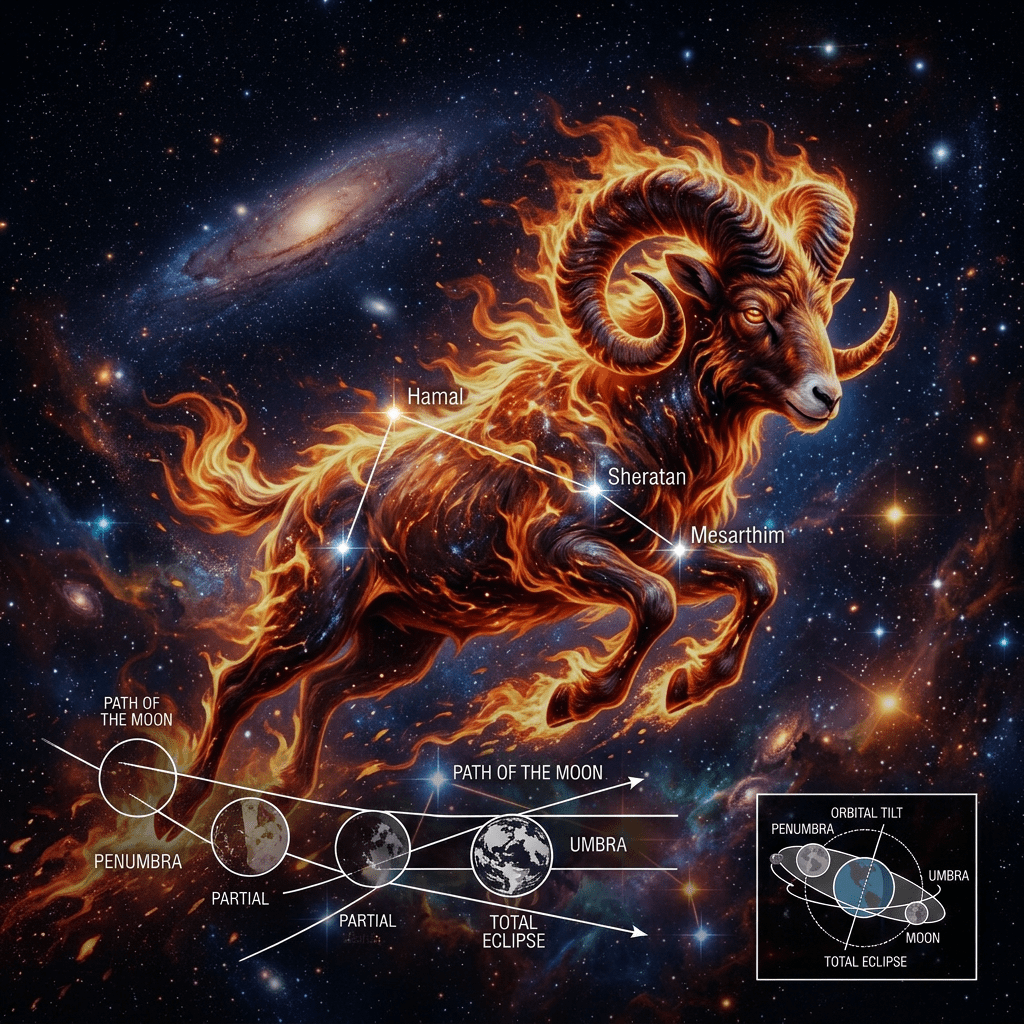
The Aries constellation depicted as a fiery ram alongside stages of a lunar eclipse
For Aries, the week of 3–9 August 2026 is one of growing anticipation rather than immediate action. Astronomically, the Sun continues its passage through Leo while the Moon moves through its monthly cycle towards the 12 August total solar eclipse, gradually increasing the gravitational and symbolic emphasis on the Sun–Moon–Earth alignment. Although the eclipse has not yet arrived, its influence begins to build, drawing attention to creativity, children, romance, personal projects and the courage to express your authentic self. Conversations and opportunities may hint at changes that will become clearer over the following fortnight.
Astrologically, this is a week to notice what inspires you rather than what drains you. Situations that have felt stalled may begin to show where fresh energy wants to flow, while relationships reveal who genuinely supports your ambitions. Resist the temptation to force outcomes or rush decisions simply because momentum is increasing. The approaching eclipse is preparing a new chapter, but the details are still unfolding.
Way through: Stay confident, finish what you have already started, and allow the right opportunities to reveal themselves before making your next bold move.
From 3–9 August 2026 the astrological atmosphere feels like the gathering of a tide before a major wave. The Sun continues its journey through Leo, emphasising leadership, identity and the creative expression of purpose, while Mercury’s movement encourages reassessment of plans rather than impulsive decisions. Although the total solar eclipse does not occur until 12 August, its influence is already building. Eclipses have long been regarded as periods when events accelerate and hidden situations move rapidly towards revelation, and many astrologers consider the days leading into an eclipse to be as significant as the eclipse itself. Collectively this week may bring increasing political tension, market uncertainty, environmental concerns and sudden announcements that have been developing behind the scenes for months. Individuals may experience a growing feeling that an important chapter is ending and another is preparing to begin. Rather than forcing outcomes, this is a week for careful observation, completing unfinished business and listening to intuition before decisive action becomes necessary.
From an astronomical perspective, the approaching eclipse is a precise alignment of the Sun, Moon and Earth, with the Moon moving directly between Earth and the Sun on 12 August. Totality will be seen best across Greenland, Iceland and northern Europe, with a small portion of Portugal also lying within the path of totality. Much of Europe, including the Netherlands, will experience a deep partial eclipse of around ninety per cent, while large parts of North America, Canada and north-west Africa will also witness a partial eclipse. As the Moon’s shadow races across Earth at thousands of kilometers per hour, scientists will study the Sun’s corona, atmospheric changes and subtle effects on Earth’s upper atmosphere, while sky-watchers experience one of nature’s rarest spectacles. Astrologically, eclipses symbolise moments when familiar patterns are interrupted, allowing new directions to emerge. Whether viewed through astronomy or astrology, this week invites us to recognise that change often begins quietly before it becomes unmistakably visible.
The Barbault Basket reaches its greatest precision between 19 and 21 July 2026, with its point of maximum symmetry occurring around 20 July. At that time Jupiter (4° Leo), Uranus (4° Gemini), Neptune (4° Aries) and Pluto (4° Aquarius) all occupy the fourth degree of their respective zodiac signs. The four planets simultaneously form a network of harmonious aspects: Jupiter opposes Pluto, Uranus trines Pluto, Neptune trines Jupiter, while Uranus and Neptune are linked by a sextile. We regard this as one of the most elegant planetary geometries of the decade and as a significant expression of the long-term Uranus–Neptune–Pluto cycle which corresponds with periods of major historical reorganisation according to the famous French astrologer André Barbault.
From an astronomical perspective, the planets themselves are widely separated in the Solar System, but when viewed from Earth they are projected onto different regions of the celestial sphere, as we all know. Jupiter, in early Leo, appears against the rich stellar fields bordering Cancer and Leo, looking outward through the Orion Spur of our Milky Way. Uranus, in early Gemini, lies in the direction of the Galactic anti-centre, beyond which are numerous open clusters including Messier 35. Neptune, in early Aries, is seen against comparatively sparse foreground stars in the direction of the Andromeda region, while Pluto, in early Aquarius, is projected towards the Pegasus–Aquarius field, beyond which modern surveys reveal immense numbers of distant galaxies. The stars and galaxies behind the planets provide the vast cosmic backdrop against which the configuration is observed.
The repeated emphasis on the fourth degree is one of the features that has attracted considerable astrological attention. Traditionally, the number four symbolises foundations, structure, manifestation and the establishment of lasting forms. Many astrologers therefore interpret the four planets occupying four degrees of their respective signs as indicating that the developments associated with this period are likely to become embedded in practical reality rather than remaining temporary or theoretical. Whether viewed symbolically or geometrically, the repeated fourth degree gives the configuration an unusual coherence and signifigance.
Comparable configurations are exceptionally rare. The exact combination occurring in July 2026 is unique within recorded historical times. Ephemeris studies identify 19–21 July 2026 as the period during which the Basket is exact, with the closest alignment around 20 July. Broader planetary arrangements involving the same outer planets have occurred at other periods, including the early 1920s, but they do not reproduce this same pattern of planetary degrees and aspect relationships. Because the orbital periods of Jupiter, Uranus, Neptune and Pluto differ so much.
Humanity now has an extraordinary scientific presence extending from interstellar space to the surface of the Sun. We also have unique technology and a wealth of historical knowledge to draw from – which has never been so before – Taken together, these observatories, spacecraft and intelligence technologies form a continuously operating system spread across the Solar System, each part contributing a different piece to our understanding of our origin, evolution and present activity.
This precise geometry does not repeat on any simple historical cycle, making the 2026 Basket a particularly rare event in planetary chronology. This time is unique – we are now able to change the pattern and put anything in the basket – this reset is our opportunity to create the beautiful world we all know is possible .
Monday 30 March You begin the week in the immediate aftermath of eclipse season, which means nothing is settled—everything is exposed but not yet resolved. The Moon is waning toward the early April lunation, and Mercury is slowing into visibility ahead of its elongation. This creates a cognitive condition of partial clarity: information surfaces, but interpretation lags. In real-world terms, this is a day of signals—political statements, market tremors, institutional leaks—that hint at direction without yet committing to it. Under a Saturn–Pluto cazimi framework, this is the “pre-compression awareness” phase: systems sense pressure and begin defensive positioning. Expect hesitancy in markets and rhetoric that sounds decisive but is not yet backed by action.
Tuesday 31 March Momentum builds subtly but unmistakably. The solar field is active, and geomagnetic sensitivity tends to peak around equinox-adjacent periods, contributing to a background of agitation—technological glitches, erratic communication, and heightened emotional reactivity. On the geopolitical level, you see rehearsal: narratives are tested, alliances probed, and policy signals floated without commitment. This is historically consistent with pre-alignment phases, where actors position themselves before a decisive shift. The tone is not yet confrontational, but it is no longer neutral. Systems are aligning under the surface.
Wednesday 1 April The Full Moon (the so-called Pink Moon) reaches peak illumination, bringing visibility and amplification.
This is a moment of exposure: whatever has been building becomes harder to ignore. In markets, this often correlates with volatility spikes or sharp sentiment shifts; in politics, with revelations or public reactions that force a response. The Saturn–Pluto undertone means that what surfaces is not trivial—it tends to involve structural weaknesses or entrenched power dynamics. Historically, Full Moons within such compressed cycles coincide with turning points in public perception rather than immediate events, but perception itself becomes the catalyst.
Thursday 2 April The system pivots from exposure to action. The Moon begins to wane, but Mercury approaches its greatest elongation, increasing visibility and decisiveness.
This is where decisions start to crystallise. Negotiations intensify, but they are less about compromise and more about defining boundaries. In financial terms, expect directional moves rather than oscillation—capital begins to flow with intent. In geopolitical terms, this is where positions harden. The cazimi dynamic expresses as compression converting into execution: what has been discussed now begins to take form, even if quietly.
Friday 3 April This is a critical hinge point. Mercury reaches peak visibility, symbolising clarity of information and communication channels.
At the same time, you are effectively within the energetic window of the Saturn–Pluto cazimi, where structural and transformative forces are fused. This produces decisive announcements, disclosures, or shifts that cannot easily be reversed. Expect news that reframes existing situations—financial data, policy moves, or geopolitical statements that alter the trajectory rather than merely comment on it. The Libra New Moon energy you referenced overlays this with a veneer of balance, but the underlying dynamic is zero-sum: agreements reached now are likely to favour one side structurally.
Saturday 4 April The comet C/2026 A1 reaches perihelion, passing extremely close to the Sun, while Earth continues moving through particulate debris fields.
This is not symbolic—it is a literal increase in solar-adjacent activity, coinciding with heightened electromagnetic conditions. The effect on Earth is indirect but real: increased strain on systems, from communications to power infrastructure, and a general sense of instability. In human terms, this is a day where pressure peaks. Events triggered earlier in the week may intensify or reveal second-order consequences. Historically, such moments correlate with sudden escalations—market jolts, abrupt political developments, or environmental घटनाएँ that reinforce the broader pattern of strain.
Sunday 5 April After the peak, the pattern shifts into consolidation. The immediate intensity eases, but the consequences remain. The Moon continues to wane, and the system begins to absorb what has occurred. This is not resolution; it is the beginning of restructuring. Decisions made earlier in the week start to show effects—alliances clarified, markets stabilising into new ranges, narratives settling into more rigid forms. The broader April pattern—meteor activity building toward the Lyrids, continued solar activity, and planetary clustering—indicates that this is only the first wave. The week ends with a sense that something has been set in motion that will not easily be reversed, and that the remainder of April will be about working through its implications rather than undoing them.
April 2026 opens in a highly charged astronomical corridor rather than a single event. We have just come through the March eclipse window, which already destabilises equilibrium, and move directly into a dense cluster of planetary interactions—Mercury restoring forward motion, Jupiter amplifying outcomes, and Pluto continuing its long restructuring arc. That “breakthrough window” from roughly April 2–18 is not mystical language; it reflects a real transition from latency to execution, where decisions that have been building since late 2025 suddenly become actionable and visible . Set against a Saturn–Pluto cazimi framework, this reads as compression followed by release: pressure does not dissipate, it converts into decisive movement. The Libra lunation at the start of the month adds a veneer of balance and negotiation, but it is a thin veneer—Venus–Pluto tensions running simultaneously point to power struggles in finance and relationships, both personal and geopolitical
Astronomically, the sky itself mirrors this clustering. April carries a rare pre-dawn alignment of Mercury, Mars, and Saturn tightening and shifting over successive days, effectively creating a visible “stacking” of planetary influence . At the same time, meteor activity increases as Earth moves into seasonal debris streams, with the Lyrids—one of the oldest recorded showers—building toward a peak later in the month
.This matters less for spectacle than for pattern: Earth is moving through particulate fields while the inner planets cluster tightly along the ecliptic. Historically, such periods coincide with heightened observational awareness—ancient records of the Lyrids go back over 2,700 years, often noted during times of upheaval or transition. Add to this a rising solar cycle, and you have a background condition of increased electromagnetic and atmospheric variability—not catastrophic, but enough to introduce friction into technological systems and climate patterns.
On Earth, the translation is already visible. The culture war intensifies not because opinions are diverging, but because underlying structures—media, governance, finance—are being forced into explicit positions. Financial systems show signs of strain and reconfiguration, with volatility not as a spike but as a sustained condition: currencies pressured, debt structures questioned, and policy responses becoming more interventionist. Geopolitically, tensions harden into blocs rather than dissolving; conflicts that were previously ambiguous become defined, even if not formally declared. This is consistent with Saturn–Pluto history: the period does not immediately produce resolution, but it removes the possibility of pretending that contradictions can coexist indefinitely.
The most practical forecast for April, then, is not dramatic collapse but accelerated sorting. Early April brings realisations and decisions; mid-April locks those decisions into motion; late April begins to show consequences. Expect disclosures—political, financial, or institutional—that force rapid repositioning. Expect negotiations that appear conciliatory on the surface but are structurally zero-sum underneath. Expect intermittent disruptions—technical, environmental, logistical—that reinforce a sense of systemic strain rather than causing singular crises. The useful stance is neither alarm nor passivity, but precision: act when clarity appears (and it will, briefly, in that early–mid April window), reduce reliance on unstable structures, and assume that whatever stabilises by the end of the month is not the old system returning, but the early outline of the next one.
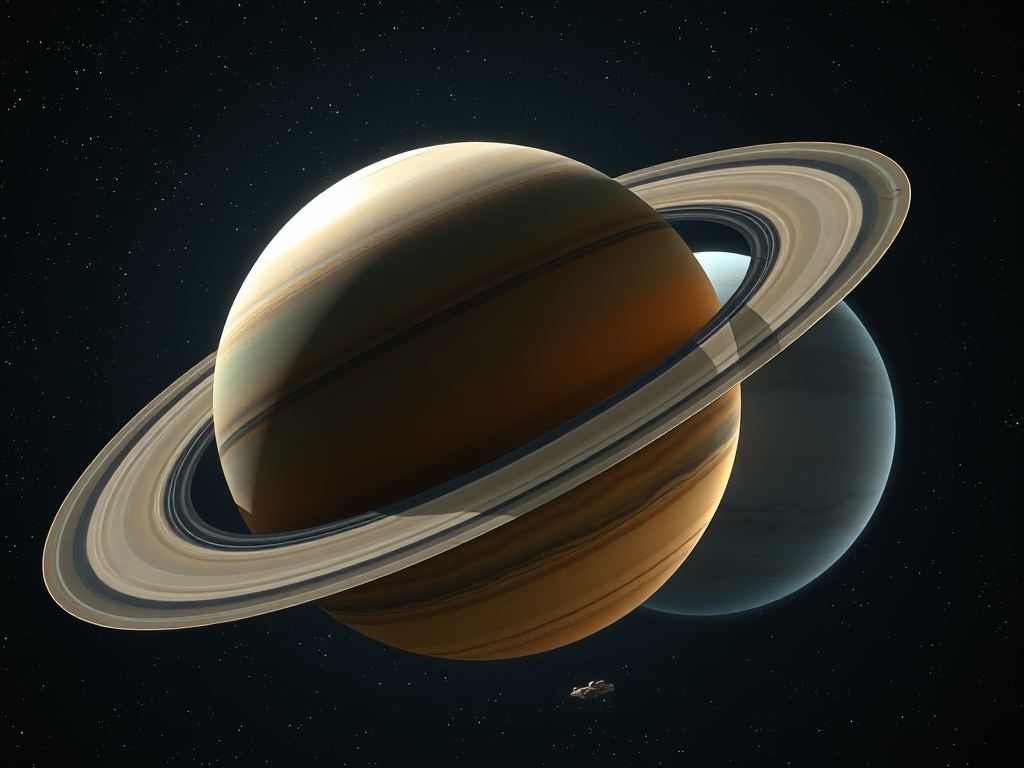
Where we stand now is not simply “astrology” but a measurable celestial configuration. On 20 February 2026 at 11:54 UTC, Saturn and Neptune met at 0°45′ Aries, initiating a cycle associated historically with ideological restructuring and the dissolution of existing political narratives. Two weeks later, on 3 March 2026 at 06:37 UTC, a total lunar eclipse at 12°53′ Virgo forced a global moment of exposure—systems, supply chains, health structures and governance weaknesses laid bare. Meanwhile Jupiter stationed direct at 15°05′ Cancer on 10 March 2026, while Mercury stationed direct at 8°29′ Pisces on 20 March, the same day the Sun crossed the Aries equinox. Astronomically, these events coincide with an unusual clustering of planets along the ecliptic and the recent six-planet alignment of 28 February 2026, when Mercury, Venus, Jupiter, Saturn, Uranus and Neptune appeared along the same arc of sky.
The immediate sky picture continues to tighten through April. Mars enters Aries on 9 April 2026 at 15:36 UTC, followed by a series of sharp interactions: Mars conjunct Neptune on 13 April (00:29 UTC) and Mars conjunct Saturn on 19 April (17:43 UTC). In the physical sky this corresponds with a visible alignment of Mercury, Mars, Saturn and Neptune around 18 April, appearing low before sunrise. At the same time a potentially bright visitor—comet C/2025 R3 (PANSTARRS)—is predicted to become visible toward the end of April 2026, adding another symbolic marker in the heavens. Astronomically these objects are simply following orbital mechanics, but historically such compressions of planetary motion tend to coincide with periods when political structures strain under their own contradictions.
From a geo-zenith perspective the sky is pointing toward restructuring rather than collapse. The Saturn–Neptune cycle dissolves illusions while demanding new forms, yet those forms are not visible yet; they tend to emerge years after the conjunction. The difficulty lies on Earth, not in the sky: ageing leadership classes, ideological rigidity and the tendency of governments to double down on propaganda precisely when transparency is required. Under Mars activating the Saturn–Neptune conjunction through April, anger, confusion and misdirection easily combine. This is the phase where misinformation multiplies and where the most disciplined response is restraint: observe carefully, verify information, and resist the urge to fall into the simplistic binaries that geopolitical narratives demand.
By mid-July 2026, the planetary field spreads slightly, offering a temporary window of relative breathing space. Astronomically the sky features calmer configurations such as the Moon–Mars–Pleiades grouping on 11 July 2026, a quieter geometric arrangement compared with the compressed April sky. Yet the larger cycle remains active. The Saturn–Neptune conjunction marks the beginning of a long restructuring of global systems—financial, political and ideological. What replaces the present order cannot yet be clearly seen, because such structures tend to emerge gradually from collective necessity rather than deliberate design.
The practical message is simple. This period requires patience, compassion and clear thinking. Some people will be in positions where they can act; others will feel powerless while watching events unfold. Both experiences are part of the same cycle. In such periods the most rational response is to care for one’s immediate circle, question every narrative, avoid taking reflexive sides, and allow the planetary pattern itself to show when genuine windows of opportunity appear. Historically these cycles are remembered not only for crisis but also for the quiet emergence of new moral frameworks—often built by ordinary people long before governments notice them.
On 17 February 2026 the Sun and Moon meet at the final degree of Aquarius in an annular solar eclipse — a New Moon that does not merely begin a cycle, but completes one. The anaretic degree carries the weight of culmination: systems stretched to exhaustion, ideologies at their limit, networks revealing their fractures. Aquarius governs the collective field — technology, governance, movements, shared narratives — and this eclipse lands precisely where those themes are most visibly strained. Around us: political aggression, protests, instability, disclosures, the sense that old authorities are losing coherence. An eclipse at 29° does not whisper. It closes a chapter.
What makes this one structurally unique is timing. Saturn and Neptune converge at 0° Aries — the zodiac’s ignition point. Zero degrees is not a continuation; it is emergence. Saturn brings form, boundary, law. Neptune dissolves and re-mythologises. Their meeting at the Aries Point marks the reset coordinate of a new collective storyline. The eclipse at the end of Aquarius clears the field; 0° Aries begins the next assertion of identity, leadership and direction. The sky is architecturally precise: finish, then initiate.
In the midst of visible chaos — aggression, ideological fragmentation, institutional fatigue — this configuration suggests not collapse but reorganisation. When systems lose stability, human choice becomes amplified. Eclipses expose where we are reactive; Aries demands conscious action. The reset is not imposed from above; it is enacted through decisions made under pressure. What we defend, what we build, what we refuse to perpetuate — these become the scaffolding of the next cycle.
Working through this eclipse means resisting reflex and choosing clarity. Aquarius asks: what collective are you feeding? Aries asks: what are you initiating? The human Earth is not ending; it is recalibrating. Old frameworks are dissolving because they cannot carry the next phase. The 17 February eclipse is a threshold — not into chaos, but into responsibility. Zero degrees signal the beginning, but the beginning depends on us.
I should have posted this a few days ago -as this alignment is so important – however it is up today – the day before the eclipse – which adds another layer – but that is another post – this is important enough for a single one. Saturn and Neptune are not enemies – they are parts of the whole, the balance, the new vision and need to be integrated as such –
At 0° Aries, Saturn and Neptune meet at the very threshold of the zodiac, forming a conjunction that is nothing short of remarkable. This is not a tension or struggle; it is a rare alignment where vision and structure, imagination and discipline, insight and action converge in perfect balance. Neptune offers the expansive, systemic view, the capacity to perceive what is possible beyond the limitations of the present, while Saturn provides the scaffolding, the material and ethical framework necessary to bring that vision into concrete reality. Together, they create a zero-point of initiation — a moment where the potential of humanity can be consciously anchored, where inspiration and execution are inseparable partners.
This conjunction is profoundly hopeful because it offers a working template for transformation. The cosmic currents encourage us to hold our dreams with clarity and to engage with the material world responsibly. It reminds us that the visions we carry — for communities, for the planet, for life itself — are not idle fantasies but blueprints waiting to be enacted. By integrating the lessons of Saturn’s discipline with Neptune’s insight, we can move beyond scattered aspiration into coherent, practical creation, aligning our actions with the highest potential for renewal.
What makes this conjunction truly beautiful is its invitation: to build consciously from the ground up while keeping the horizon in sight. It is a cosmic moment that validates the wisdom of combining care with courage, imagination with accountability. In the alignment of Saturn and Neptune, the universe offers not only possibility but a pathway, a structural embrace of the dreams we hold. It is a reminder that a more beautiful world is not only imaginable — it is possible, and it can be realized when vision and responsibility work together, hand in hand, at the very start of a new cycle.





 ASTROLOGY CRUCIBLE