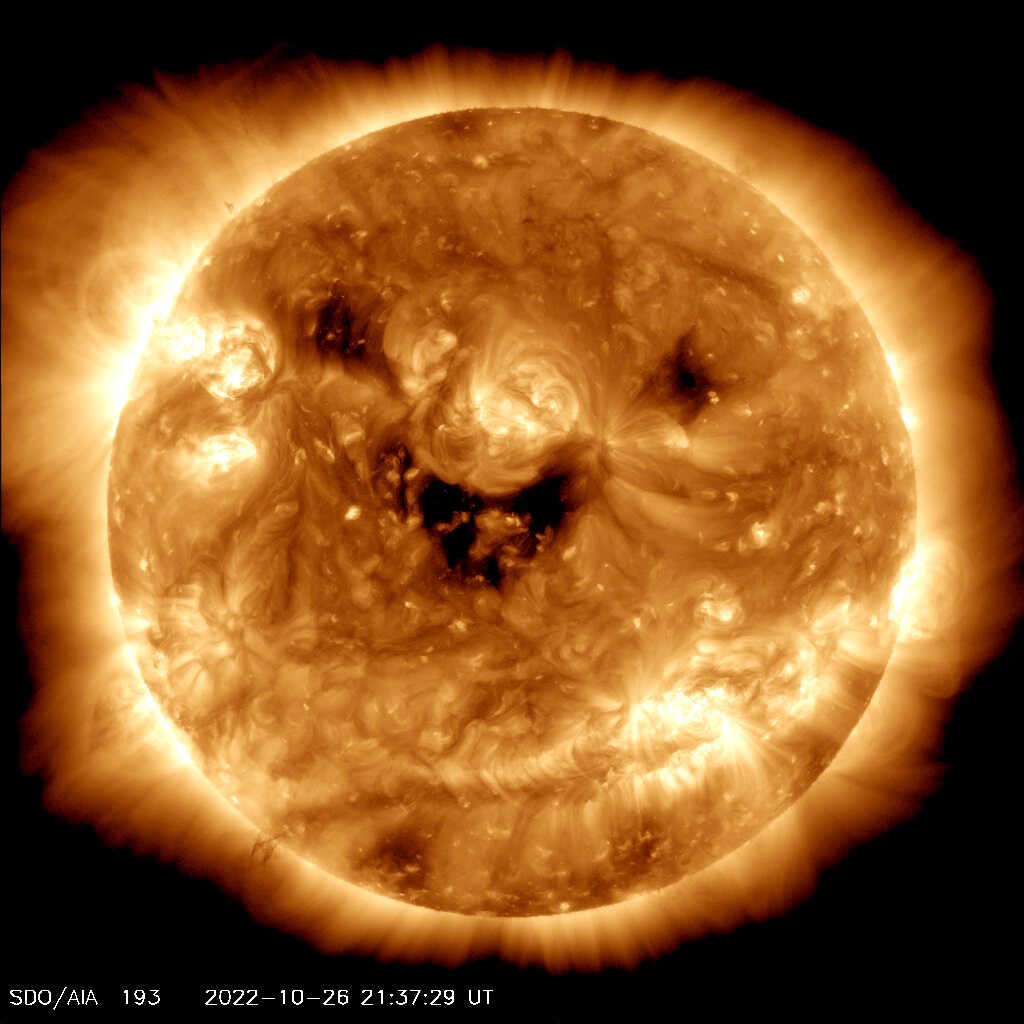
Solar flares – part two

The human brain is sensitive to electromagnetic fluctuations, particularly in the 0.5–40 Hz range of natural brainwave activity (delta through gamma). Piezoelectric-like calcite microcrystals in the pineal gland transduce environmental electromagnetic signals into electrical or chemical responses, influencing circadian rhythms, hormone production, and thus also cognitive or emotional states. While the effects are subtle, they are measurable under controlled conditions and explain some behavioural or mood changes during geomagnetic disturbances.

Researchers note that periods of heightened solar activity correlate with shifts in collective energy, decision-making, and societal tension. Astrologers similarly interpret strong solar events as times of increased emotional volatility and sensitivity, both individually and collectively. Individual responses vary, but global geomagnetic shifts appear to align with periods of systemic stress, unusual weather patterns, or heightened awareness.

Astronomers, space agencies, and observatories monitoring the Sun emphasise that solar events interact with Earth’s magnetic field, affecting satellite operations, communications, and navigation systems. When combined with ongoing seismic, volcanic, and extreme weather activity, there is a complex network of environmental signals to which humans are subtly attuned, both physiologically and behaviourally. As we are also electromagnetic beings, having an, aura or electromagnetic field.

All solar activity produces measurable geomagnetic effects that influence brainwave patterns, pineal gland activity, and human emotional states. Astrological and scientific observations converge on the conclusion that these periods of heightened solar activity are associated with heightened sensitivity and shifts in collective behaviour. So, there is change happening now during these extreme solar conditions. We can all feel it, we can see it, we know – and soon we will have the eclipse season, which will truly be noticeable events – both inner and outer.

3I Atlas trajectory

The solar system is being traversed by an interstellar visitor of extraordinary proportions, known as 3I/ATLAS. Unlike the brief flyby of its predecessors, this object moves along a trajectory almost parallel to the ecliptic plane, threading through the inner planets at a retrograde inclination of 175 degrees. Its current velocity is around 58 kilometres per second, accelerating to roughly 68 kilometres per second as it nears perihelion on 29 October 2025. The object is enormous: estimates place its nucleus at 46 to 50 kilometres across, while its coma, rich in carbon dioxide and plasma, already spans nearly 700,000 kilometres which is half the diameter of the Sun! This dusty, electrically charged envelope renders this visitor highly active as it interacts with the solar wind and heliospheric currents, particularly during the heightened activity of our current solar maximum.

This trajectory will take it just above Mars in early October, past the asteroid belt, and later toward Jupiter by March 2026. Along the way, it will traverse the electromagnetic environment of the inner planets and their moons, and subtly influence dwarf planets such as Ceres, Haumea, Makemake, and Eris. Its plasma tail and ionised gases will interact with solar, ultraviolet and X-ray radiation, expanding and energising the coma, while the gravitational and magnetic fields of the planets will shape its outbound trajectory. Though no physical contact is expected with any planetary body, its presence represents a rare moment of systemic resonance, as interstellar material and electromagnetic energy thread through the solar system over the next few months.

From an astrological perspective, the geo-zenith alignments of this period intensify the already volatile planetary currents. September begins with two eclipses – the solar on the 7th and the lunar on the 18th—priming collective awareness and initiating subtle systemic shifts. We will already be aware that change is in the air. The object’s close passage to Mars coincides with a new moon and a superior conjunction with Earth, amplifying perception and reflection on structural and emotional frameworks. Its perihelion near the Sun acts as an energetic fulcrum, enhancing interactions across the Virgo-Pisces axis, while its outbound movement past Jupiter in March resonates with expansion, insight, and recalibration of broader societal and philosophical patterns. Dwarf planets and inner moons act as secondary nodes in this network, subtly modulating the energetic and astro-magnetic interplay. The world will be so changed – as will we.

3I/ATLAS is not just a celestial visitor but a long-time catalyst, threading the solar system with interstellar energy and interacting with both planetary fields and collective consciousness. Its trajectory and electromagnetic presence provide a unique opportunity to observe the intersection of cosmic physics and geo-zenith astrology, a rare alignment of astronomical and systemic resonance that will unfold over the coming months, leaving subtle yet tangible imprints on both our solar environment and our planetary awareness. We may even get more images and readings from our satellites and telescopes – so keep watching.

The void moon

The moon the moon
Though the moon has been right out there – all void of course
the Moon is having a party with all the other planets while the sun is out on it’s own

So everything is a communication, a chat
an aspect
a conjunction
pan psychic party it is – Specially the Venus- Jupiter party –
We can have a bit of fun with that -while we watch the chaos around us.
Launch your ships by lunchtime and we can all sail across the milky way
A lucky aspect

Can’t stop thinking about what the stars are up to
Can’t stop thinking about what all the planets are doing – as they sail across the night sky

Look now pre-dawn
The beautiful view before sunup of Venus and Jupiter – close as they are to Sirius
The star of ancient Egypt, the Nile flood, water, agriculture, the fall of kings and emperors.
Love the astrology, love the astronomy, love the mythology –
I love the night sky, the moon, the milky way, the twinkling stars, the meteors as the his across the night
there and there – look –
and the dawn – as stars make way for the colours of the sky and clouds and
Our beautiful sun

Good morning – enjoy the day everyone!

The Perseid Meteor Shower

Every year around mid-August, Earth plunges through a stream of debris shed by Comet 109P/Swift–Tuttle. These fragments, mostly no larger than grains of sand, blaze through our atmosphere at around 59 km/s, (that is ‘per second’) becoming the Perseids—one of the most spectacular and reliable annual meteor showers. I have watched for them many times before – I hope it’s a clear night and we can all see them. They are consistent and timely as the Earth’s orbit intersects that cometary trail at nearly the same time and path each year.

Tonight marks the peak of the Perseid meteor shower, with Earth moving through the densest stream of debris from the comet’s tail. These particles ignite in our upper atmosphere, producing up to 100 meteors per hour under ideal conditions – which is spectacular to watch.

But where do we look, I hear you ask? In the constellation Perseus, which lies in the northeastern sky, climbing higher as the night deepens. Instead of staring directly, glance about 40° above the ‘radiant,’ – not directly at the source of the meteors. You can generally see more if you rely on your peripheral vision to catch sight of more meteors across the sky

It’s a cosmic reminder that even dust carries the tale of the ancient wanderers of space, reflected in dazzling, brilliant streaks of light across our skies. So wonder at the wanderer

This celestial spectacle repeats every August because Earth’s orbit reliably intersects the same cometary dust stream – every year unchanged across centuries. The com­et itself loops past Earth about every 133 years; its next close return is estimated in 2126
Lets look up at the marvellous meteor showers tonight – to remind ourselves we live on a planet in space.

Meteor showers

Meteor showers occur when Earth passes through the orbital debris trails left behind by comets or, less commonly, asteroids. These orbits are vast, elliptical paths around the Sun, some spanning hundreds of millions of kilometres and taking decades, centuries, or even millennia to complete.

In August we get three major meteor showers.
The Perseids from the Comet Swift-Tuttle, which orbits the Sun every 133 years on a long elliptical path stretching from just outside Earth’s orbit to well beyond Pluto.

The Delta Aquariids, believed to come from Comet 96P/Machholz, which has a much shorter orbital period of about 5.2 years, but it is an extreme orbit that brings it very close to the Sun (0.12 AU) and far into the outer solar system (5.9 AU).

The Alpha Capricornids, associated with the inactive comet 169P/NEAT, have a more moderate orbit with a period of about 4.2 years, but their debris has spread widely over time, making for a broader and longer-lasting shower.

These orbits intersect Earth’s path because the comets shed dust and rock as they near the Sun, creating debris trails that linger in space. When Earth moves through these trails, we get meteor showers. The orbits themselves form part of the larger architecture of the solar system, ancient relics of its formation and evolution.

Let’s have a look at them through the Astrology crucible lens

The Southern Delta Aquariids — July 29–30 Peak

Astronomy:
Peaking overnight on 29–30 July, the Southern Delta Aquariids bring up to 20 meteors per hour—swift, silent, and low-radiant streaks. Best seen pre-dawn, especially from the Southern Hemisphere: northern Australia, southern Africa, South America.

Astrology & Geo-Zenith Lens:
This shower beams through the Aquarius-Sagittarius sky path, with zenith influence over the Amazon basin, Southern Africa, and parts of Indonesia—regions currently under strain from fire, water crises, and mining geopolitics. The Aquarian tone pushes for collective solutions, but Pluto’s shadow over these lands intensifies the clash between old systems and emergent voices. Expect whistleblowing, infrastructure cracks, and civil defiance.

Alpha Capricornids — July 30–31 Peak

Astronomy:
This minor shower peaks 30–31 July, sending bright fireballs across southern skies. Only about 5 meteors per hour, but slow and dramatic. Visible globally, best seen from South America, southern Europe, North Africa, and Indonesia.

Astrology & Geo-Zenith Lens:
Capricornid meteors cut through the Capricorn sky dome, lighting up zenith lines across southern Europe, the Middle East, and Central Asia. These fireballs arrive amid authoritarian crackdowns and economic tension. Astrologically, this is a Saturn-ruled omen: karma made visible. Fireballs over Greece, Turkey, and Iran suggest judgement day energies for leaders refusing reform. These meteors don’t ask for permission, they declare the end of denial.

The Perseids — August 12–13 Peak

Astronomy:
The Perseids are the main event of the season they are active now through 24 August, peaking early 12–13 August. The brighter ones can be seen even with some moonlight. Visible, especially in Europe, Central Asia, North America, and Japan.

Astrology & Geo-Zenith Lens:
These meteors radiate from Perseus, beneath the Capricorn-Aquarius-Taurus arc, linking global breadbaskets, financial hubs, and ‘war corridors’. The dwarf planets Sedna and Eris are active in Taurus—signalling famine, resource hoarding, and moral testing. This aligns directly with Palestine, Sudan, and parts of Eastern Europe, where the spark of truth or defiance may catch fire. The Moon’s interference mirrors misinformation: bright little and big lies drowning out the quiet, dark truth. But those awake at night will see what others don’t.