After the eclipse

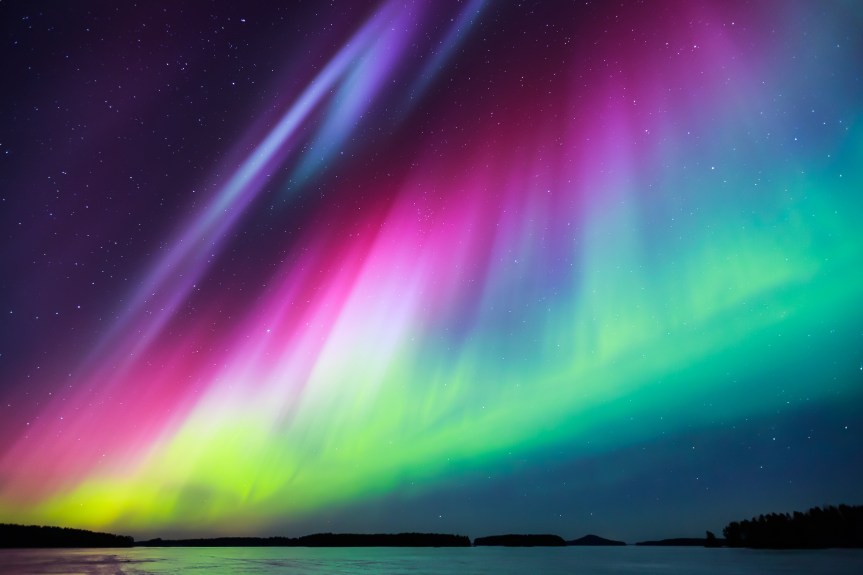
Image from internet – lovely aurora borealis (please tell me who made this)

The eclipse has passed, but the week of 17 to 23 August is not a return to ordinary skies. We are now living in the aftermath of the 12 August Leo solar eclipse, with the newly changed Aquarius–Leo nodal axis still setting the direction and the Sun completing its passage through Leo before entering Virgo on 23 August. Mercury and Jupiter remain together in Leo, carrying forward the great question of the eclipse: what kind of leadership, creativity and collective future are we actually prepared to build? Pluto is retrograde in Aquarius and has now gone out of bounds, adding an unusually powerful, unruly quality to the transformation of collective systems, while Uranus in Gemini continues to break open old assumptions about information, communication and intelligence. The eclipse was the fulcrum; this week begins the process of living with what it revealed. The Perseids are still active until 24 August, although their peak has passed, so Earth is still moving through the debris stream of Swift Tuttle while the sky gradually changes from the darkness of eclipse week towards a waxing Moon.

The physical heavens remain unusually active. A magnetic filament erupted from the Sun on 14 August and launched a CME towards Earth, with models predicting a glancing encounter around 17 August and possible G1 geomagnetic storm conditions; the Met Office likewise expects CME arrival on the 17th, followed from the 18th by coronal hole high speed solar winds. This means the week opens with Earth still inside a disturbed solar environment, with the possibility of auroral activity at northern latitudes as the solar wind changes. Astrologically, the same layering continues: Saturn retrograde in Aries asks us to reconsider what we are building, Neptune retrograde in Aries dissolves old certainties, Pluto retrograde in Aquarius turns the collective transformation inward, and Chiron retrograde in Taurus keeps returning us to the wound of land, resources and physical security. Mars in Cancer brings the question of protection, water, home and nourishment into the foreground. On 17 August Mercury trines Saturn and Venus sextiles Jupiter, offering something the eclipse week lacked: a chance to give the new vision structure, while Venus in Libra seeks cooperation rather than conflict.

Then comes the grounding. The First Quarter Moon arrives on 20 August and passes through Scorpio before moving into Sagittarius, bringing increasing emotional intensity followed by a need to understand the larger picture; on 19–20 August it passes close to Antares, the red heart of Scorpius, while later on 22–23 August it moves through Sagittarius towards the centre of the Milky Way. On 21 August Venus opposes retrograde Saturn, asking what relationships, agreements and values can actually withstand reality, while the Sun approaches the end of Leo and finally enters Virgo on 23 August, bringing the enormous symbolic fire of the eclipse down into practical earthly work. This is the crucial movement now: from revelation to application, from seeing the future to doing something about it. The world may still feel suspended between what is ending and what has not yet fully arrived, but the direction is changing. The eclipse opened the door; this week asks us to walk through it, take stock of what remains, and begin the painstaking work of making the new world habitable.
The Eclipse and the Perseids

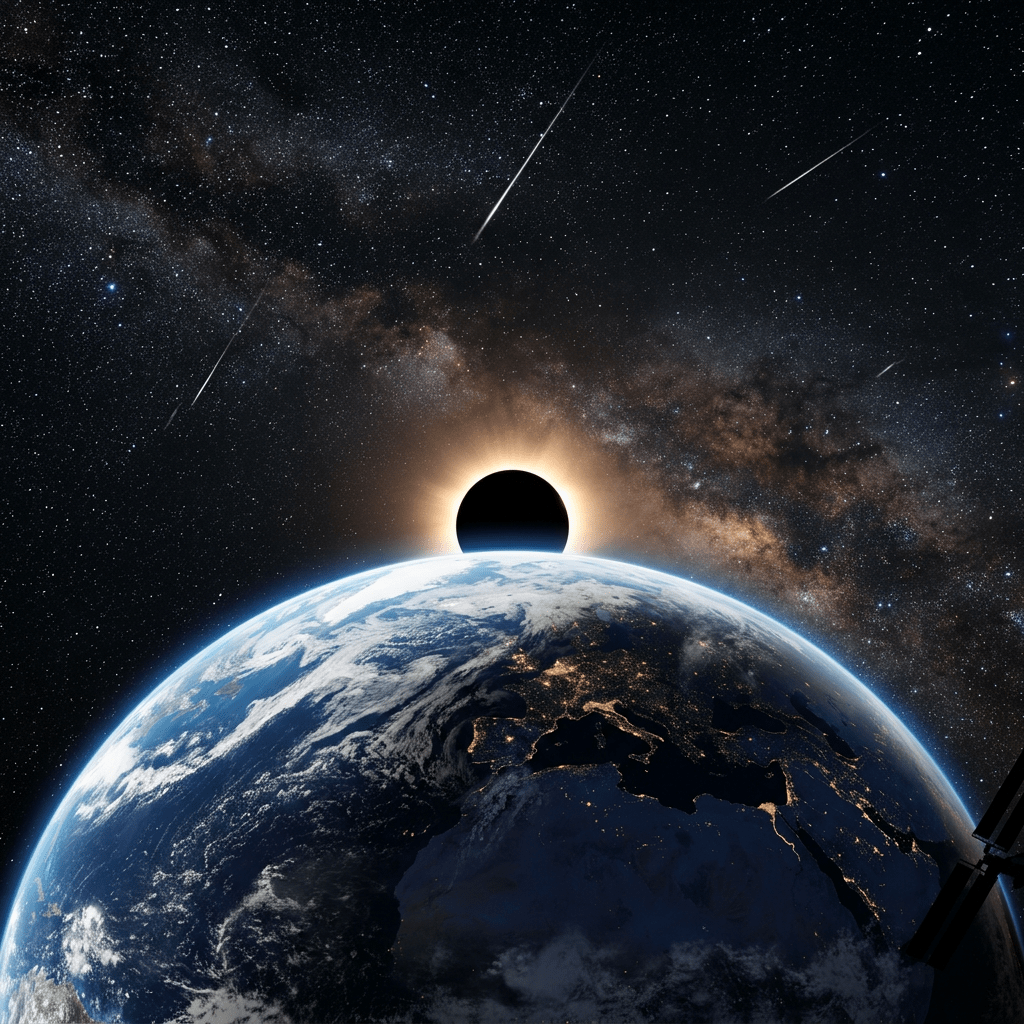
Solar eclipse above Earth with visible stars and meteor streaks

This week we should get the most spectacular skies, not only is the sun showing some volatile activity leading to northern lights, We also have the solar eclipse in Leo, and space itself is very interesting right now as we travel through the Perseid stream

The space we are travelling through is itself also worth distinguishing from the Perseid stream. The Solar System is moving through the local interstellar medium, within the very low-density region surrounding the heliosphere; the heliosphere is continually interacting with that external plasma and magnetic environment while the Sun and planets move through it.
At the same time, Earth is travelling around the Sun at about 30 km/s, carrying us through a much more local stream of material: the Perseid meteoroid trail. The Perseids are not a cloud arriving at Earth from Perseus; Earth is crossing the elongated orbital debris stream of Comet 109P/Swift–Tuttle. The comet’s orbit is highly elongated and retrograde, with an inclination of about 113°, so its debris travels through the Solar System in the opposite direction to the planets.
That makes our encounter unusually fast and nearly head-on, producing the Perseids which enter the atmosphere at roughly 59 km/s.
Around 10–16 August 2026, Earth is moving through the densest part of this debris corridor, with the Perseid peak around 12–13 August, precisely alongside the solar eclipse. The stream itself is much broader than the visible meteors suggest at roughly 0.1 AU wide, and Earth takes days to cross it, which is why the shower builds before the peak and continues afterwards.
The apparent trajectory is therefore particularly interesting: the particles are travelling along the ancient orbit of Swift–Tuttle, while Earth cuts across that orbit; from Earth they appear to radiate outward from Perseus, but their actual paths through space are almost parallel to the comet’s retrograde trajectory.
So this week we have three different spatial encounters layered together: the Solar System moving through the local interstellar environment, Earth moving through the Sun’s changing solar-wind and magnetic environment, and Earth physically crossing the ancient Swift–Tuttle debris stream. Then the 12 August eclipse occurs at the centre of that passage, with the darkened sky making the Perseid encounter unusually visible. That is quite an extraordinary piece of celestial geometry for the Geo-Zenith picture.
It goes almost without saying that every single one of us will be affected by this – everyone.

The Perseid Meteor Shower

Every year around mid-August, Earth plunges through a stream of debris shed by Comet 109P/Swift–Tuttle. These fragments, mostly no larger than grains of sand, blaze through our atmosphere at around 59 km/s, (that is ‘per second’) becoming the Perseids—one of the most spectacular and reliable annual meteor showers. I have watched for them many times before – I hope it’s a clear night and we can all see them. They are consistent and timely as the Earth’s orbit intersects that cometary trail at nearly the same time and path each year.

Tonight marks the peak of the Perseid meteor shower, with Earth moving through the densest stream of debris from the comet’s tail. These particles ignite in our upper atmosphere, producing up to 100 meteors per hour under ideal conditions – which is spectacular to watch.

But where do we look, I hear you ask? In the constellation Perseus, which lies in the northeastern sky, climbing higher as the night deepens. Instead of staring directly, glance about 40° above the ‘radiant,’ – not directly at the source of the meteors. You can generally see more if you rely on your peripheral vision to catch sight of more meteors across the sky

It’s a cosmic reminder that even dust carries the tale of the ancient wanderers of space, reflected in dazzling, brilliant streaks of light across our skies. So wonder at the wanderer

This celestial spectacle repeats every August because Earth’s orbit reliably intersects the same cometary dust stream – every year unchanged across centuries. The com­et itself loops past Earth about every 133 years; its next close return is estimated in 2126
Lets look up at the marvellous meteor showers tonight – to remind ourselves we live on a planet in space.