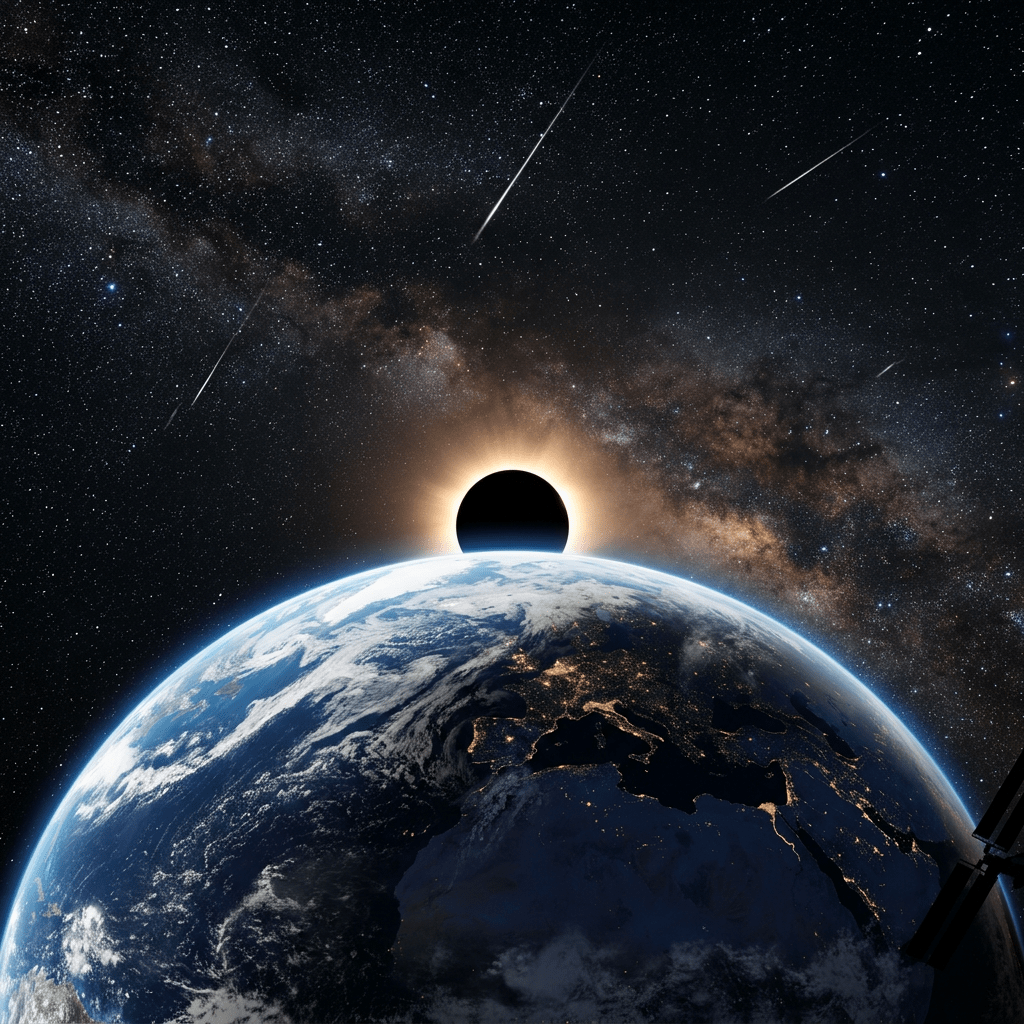
This week we should get the most spectacular skies, not only is the sun showing some volatile activity leading to northern lights, We also have the solar eclipse in Leo, and space itself is very interesting right now as we travel through the Perseid stream
The space we are travelling through is itself also worth distinguishing from the Perseid stream. The Solar System is moving through the local interstellar medium, within the very low-density region surrounding the heliosphere; the heliosphere is continually interacting with that external plasma and magnetic environment while the Sun and planets move through it.
At the same time, Earth is travelling around the Sun at about 30 km/s, carrying us through a much more local stream of material: the Perseid meteoroid trail. The Perseids are not a cloud arriving at Earth from Perseus; Earth is crossing the elongated orbital debris stream of Comet 109P/Swift–Tuttle. The comet’s orbit is highly elongated and retrograde, with an inclination of about 113°, so its debris travels through the Solar System in the opposite direction to the planets.
That makes our encounter unusually fast and nearly head-on, producing the Perseids which enter the atmosphere at roughly 59 km/s.
Around 10–16 August 2026, Earth is moving through the densest part of this debris corridor, with the Perseid peak around 12–13 August, precisely alongside the solar eclipse. The stream itself is much broader than the visible meteors suggest at roughly 0.1 AU wide, and Earth takes days to cross it, which is why the shower builds before the peak and continues afterwards.
The apparent trajectory is therefore particularly interesting: the particles are travelling along the ancient orbit of Swift–Tuttle, while Earth cuts across that orbit; from Earth they appear to radiate outward from Perseus, but their actual paths through space are almost parallel to the comet’s retrograde trajectory.
So this week we have three different spatial encounters layered together: the Solar System moving through the local interstellar environment, Earth moving through the Sun’s changing solar-wind and magnetic environment, and Earth physically crossing the ancient Swift–Tuttle debris stream. Then the 12 August eclipse occurs at the centre of that passage, with the darkened sky making the Perseid encounter unusually visible. That is quite an extraordinary piece of celestial geometry for the Geo-Zenith picture.
It goes almost without saying that every single one of us will be affected by this – everyone.
 ASTROLOGY CRUCIBLE