The Eclipse and the Perseids

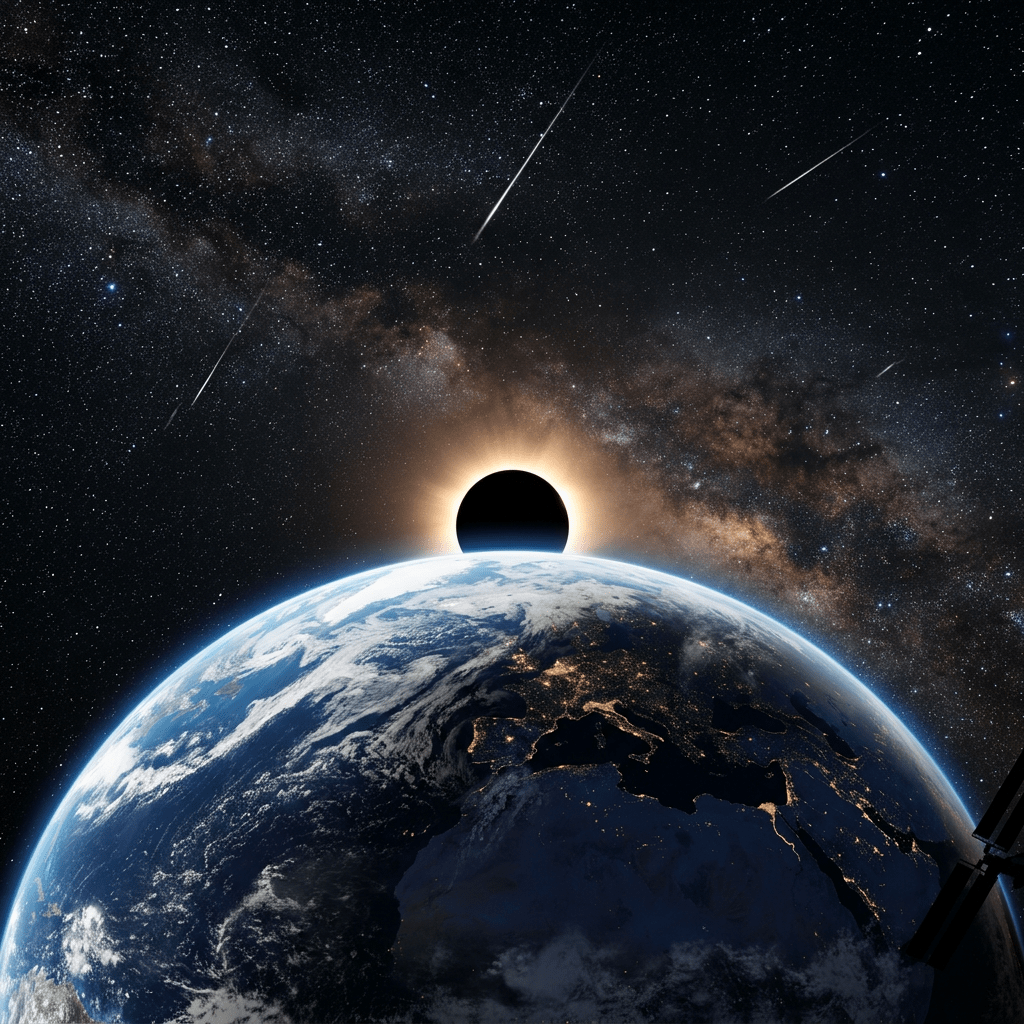
Solar eclipse above Earth with visible stars and meteor streaks

This week we should get the most spectacular skies, not only is the sun showing some volatile activity leading to northern lights, We also have the solar eclipse in Leo, and space itself is very interesting right now as we travel through the Perseid stream

The space we are travelling through is itself also worth distinguishing from the Perseid stream. The Solar System is moving through the local interstellar medium, within the very low-density region surrounding the heliosphere; the heliosphere is continually interacting with that external plasma and magnetic environment while the Sun and planets move through it.
At the same time, Earth is travelling around the Sun at about 30 km/s, carrying us through a much more local stream of material: the Perseid meteoroid trail. The Perseids are not a cloud arriving at Earth from Perseus; Earth is crossing the elongated orbital debris stream of Comet 109P/Swift–Tuttle. The comet’s orbit is highly elongated and retrograde, with an inclination of about 113°, so its debris travels through the Solar System in the opposite direction to the planets.
That makes our encounter unusually fast and nearly head-on, producing the Perseids which enter the atmosphere at roughly 59 km/s.
Around 10–16 August 2026, Earth is moving through the densest part of this debris corridor, with the Perseid peak around 12–13 August, precisely alongside the solar eclipse. The stream itself is much broader than the visible meteors suggest at roughly 0.1 AU wide, and Earth takes days to cross it, which is why the shower builds before the peak and continues afterwards.
The apparent trajectory is therefore particularly interesting: the particles are travelling along the ancient orbit of Swift–Tuttle, while Earth cuts across that orbit; from Earth they appear to radiate outward from Perseus, but their actual paths through space are almost parallel to the comet’s retrograde trajectory.
So this week we have three different spatial encounters layered together: the Solar System moving through the local interstellar environment, Earth moving through the Sun’s changing solar-wind and magnetic environment, and Earth physically crossing the ancient Swift–Tuttle debris stream. Then the 12 August eclipse occurs at the centre of that passage, with the darkened sky making the Perseid encounter unusually visible. That is quite an extraordinary piece of celestial geometry for the Geo-Zenith picture.
It goes almost without saying that every single one of us will be affected by this – everyone.
Solar flares – part one

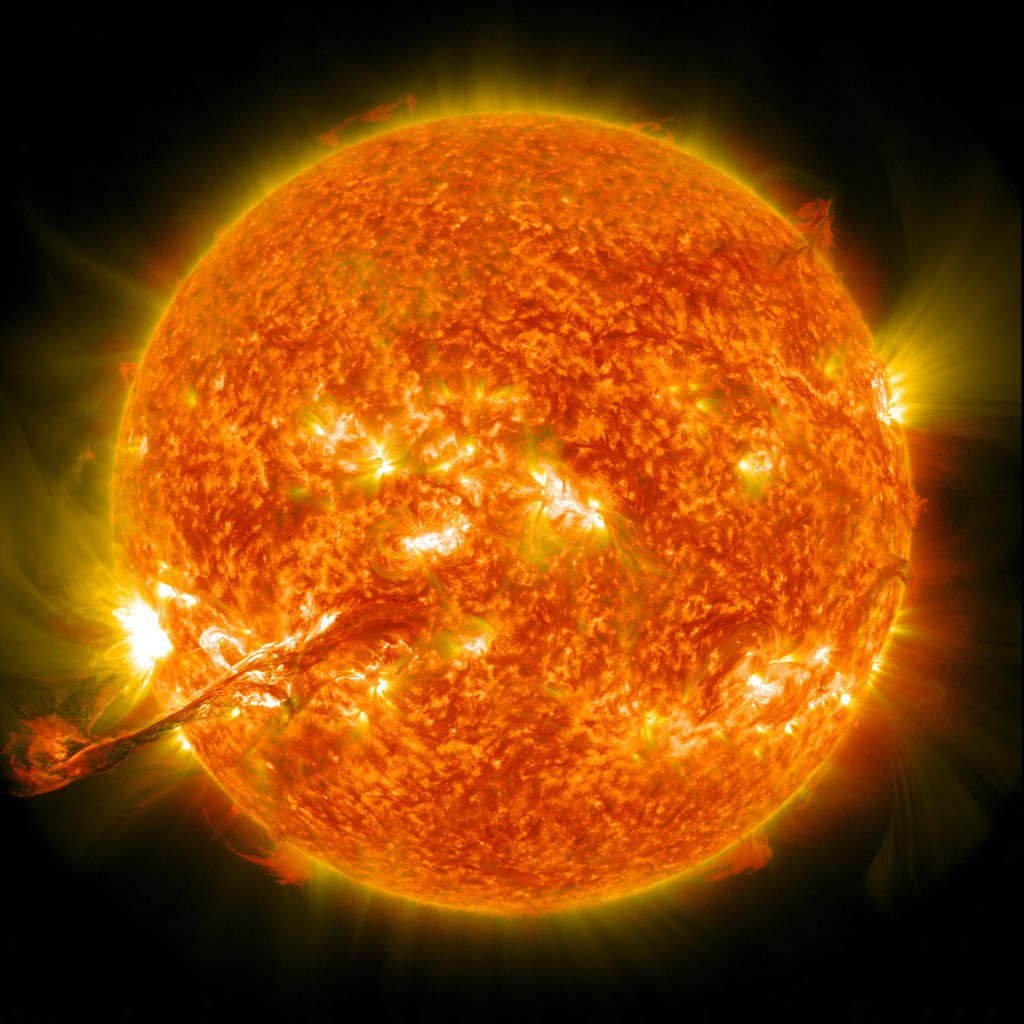
Image by NASA

In the stillness of 1st September 2025, the Sun unleashed a rare and dramatic event  –  two successive coronal mass ejections (CMEs), one chasing and engulfing the other. This cosmic “cannibal storm” has now reached Earth, and set the stage for a night of vibrant aurora and subtle terrestrial reverberations. With a bit of luck you would have seen some of it. A G2–G3 (possibly G4) geomagnetic storm

This twin-edged solar outburst was born from sunspot AR4199, which erupted on August 30. The storm reached our planet September 1st into the early hours of September 2

NOAA’s Space Weather Prediction Centre issued a Moderate to Strong geomagnetic storm watch (G2–G3), with the potential for G4-level severity – a threshold that brings rare intensity to the night’s sky.

Astronomically speaking, the CME’s arrival compressed Earth’s day-side magnetosphere and extended its magnetotail – an energetic dance of magnetic reconnection that channels many terawatts of energy into the upper atmosphere. These induced currents ripple through the ionosphere, increasing electron density particularly in high latitudes. The ionospheric plasma becomes a stage for auroral light, and HF radio waves can experience absorption, leading to shortwave communication blackouts.
Even at Earth’s surface, geomagnetically induced currents (GICs) stir in pipelines and power grids. While today’s storm did not cause widespread interference, it nudged our technological veins all the same.

Aside from aurora borealis, any geomagnetic storm may – at least modestly – disrupt satellites, tweak HF radio propagation, and momentarily ruffle GPS accuracy. Satellite operators and power grid managers are always notified to brace for these episodic fluctuations.

This solar activity arrived amid Solar Cycle 25’s growing outbursts. As this solar activity surges, the Sun’s tangled magnetism repels cosmic rays, leading to a measured drop in atmospheric radiation.

And though the Carrington Event of September 1859 remains unmatched in historical ferocity, the current “cannibal storm” offers a fresh reminder of our star’s dynamic temperament – capable of disrupting terrestrial systems or, if conditions are right, painting the night sky in shimmering colours – which are a sight worth going to see if you can.

Earth is currently experiencing elevated solar activity. Coronal mass ejections (CMEs) and solar flares have increased in frequency, impacting the magnetosphere with geomagnetic storms. These disturbances compress the magnetosphere, drive currents in the ionosphere, and subtly alter Earth’s electromagnetic environment. Plasma bursts from the Sun contribute to these effects, producing variations in the geomagnetic field that can propagate to the surface. Creating sights and events that also effect you, as the human being is a torus of electromagnet balance of the utmost delicacy – as are all living beings.