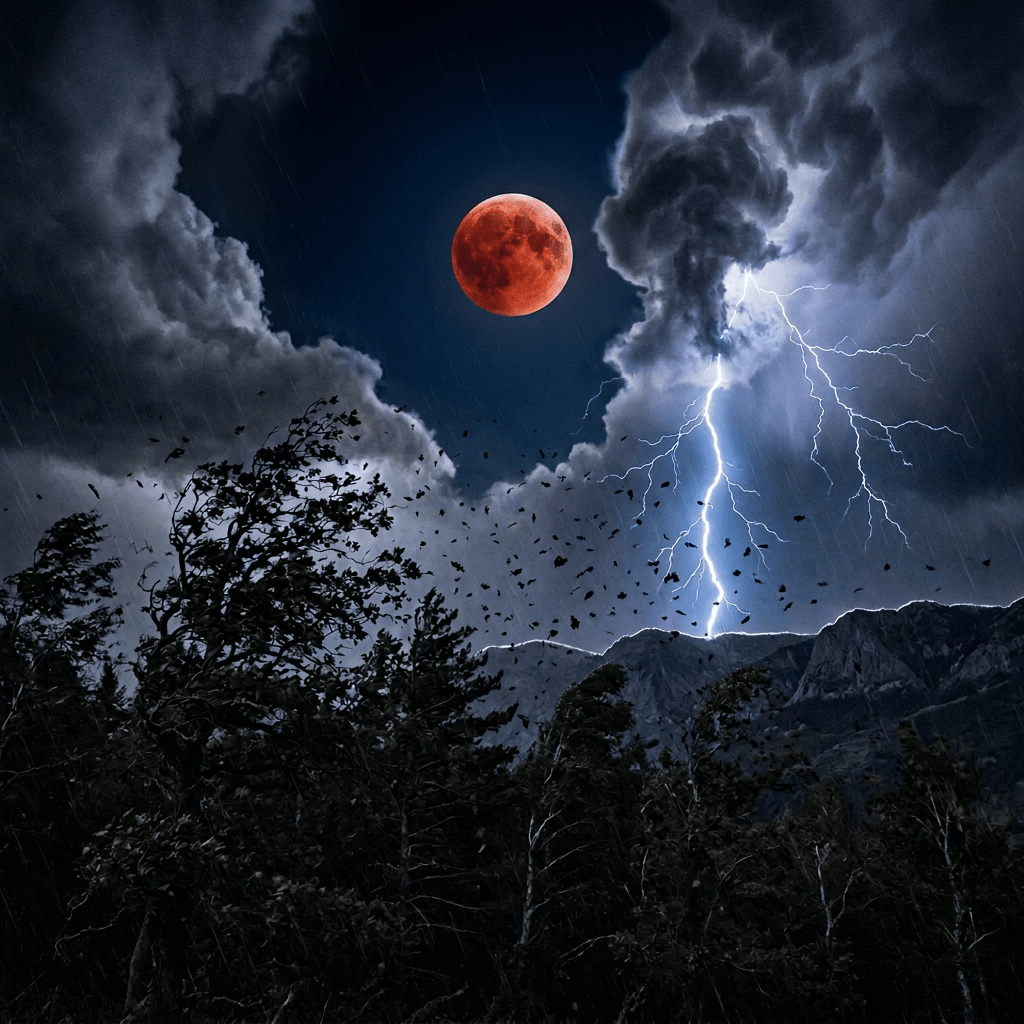
This lunar eclipse is a remarkable threshold, and the astronomy itself gives it unusual weight. At 06:12 CEST on 28 August, Earth places its shadow across the Full Moon, with about 96 percent of the lunar disc entering the darkest part of Earth’s shadow. In tropical astrology the Moon is at 4°51 Pisces opposite the Sun at 4°51 Virgo, with Mercury close to the Sun and Uranus in Gemini squaring the eclipse axis. Pisces, Virgo and Gemini create a powerful pattern of perception, discernment and information. We are living through an extraordinary flood of information, misinformation, revelations and competing realities, while old explanations are increasingly being challenged. Uranus brings disruption and sudden insight, Pisces asks us to listen beyond the obvious, and Virgo demands that what we perceive is examined carefully.
The eclipsed Moon sits almost exactly upon Fomalhaut, one of the four ancient Royal Stars, associated with the Southern Watcher, vision, spiritual perception and the necessity of distinguishing illumination from illusion. This feels particularly significant now. Human beings are not detached observers of Earth but living systems embedded within its electromagnetic, gravitational and environmental fields, while the planet itself is experiencing extremes of heat, drought, fire and sudden inundation. At the same time, people are questioning old political structures, inherited beliefs and the narrow definitions of what constitutes legitimate knowledge. Pisces represents permeability and sensitivity, Virgo discrimination and Gemini the vast information network through which humanity now communicates. The eclipse therefore asks us not simply to acquire more information, but to become better listeners and more discerning perceivers.
Beyond the visible planets, Pluto in Aquarius continues the transformation of collective power and civilisation, while Haumea brings regeneration, Makemake creation and relationship with the living world, Eris the excluded voice demanding recognition, and distant Gonggong the mythology of water and overturned cosmic order. These long orbital bodies add a remarkable mythological layer to the eclipse. The larger story is one of dissolution and regeneration, ecological consequence, changing power structures and the widening of human perception. This does not require us to abandon science; rather, it asks whether science itself can become sufficiently open to investigate the full range of human experience. We may be approaching a period in which intuition, embodied awareness, subtle perception and forms of consciousness previously dismissed are examined with new seriousness. The eclipse marks the closing of a long Pisces cycle and asks humanity to learn the art of listening: neither believing everything nor dismissing everything, but becoming capable of seeing what is actually there.
 ASTROLOGY CRUCIBLE