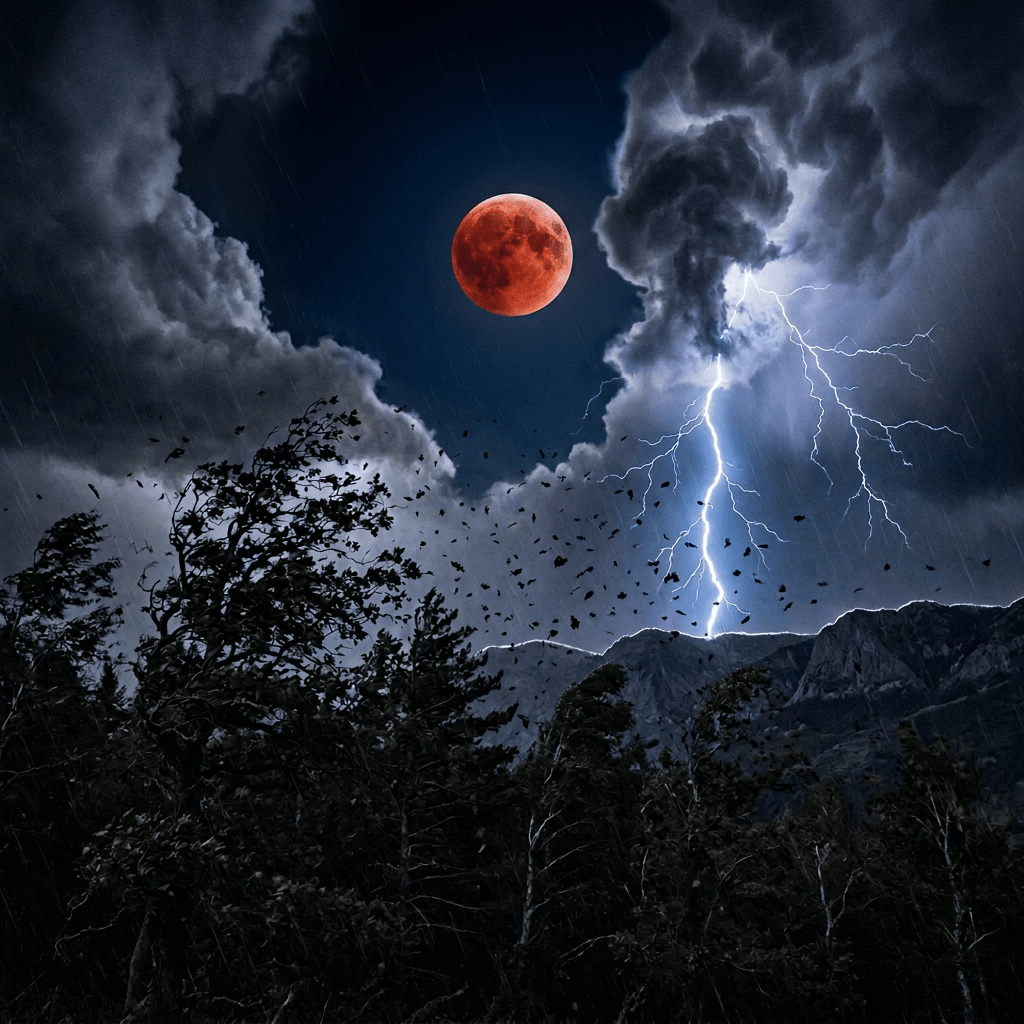
The blood moon

Red moon above storm clouds, lightning, mountains, and windblown trees

This lunar eclipse is a remarkable threshold, and the astronomy itself gives it unusual weight. At 06:12 CEST on 28 August, Earth places its shadow across the Full Moon, with about 96 percent of the lunar disc entering the darkest part of Earth’s shadow. In tropical astrology the Moon is at 4°51 Pisces opposite the Sun at 4°51 Virgo, with Mercury close to the Sun and Uranus in Gemini squaring the eclipse axis. Pisces, Virgo and Gemini create a powerful pattern of perception, discernment and information. We are living through an extraordinary flood of information, misinformation, revelations and competing realities, while old explanations are increasingly being challenged. Uranus brings disruption and sudden insight, Pisces asks us to listen beyond the obvious, and Virgo demands that what we perceive is examined carefully.

The eclipsed Moon sits almost exactly upon Fomalhaut, one of the four ancient Royal Stars, associated with the Southern Watcher, vision, spiritual perception and the necessity of distinguishing illumination from illusion. This feels particularly significant now. Human beings are not detached observers of Earth but living systems embedded within its electromagnetic, gravitational and environmental fields, while the planet itself is experiencing extremes of heat, drought, fire and sudden inundation. At the same time, people are questioning old political structures, inherited beliefs and the narrow definitions of what constitutes legitimate knowledge. Pisces represents permeability and sensitivity, Virgo discrimination and Gemini the vast information network through which humanity now communicates. The eclipse therefore asks us not simply to acquire more information, but to become better listeners and more discerning perceivers.

Beyond the visible planets, Pluto in Aquarius continues the transformation of collective power and civilisation, while Haumea brings regeneration, Makemake creation and relationship with the living world, Eris the excluded voice demanding recognition, and distant Gonggong the mythology of water and overturned cosmic order. These long orbital bodies add a remarkable mythological layer to the eclipse. The larger story is one of dissolution and regeneration, ecological consequence, changing power structures and the widening of human perception. This does not require us to abandon science; rather, it asks whether science itself can become sufficiently open to investigate the full range of human experience. We may be approaching a period in which intuition, embodied awareness, subtle perception and forms of consciousness previously dismissed are examined with new seriousness. The eclipse marks the closing of a long Pisces cycle and asks humanity to learn the art of listening: neither believing everything nor dismissing everything, but becoming capable of seeing what is actually there.
The week of 8–14 September 2025

This week opens in the shadow of a total lunar eclipse, a long and emotionally charged Blood Moon that left its mark across much of the world. Eclipses act as turning points, and this one has surfaced deep reservoirs of feeling—grief, longing, unfinished business—and placed them into the collective arena. The coming days are not about gradual adjustment but about sudden closures, reckonings, and visible acts of care or defiance. The eclipse energy insists that what has been hidden can no longer be ignored.

With the Sun still travelling through Virgo, the attention turns to systems, details, and competence. Expect scrutiny of how institutions, governments, and aid networks respond to crises already unfolding—from natural disasters to conflicts that have left populations displaced. Where systems function, relief and order can be restored swiftly; where they fail, the eclipse magnifies the gap, forcing leaders to answer questions they would rather defer. This is a week when logistics and accountability matter more than rhetoric.

On the geopolitical stage, the eclipse sharpens signals. We may see sudden gestures—temporary ceasefires, humanitarian corridors, symbolic treaties—emerging as leaders attempt to ride the emotional current. Equally, some actors may take advantage of distraction to escalate conflicts. Both patterns are consistent with eclipse energy: revelation, disruption, and the attempt to seize narrative control. Nothing settled this week will be final, but the moves made now will carry weight in the weeks ahead as the solar eclipse and equinox approach.

For individuals, the advice is both practical and simple: act where you can make a tangible difference. Donations, direct aid, or local acts of solidarity will cut through more effectively than abstract words. On a personal level, the eclipse’s charge is best handled through ritual, memory work, and communal spaces that acknowledge both loss and resilience. This week is heavy, but it is also fertile ground for repair—private or public, individual or collective.

The astrology of the Lunar eclipse

The total lunar eclipse of 7 September 2025 falls at about 15° Pisces, a mutable water sign that dissolves boundaries and exposes the porousness between fact and imagination. Astronomically this is a deep eclipse, with the Moon fully immersed in Earth’s shadow for over an hour, visible across Europe, Africa, Asia and Australia. In astrology, eclipses on this axis tend to signal endings and closures, particularly of emotional, spiritual, or collective narratives that have outlived their function. Pisces colours the event with themes of compassion, sacrifice, and the pull between dream and disillusion.

What sharpens the tone of this eclipse is Saturn’s strong involvement in Pisces alongside it. Saturn insists on accountability and structure, so the otherwise fluid Piscean themes are given a stern, even karmic edge. Loose boundaries and sentimental evasions will not hold; decisions about what to release or where to draw a line may feel final, and the consequences tangible. In practice, this looks like institutions of care, religion, art, and humanitarian work facing calls to take responsibility, while individuals with mutable sign placements between 13° and 17° will be asked to let go of outdated roles and commitments.

Uranus adds another layer by stationing retrograde just the day before. This sudden electric jolt can bring surprises, reversals, or revelations around information and technology, transforming the eclipse from an inner tide into external disruption. It suggests that what dissolves in Pisces may swiftly be exposed in public space, through leaks, shifts in networks, or shocks to systems we assumed were stable. The combination of Saturn’s gravity with Uranus’s shocks makes this eclipse a threshold moment: endings that are not just private but structural, with wider collective reverberations.

For personal and collective navigation, the eclipse marks a point of closure and clarity. It is a moment to acknowledge what has run its course, to take responsibility for boundaries, and to prepare for sudden adjustments. The overarching lesson is that compassion without structure becomes enabling, and structure without compassion becomes brittle. In the weeks and months after, as the dust of Uranus’s reversals settles, the Saturn-Pisces demand will remain: to bring integrity, accountability and clarity into those spaces of imagination and empathy where boundaries have long blurred

The lunar eclipse

image by Martin Adams
Image by Martin Adams

On the night of September 7, 2025, Earth’s only satellite, our moon, will glide into alignment with the Sun and our planet, entering a grand total lunar eclipse. As Earth casts its darkest shadow – the umbra – fully across the lunar surface, the full September Moon will take on a haunting, coppery-red glow, the phenomenon is commonly known as a “Blood Moon.” Unlike a solar eclipse that flashes by in minutes, this lunar event will unfold with dignified duration and atmospheric depth, inviting quiet contemplation rather than breathless exclamation.

The eclipse will commence with the penumbral phase as Earth’s faint outer shadow begins to dim the Moon, starting around 15:28 UTC. Gradually moving deeper, the Moon enters partial eclipse a little before 16:27 UTC, until at roughly 17:30 UTC, totality begins. At this moment, the Moon will be fully immersed in Earth’s umbra and its glowing face transformed by sunlight filtered through our atmosphere. This total phase will reach its apex at approximately 18:11 UTC and will linger for about eighty-three minutes, finally ending near 18:52 UTC, as the Moon emerges and begins the reverse shadow dance—partial eclipse until about 19:56 UTC and penumbral retreat completed by 20:55 UTC.

This eclipse is striking not only for its beauty but also for its astronomical rhythm. It belongs to the venerable Saros series 128, being the 41st of seventy-one eclipses, each spaced by approximately 18 years. It occurs when the full Moon lies near the ascending node of its orbit, slightly southward, with a gamma value of about –0.275, denoting the Moon passing somewhat south of the central line of Earth’s shadow. Its umbral magnitude, roughly 1.36, indicates that the Moon delves well into the shadow’s core.

In practical terms, this eclipse will be observed fully across vast expanses of our planet. Viewers in Europe, Africa, Asia, and Australia will witness the entire spectacle, while those in the Americas will unfortunately miss it altogether – this is an Eclipse of the Eastern Hemisphere. Astronomical visibility is generous: around 85 percent of the global population will see at least part of the total phase, with roughly 76 percent able to catch the entirety of totality, and about 60 percent afforded the full run of every phase from beginning to end.

For observers, the sight will be marvelously safe and accessible – no special eyewear is needed, unlike solar eclipses. With clear Eastern horizons, one might witness the waning silver face of the Moon darken gently and then deepen into burnished red as if glowing from within, before slowly emerging again into ordinary twilight.

And as an astronomical encore, this cosmic choreography is framed by an eclipse season: two weeks later, on September 21, 2025, Earth will experience a partial solar eclipse, neatly bookending the lunar event