The week 22nd – 28th September 2025

Forced balance or good choices?

Firstly I apologise for my timing – but I will continue. The week of 22–28 September 2025 unfolds under the heavy shadow of the 21 September partial lunar eclipse and the 22 September equinox, both of which continue to reverberate through the planetary field. Astronomically, the Sun now sits at 0° Libra, balanced at the celestial equator, while the Moon moves from late Aries into Taurus, grounding the volatility of the eclipse’s final ripples. Jupiter retrograde at 27° Gemini forms a tightening square to Saturn at 27° Pisces, a clash of truth and consequence that presses against global narratives. Uranus holds a stubborn retrograde at 27° Taurus, edging closer to the Pleiades and stirring tectonic, financial, and ecological unrest. Mercury, now direct in Virgo, forms an applying trine to Pluto in Capricorn, sharpening analysis and unearthing the buried logic of crises. This is a sky of correction, where the equinox’s perfect balance exposes the crooked scaffolding of human systems.

Culturally, this alignment speaks of fragile equilibrium amid escalating upheaval. News cycles this week are dominated by worsening famines in East Africa, a grinding war in Eastern Europe, and the slow-motion genocide accusations emerging from conflict zones in the Middle East. The Libra Sun demands diplomacy, but Saturn in Pisces undercuts illusions, forcing recognition of moral failures and the collapse of once-comforting fictions. The Jupiter–Saturn square is the signature of treaties tested, of laws strained to breaking point, and of propaganda meeting the cold geometry of facts. This is a week when rhetoric meets the hard mathematics of survival, and when balance is not compromise but the exact measurement of what remains.

Emotionally, the eclipse continues to pull at the psychic tide. Lunar eclipses are always disclosures, and this one—occurring just hours before the equinox—magnifies the sensation of a collective threshold. Individuals may feel an oscillation between paralysis and decisive clarity, as if personal choices carry the weight of planetary consequence. Uranus near the Pleiades electrifies the nervous system, creating sudden awakenings and flashes of insight that can destabilise old habits. Venus in Leo opposing Neptune in Pisces adds an undertow of longing, a bittersweet recognition of beauty in a world on fire, while Mars in Cancer drives protective instincts, especially around home and kin.

The Geo-Zenith reading therefore frames this week as a hinge in the long cycle of 2025, a moment when celestial balance demands terrestrial reckoning. The equinox invites measured reorientation, yet the eclipse refuses complacency. Jupiter’s retrograde square to Saturn insists on systemic correction, whether in finance, food distribution, or governance. For those attuned to the deeper harmonics, this is not merely another crisis week but a visible cross-section of the planetary story: a sky of symmetrical light exposing the crookedness below, reminding humanity that equilibrium is never static but a discipline continually earned.
The week 15th – 21st September 2025

The Geo-Zenith forecast for the week of 15–21 September 2025: the week sits inside a tight eclipse season whose mechanical centre is the partial solar eclipse on 21 September. Astronomically that new-moon/eclipse takes place across the South Pacific and registers as a deep partial (greatest eclipse ≈ 19:43–19:55 UTC), so while it will not be widely visible across Europe it nevertheless marks a global nodal reset in the ecliptic that tightens polarities and accelerates endings and new starts. Practically, treat the 21st as a deadline energy: projects, narratives and reputations that have been simmering will either be closed down or forced into a new, visible form around that date.

Above and beneath that focal eclipse you have a distinctly Virgoan foreground: the Sun and Mercury remain in Virgo for this week, emphasising classification, repair and rhetoric that must be serviceable rather than pretty. That placement privileges tidy records, inventories and the practical re-coding of what is useful; Mercury in Virgo will be busy reducing myth to checklist, which makes it an excellent week for editing, publishing clear timelines or compiling evidence rather than chasing grand narratives. Use the Virgoan window to file what the eclipse will later reconfigure; the ephemerides show the Sun and Mercury firmly engaged in Earth-sign work through this interval.

There is an undercurrent of Uranian shock and ancestral imagery leftover from the recent Moon–Pleiades appulse (12 September) and Uranus lingering in the Taurus sector nearby. The literal sky event — the Moon’s close approach to the Pleiades with Uranus in the same patch of Taurus — seeded the collective with sudden recollections or data-drops about lineage, networks and what counts as “home.” In Geo-Zenith terms that combination reads as old loyalties being contacted by an outside intelligence: expect unexpected disclosures about origins, sudden returns of archival material, or technical leaks that reshape how a family or institution tells its story.

How to work with this week: log and date everything you or others publish between the 15th and the 21st and treat the 21st as a cut-off for structural decisions. Keep language precise and auditable — Mercury in Virgo rewards plain records; avoid speculative grandiosity. If something abrupt lands (Uranus-style) don’t treat it as the whole story; file it, cross-check against older records and let the eclipse purge what’s built on poor documentation. For deeper context, the richer, longer-form takes from experienced technical astrologers (the Astrology Podcast and Bernadette Brady’s eclipse analyses) are the kind of sources worth consulting when you want methodical, layered readings rather than headline horoscopes.

To move through this week well: keep a journal; mark the moments of deep insight or discomfort, especially around the middle (17-19) and on the 21st. Before acting, wait for clarity—let the eclipse close the chapter cleanly. Ground yourself through daily rituals, practical service, and honest inner listening. In that space you’ll cross the threshold not just changed, but more truly aligned.

The eclipse tunnel

The eclipse tunnel opening between the lunar and solar eclipses of September 2025 is not a flat stretch of time but a shifting corridor, alive with subtle alterations in tone and emphasis as the planets move against one another. The period from the 9th to the 20th is marked by a sense of cleansing, of stripping down to essentials, a necessary release before the charged new beginning of the solar eclipse on the 21st. The signature is unmistakably emotional, woven from the interplay of Moon transits, the languid pressure of retrograde outer planets, and the gnawing tension of the nodal axis strung tight between Leo and Aquarius.

At the start of the tunnel, the Moon’s contact with Saturn and Neptune in Pisces draws a veil across collective consciousness. Saturn retrograde lends weight, as though every feeling must first be tested against some karmic rubric, while Neptune retrograde dissolves boundaries, allowing old griefs and disillusions to seep through. This is the “heavy water” stage of the tunnel: the sensation of wading through ancestral memory and collective sorrow. Nations already burdened by water crises or institutional breakdowns — South Asia during monsoon season, island states grappling with climate-linked inundation — are especially likely to feel the mirrored weight of this Piscean emphasis. On the personal level, the task is to allow the tides to wash away false certainties without rushing to replace them.

As the days progress, the Moon moves on to encounter Mars in Virgo, sharpening emotional responses into critique, precision, and sometimes irritability. The tunnel here takes on a forensic quality: flaws and inefficiencies are exposed, both within personal lives and within public structures. We may expect heightened discourse around healthcare, logistics, and the small mechanisms by which societies either function smoothly or grind down. In Europe, with its bureaucratic intricacies and recent strains on supply chains, this passage may coincide with further arguments over systems of management, echoing Mars’ relentless insistence on detail. For individuals, it is the moment to trim, to edit, to discard the excess that clutters both mind and daily routine.

Midway through, the Moon’s sweep across Aries and Taurus stirs the latent power of Uranus retrograde. Here the tunnel takes on its crackling, unstable quality: emotions lurch, freedoms are craved, disruptions slip through cracks. Retrograde Uranus is not the open revolution but the rehearsal, the draft explosion in the inner world before the outer detonation. Collectively, this can play out in technological uncertainty and unexpected reversals of progress, especially in regions tied to rapid innovation — the United States and East Asia may feel this jolt in their economic or digital sectors. The key lesson is that stability is a façade; within the tunnel, we are asked to embrace the instability as a sign that outdated structures are ready to be shed.

Towards the close of the tunnel, the Moon conjoins Jupiter in Gemini. This is the restless, swollen stage: optimism brims but lacks containment. Ideas multiply, words spill out, promises balloon larger than the means to fulfil them. Here the square to the Leo Sun still active in the nodal zone sharpens the tension — belief against fact, inspiration against pride. It can be a time of misjudgement on the world stage, when leaders may overstate or overreach. Watch for regions with fragile political coalitions — Latin America, parts of Africa — where rhetoric may climb beyond pragmatic capacity. Yet on the personal plane, this same aspect can offer a glimpse of the broader horizon that awaits on the other side of the solar eclipse, provided one does not take the inflation too literally.

Throughout the entire tunnel, the drag of Pluto retrograde in Capricorn and Saturn retrograde in Pisces provides the shadow undertow. These are not days for launching grand schemes, but for purging — the political scandals, the financial reckonings, the personal decisions to abandon roles that no longer fit. The tunnel functions as a crucible in which the unnecessary, the redundant, the false is burnt off. It is emotional, yes, but not chaotic for its own sake; the purpose is purification, so that when the solar eclipse arrives, we can step into the new chapter unencumbered.

The global mood during these days will be one of intensity and reckoning. Where water, institutions, and identity are already fragile, pressure will build most visibly. Where personal pride and collective necessity are at odds, expect tension. And where outdated forms cling to life, the eclipse tunnel demands their release. It is not a comfortable passage, but it is a clarifying one. By the 20th, if the work has been done, much of the rubbish — both emotional and structural — will have been stripped away, leaving a sharper edge for the solar eclipse to cut cleanly into what must come next.

The lunar eclipse

image by Martin Adams
Image by Martin Adams

On the night of September 7, 2025, Earth’s only satellite, our moon, will glide into alignment with the Sun and our planet, entering a grand total lunar eclipse. As Earth casts its darkest shadow – the umbra – fully across the lunar surface, the full September Moon will take on a haunting, coppery-red glow, the phenomenon is commonly known as a “Blood Moon.” Unlike a solar eclipse that flashes by in minutes, this lunar event will unfold with dignified duration and atmospheric depth, inviting quiet contemplation rather than breathless exclamation.

The eclipse will commence with the penumbral phase as Earth’s faint outer shadow begins to dim the Moon, starting around 15:28 UTC. Gradually moving deeper, the Moon enters partial eclipse a little before 16:27 UTC, until at roughly 17:30 UTC, totality begins. At this moment, the Moon will be fully immersed in Earth’s umbra and its glowing face transformed by sunlight filtered through our atmosphere. This total phase will reach its apex at approximately 18:11 UTC and will linger for about eighty-three minutes, finally ending near 18:52 UTC, as the Moon emerges and begins the reverse shadow dance—partial eclipse until about 19:56 UTC and penumbral retreat completed by 20:55 UTC.

This eclipse is striking not only for its beauty but also for its astronomical rhythm. It belongs to the venerable Saros series 128, being the 41st of seventy-one eclipses, each spaced by approximately 18 years. It occurs when the full Moon lies near the ascending node of its orbit, slightly southward, with a gamma value of about –0.275, denoting the Moon passing somewhat south of the central line of Earth’s shadow. Its umbral magnitude, roughly 1.36, indicates that the Moon delves well into the shadow’s core.

In practical terms, this eclipse will be observed fully across vast expanses of our planet. Viewers in Europe, Africa, Asia, and Australia will witness the entire spectacle, while those in the Americas will unfortunately miss it altogether – this is an Eclipse of the Eastern Hemisphere. Astronomical visibility is generous: around 85 percent of the global population will see at least part of the total phase, with roughly 76 percent able to catch the entirety of totality, and about 60 percent afforded the full run of every phase from beginning to end.

For observers, the sight will be marvelously safe and accessible – no special eyewear is needed, unlike solar eclipses. With clear Eastern horizons, one might witness the waning silver face of the Moon darken gently and then deepen into burnished red as if glowing from within, before slowly emerging again into ordinary twilight.

And as an astronomical encore, this cosmic choreography is framed by an eclipse season: two weeks later, on September 21, 2025, Earth will experience a partial solar eclipse, neatly bookending the lunar event

Solar flares – part two

The human brain is sensitive to electromagnetic fluctuations, particularly in the 0.5–40 Hz range of natural brainwave activity (delta through gamma). Piezoelectric-like calcite microcrystals in the pineal gland transduce environmental electromagnetic signals into electrical or chemical responses, influencing circadian rhythms, hormone production, and thus also cognitive or emotional states. While the effects are subtle, they are measurable under controlled conditions and explain some behavioural or mood changes during geomagnetic disturbances.

Researchers note that periods of heightened solar activity correlate with shifts in collective energy, decision-making, and societal tension. Astrologers similarly interpret strong solar events as times of increased emotional volatility and sensitivity, both individually and collectively. Individual responses vary, but global geomagnetic shifts appear to align with periods of systemic stress, unusual weather patterns, or heightened awareness.

Astronomers, space agencies, and observatories monitoring the Sun emphasise that solar events interact with Earth’s magnetic field, affecting satellite operations, communications, and navigation systems. When combined with ongoing seismic, volcanic, and extreme weather activity, there is a complex network of environmental signals to which humans are subtly attuned, both physiologically and behaviourally. As we are also electromagnetic beings, having an, aura or electromagnetic field.

All solar activity produces measurable geomagnetic effects that influence brainwave patterns, pineal gland activity, and human emotional states. Astrological and scientific observations converge on the conclusion that these periods of heightened solar activity are associated with heightened sensitivity and shifts in collective behaviour. So, there is change happening now during these extreme solar conditions. We can all feel it, we can see it, we know – and soon we will have the eclipse season, which will truly be noticeable events – both inner and outer.

Solar flares – part one

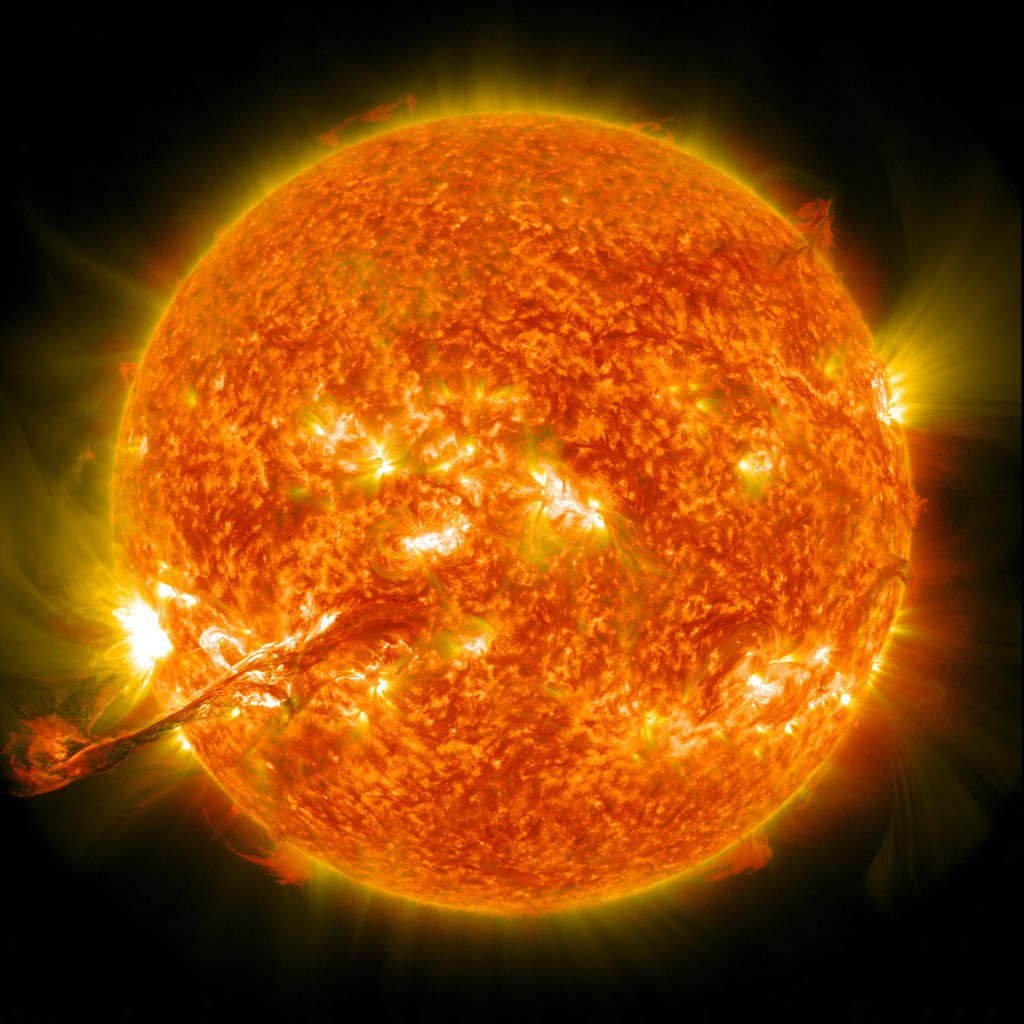
Image by NASA

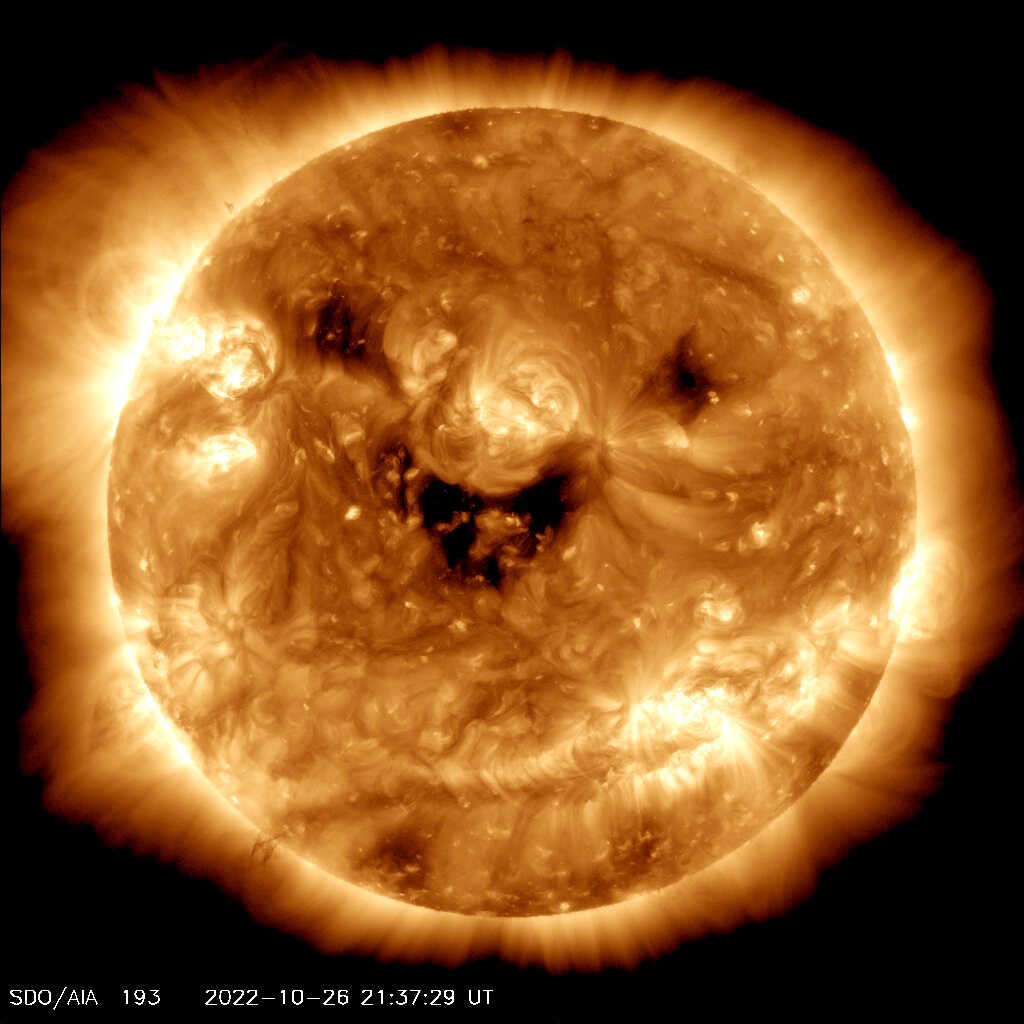
In the stillness of 1st September 2025, the Sun unleashed a rare and dramatic event  –  two successive coronal mass ejections (CMEs), one chasing and engulfing the other. This cosmic “cannibal storm” has now reached Earth, and set the stage for a night of vibrant aurora and subtle terrestrial reverberations. With a bit of luck you would have seen some of it. A G2–G3 (possibly G4) geomagnetic storm

This twin-edged solar outburst was born from sunspot AR4199, which erupted on August 30. The storm reached our planet September 1st into the early hours of September 2

NOAA’s Space Weather Prediction Centre issued a Moderate to Strong geomagnetic storm watch (G2–G3), with the potential for G4-level severity – a threshold that brings rare intensity to the night’s sky.

Astronomically speaking, the CME’s arrival compressed Earth’s day-side magnetosphere and extended its magnetotail – an energetic dance of magnetic reconnection that channels many terawatts of energy into the upper atmosphere. These induced currents ripple through the ionosphere, increasing electron density particularly in high latitudes. The ionospheric plasma becomes a stage for auroral light, and HF radio waves can experience absorption, leading to shortwave communication blackouts.
Even at Earth’s surface, geomagnetically induced currents (GICs) stir in pipelines and power grids. While today’s storm did not cause widespread interference, it nudged our technological veins all the same.

Aside from aurora borealis, any geomagnetic storm may – at least modestly – disrupt satellites, tweak HF radio propagation, and momentarily ruffle GPS accuracy. Satellite operators and power grid managers are always notified to brace for these episodic fluctuations.

This solar activity arrived amid Solar Cycle 25’s growing outbursts. As this solar activity surges, the Sun’s tangled magnetism repels cosmic rays, leading to a measured drop in atmospheric radiation.

And though the Carrington Event of September 1859 remains unmatched in historical ferocity, the current “cannibal storm” offers a fresh reminder of our star’s dynamic temperament – capable of disrupting terrestrial systems or, if conditions are right, painting the night sky in shimmering colours – which are a sight worth going to see if you can.

Earth is currently experiencing elevated solar activity. Coronal mass ejections (CMEs) and solar flares have increased in frequency, impacting the magnetosphere with geomagnetic storms. These disturbances compress the magnetosphere, drive currents in the ionosphere, and subtly alter Earth’s electromagnetic environment. Plasma bursts from the Sun contribute to these effects, producing variations in the geomagnetic field that can propagate to the surface. Creating sights and events that also effect you, as the human being is a torus of electromagnet balance of the utmost delicacy – as are all living beings.

3I Atlas trajectory

The solar system is being traversed by an interstellar visitor of extraordinary proportions, known as 3I/ATLAS. Unlike the brief flyby of its predecessors, this object moves along a trajectory almost parallel to the ecliptic plane, threading through the inner planets at a retrograde inclination of 175 degrees. Its current velocity is around 58 kilometres per second, accelerating to roughly 68 kilometres per second as it nears perihelion on 29 October 2025. The object is enormous: estimates place its nucleus at 46 to 50 kilometres across, while its coma, rich in carbon dioxide and plasma, already spans nearly 700,000 kilometres which is half the diameter of the Sun! This dusty, electrically charged envelope renders this visitor highly active as it interacts with the solar wind and heliospheric currents, particularly during the heightened activity of our current solar maximum.

This trajectory will take it just above Mars in early October, past the asteroid belt, and later toward Jupiter by March 2026. Along the way, it will traverse the electromagnetic environment of the inner planets and their moons, and subtly influence dwarf planets such as Ceres, Haumea, Makemake, and Eris. Its plasma tail and ionised gases will interact with solar, ultraviolet and X-ray radiation, expanding and energising the coma, while the gravitational and magnetic fields of the planets will shape its outbound trajectory. Though no physical contact is expected with any planetary body, its presence represents a rare moment of systemic resonance, as interstellar material and electromagnetic energy thread through the solar system over the next few months.

From an astrological perspective, the geo-zenith alignments of this period intensify the already volatile planetary currents. September begins with two eclipses – the solar on the 7th and the lunar on the 18th—priming collective awareness and initiating subtle systemic shifts. We will already be aware that change is in the air. The object’s close passage to Mars coincides with a new moon and a superior conjunction with Earth, amplifying perception and reflection on structural and emotional frameworks. Its perihelion near the Sun acts as an energetic fulcrum, enhancing interactions across the Virgo-Pisces axis, while its outbound movement past Jupiter in March resonates with expansion, insight, and recalibration of broader societal and philosophical patterns. Dwarf planets and inner moons act as secondary nodes in this network, subtly modulating the energetic and astro-magnetic interplay. The world will be so changed – as will we.

3I/ATLAS is not just a celestial visitor but a long-time catalyst, threading the solar system with interstellar energy and interacting with both planetary fields and collective consciousness. Its trajectory and electromagnetic presence provide a unique opportunity to observe the intersection of cosmic physics and geo-zenith astrology, a rare alignment of astronomical and systemic resonance that will unfold over the coming months, leaving subtle yet tangible imprints on both our solar environment and our planetary awareness. We may even get more images and readings from our satellites and telescopes – so keep watching.

The sextiles rock!

Today, 15 August 2025, the skies have arranged themselves into a set of sextiles so clean and well-cut you could use them to slice through the wet papier-mâché thinking that currently passes for global leadership. This isn’t one of those vague, sentimental alignments where you “just follow your heart” and hope for the best; these are precision-engineered opportunities. The geometry is crisp, the geo-zenith lines almost surgical, and the entire pattern screams “if you’re going to do something big, do it now, and do it properly.” From London to Lagos, Delhi to Detroit, the planetary lines are whispering the same message: stop dithering, build something worth keeping, and for heaven’s sake, say what you mean.

At the heart of the day is Mercury in Leo sextile Mars in Libra, a combination that turns words into weapons—charming weapons, perhaps, but weapons nonetheless. The geo-zenith for this one is particularly sharp over the Middle East and Central Europe, where diplomacy is already tap-dancing on the edge of sabres. For the rest of us, it’s perfect for declarations that are both creative and impossible to ignore. Layer onto that the Saturn–Uranus sextile stretching across Aries and Gemini: the architectural blueprint for revolution, but without the sloppy idealism. This is the kind of energy you’d want if you were, say, dismantling an obsolete institution and replacing it with something that might actually work before the ice caps finish their slow suicide.

Saturn’s other flirtation, with Pluto, adds the heavy machinery. Pluto is the deep miner, Saturn the construction foreman, and together they’re giving you the green light to tear down the rot and rebuild the bones. The geo-zenith emphasis over the Americas hints that economic and political power games are shifting, and not quietly. Uranus sextile Neptune rounds out the picture with a vision you can actually manifest. It’s the rare “dream plus blueprint” combination, and its zenith through the Pacific suggests the next big leap in tech or environmental policy could come from places currently underestimated. Think less “Silicon Valley” and more “unexpected island nation that just rewrote the rules.”

In real-time terms, these sextiles are a counterpoint to the current parade of crises—wildfires fanned by political hot air, trade disputes dressed up as moral crusades, and a news cycle that somehow manages to be both hysterical and bored. What these aspects offer is focus. They are not the cosmic equivalent of a spa day; they are the kind of conditions that let you negotiate peace treaties, launch major ventures, and pull off strategic coups while everyone else is still refreshing their feeds. This is not the day to quietly tidy your inbox.

If you want to be great under this sky, stop looking for the “right moment” and start acting as if the moment you’ve been waiting for just walked in the door wearing a sign with your name on it. Build with intention, speak with precision, and innovate with the kind of discipline that turns a clever idea into a lasting legacy. The geometry overhead will meet you halfway, but you have to move. Whether you’re launching a new project, a campaign, or a personal transformation, today’s sky isn’t just favourable—it’s an accomplice. Use it.

The void moon

The moon the moon
Though the moon has been right out there – all void of course
the Moon is having a party with all the other planets while the sun is out on it’s own

So everything is a communication, a chat
an aspect
a conjunction
pan psychic party it is – Specially the Venus- Jupiter party –
We can have a bit of fun with that -while we watch the chaos around us.
Launch your ships by lunchtime and we can all sail across the milky way
A lucky aspect

Can’t stop thinking about what the stars are up to
Can’t stop thinking about what all the planets are doing – as they sail across the night sky

Look now pre-dawn
The beautiful view before sunup of Venus and Jupiter – close as they are to Sirius
The star of ancient Egypt, the Nile flood, water, agriculture, the fall of kings and emperors.
Love the astrology, love the astronomy, love the mythology –
I love the night sky, the moon, the milky way, the twinkling stars, the meteors as the his across the night
there and there – look –
and the dawn – as stars make way for the colours of the sky and clouds and
Our beautiful sun

Good morning – enjoy the day everyone!

The line up

The pre – dawn sky today is putting on one of its rare processions, I can see Venus and Jupiter in the east as it’s clear today.  Mercury retrogrades at 4° Leo as the Sun shines at 17° Leo. Hovering in Cancer are Venus at 11° and Jupiter near 13°, Saturn and Neptune retrograde at 1°Aries, Uranus sits stubbornly in Taurus, and Pluto is as we know, in Aquarius at 2° – steady, buried transformation at work. Astronomically, it’s a graceful arc of light and shadow stretching across the heavens. Astrologically, it’s a cosmic mirror held up to show us our uneasy reflection. We are at the beginnings of the end of chaos.

Right now the sky is taut like a stretched cable. At local zeniths, the heavyweight players are glaring down: Mars riding high over eastern Ukraine, its angular dominance feeding both military escalation and political brinkmanship. Saturn, stern and unyielding, is pressing from above over parts of East Africa and the Arabian Peninsula, correlating with the deepening famine reports and resource conflicts there, from Sudan to Gaza. Neptune looms at zenith over the central Pacific, muddling diplomatic waters and fuelling opaque manoeuvres in maritime disputes.

The tighter the Sun – Venus conjunction in Leo becomes, the more it’s shining a light on the world power theatre – which is becoming increasingly unreal – celebrity distraction meets with authoritarian pageantry – while Pluto’s high point over the western US is digging up more financial rot beneath the already creaking economic scaffolding. Jupiter in Gemini, angular over parts of Central Asia, should be a voice of optimism, but in this current square to Saturn it’s like a motivational speaker at a bankruptcy hearing – loud, cheerful, and slightly delusional. It feels all wrong.

It’s grim, yes. But there’s an outlet forming: Uranus in Taurus is breaking the stalemate, pressing at zenith over parts of South America and southern Africa – regions where grassroots movements are forcing genuine reform and land-use innovation. It’s slow, but it’s real. Mercury, also in Leo, is giving airspace to sharp tongues and quick retorts – this is the week to speak up, but with precision, not volume. Time to say exactly what you think – here come the truth tellers. I hope they will be heard above the general din.


Don’t spiral into depression with the newsfeed. The astrology says you’ll burn out fast if you chase every crisis. We can only handle so much, and we want to be able to do something, we want to feel worth something. Pick one thing you can do, you know what you are good at, and show how you want to care – volunteer, donate, teach, write, plant, repair – add your vote, march, dare to protest. It will all count – and actually do it. The personal becomes the planetary when it’s multiplied. Small acts are the only reason humanity has made it this far. A thousand small acts are also how we’ll claw our way out of this mess.

By the end of August, Mercury’s move into Virgo with Jupiter easing the Saturn clampdown will let the air out of the current ‘crisis-inflation.’ This won’t lead us to instant utopia, but we’ll be able to take a proper breath without choking on the headlines.
Trust me, it get’s better – by the eclipse we will see our way through.

AUGUST 2025 FORECAST

The Truth About August 2025:
There is no sugarcoating this cosmic circus

Let’s get real – August isn’t here to pamper you with soft, fluffy vibes, August is not nice.
The geo-zenith skies are a mess of heavyweight cosmic players squaring off in Sagittarius, Capricorn, Aries, and Pisces.
The universe isn’t asking for polite nods; it’s demanding your raw honesty, your deepest reckonings, and your ability to hold discomfort without running for the hills.

Forget the usual horoscopes that tell you “great things are coming.” August is about tearing down old structures – personal, societal, ancestral – that have overstayed their welcome.
It’s about facing the ancestors’ shadows without wincing and wrestling with the planetary chaos that insists on shaking your foundations.
You’ll be pushed to evolve, or frankly, get stuck in the cosmic mud.

The Way Through?
Hold your boundaries but stay open enough to learn hard lessons.
Do the work, but pace yourself. Physical grounding (yes, gardening or a forest walk, fresh air, no excuses) will be your salvation amid all this mental noise.
A sense of humour is vital, keep it close, even if it’s dark, dry, and sarcastic – because you’ll need it.

The Geo-Zenith Realities:

South America’s southern area and East Africa are focal points of energy – so it will hit you harder if you live there.
Ancestral reckoning and transformation won’t just be personal though, they will be global.
Planets cluster in fire and earth signs, so, dear fire signs – do your best. This is driving themes of deep change, ambition, and emotional purging.
This month’s geo-zenith alignments emphasize confronting trauma, releasing old grief, and stepping into your power even when it feels like the world is collapsing. We all feel that it is.

August 2025 General Reading

Expect tension between your desire to push forward and the reality of what must be let go.
The usual distractions won’t work. Humming loudly with your hands over your ears won’t make it go away.
The planet – and the dwarf planets clustered near the galactic centre – call for radical honesty with yourself and others.
No more dodging the messy stuff.

Your ancestors’ voices whisper through the geo – zenith alignments; their unresolved histories influence your personal and collective landscape.
This is a time for ancestral healing.
It is time for acknowledging what’s been buried and finding new ways to carry your lineage forward without repeating old cycles.

Financially and practically, the landscape looks rocky but not impossible.
There’s potential to solidify new foundations, but only if you keep your feet on the ground and your eyes on your long term goals.

In relationships, expect intensity.
Old patterns may resurface in unexpected ways – time for clearing.
Patience is a luxury, but necessary if you want breakthroughs rather than breakdowns.
patience is key.

Bottom line: August demands grit and grace.
It will test your limits and your resolve. But lean into the discomfort – there is no avoiding it anyway –  and that’s where transformation lives.

Dwarf planets

The ever expanding list of dwarf planets are clustered in four major zones – the kuiper belt, the scattered disk, the Sedna belt and the asteroid belt – gone are the days when the asteroid belt was a big deal in Sci-Fi. Today we can track these celestial bodies and see how their mythological characteristics influence the earth together with the planets. This is a new and fascinating area of astronomical and astrological research. Let’s take a look at some of the data we have. Not all of them have been named, many carry numbers – these of course are not used in astrology as the name gives the resonance we need for interpretation.

1. The Pluto Zone – Inner Kuiper Belt and Plutinos

  • Orbital range: ~30–50 AU from the Sun
  • Defining feature: Locked in a 2:3 orbital resonance with Neptune, like Pluto itself.
  • Key named bodies: Pluto, Orcus, Ixion, Huya, Rhadamanthus, Typhon, Thereus.
  • Role: Shadow processors, karmic underworld archetypes, exposing hidden power structures.

2. The Scattered Disc (Detached or High-Eccentricity Trans-Neptunian Objects)

  • Orbital range: ~30–100+ AU, highly eccentric, often with extreme inclinations.
  • Defining feature: Perturbed by Neptune’s past gravitational interactions; not resonant but still influenced by giant planets.
  • Key named bodies: Eris, Gonggong, Quaoar, Varuna, Salacia, Chaos, Ammonite (newly named).
  • Role: Outer trauma codex, chaotic rebalancing forces, creators and truth-bringers, restoring cosmic order.

3. The Sedna Belt – Detached or Inner Oort Cloud Objects

  • Orbital range: Hundreds to thousands of AU, well beyond Neptune’s influence.
  • Defining feature: Ultra-long orbital periods (thousands of years), possibly shaped by an unknown massive planet or galactic tides.
  • Key named bodies: Sedna, Leleākūhonua, 2012 VP113 (“Biden”), 2004 VN112.
  • Role: Galactic messengers, threshold guardians, awakening forgotten epochs of deep time and ancestral trauma.

4. The Asteroid Belt – Between Mars and Jupiter

  • Orbital range: 2–3.5 AU from the Sun.
  • Defining feature: Inner solar system remnants, many mythic goddess names, some promoted to dwarf planet status (e.g., Ceres).
  • Key named bodies: Ceres, Vesta, Pallas, Juno, Hekate, Isis, Lilith (asteroid form).
  • Role: Feminine principle, sacred law, devotion, soul contracts, balance of human and divine order.

We are still learning the significance of these bodies – but here is a ‘snapshot’ of how they are influencing us today. This snapshot for late July 2025 shows strong concentrations near the southern cone of South America, East Africa, and parts of the Middle East, many dwarf planets and archetypal bodies are currently influencing these geo-zenith points. Many are clustered around Sagittarius-Capricorn and Aries-Pisces zodiac sectors, highlighting themes of transformation, ancestral reckoning, and deep trauma transmutation globally. Of course we still see Pluto as a planet – and the most well known dwarf planets are Sedna, Chiron, Ceres and Eris.

Meteor showers

Meteor showers occur when Earth passes through the orbital debris trails left behind by comets or, less commonly, asteroids. These orbits are vast, elliptical paths around the Sun, some spanning hundreds of millions of kilometres and taking decades, centuries, or even millennia to complete.

In August we get three major meteor showers.
The Perseids from the Comet Swift-Tuttle, which orbits the Sun every 133 years on a long elliptical path stretching from just outside Earth’s orbit to well beyond Pluto.

The Delta Aquariids, believed to come from Comet 96P/Machholz, which has a much shorter orbital period of about 5.2 years, but it is an extreme orbit that brings it very close to the Sun (0.12 AU) and far into the outer solar system (5.9 AU).

The Alpha Capricornids, associated with the inactive comet 169P/NEAT, have a more moderate orbit with a period of about 4.2 years, but their debris has spread widely over time, making for a broader and longer-lasting shower.

These orbits intersect Earth’s path because the comets shed dust and rock as they near the Sun, creating debris trails that linger in space. When Earth moves through these trails, we get meteor showers. The orbits themselves form part of the larger architecture of the solar system, ancient relics of its formation and evolution.

Let’s have a look at them through the Astrology crucible lens

The Southern Delta Aquariids — July 29–30 Peak

Astronomy:
Peaking overnight on 29–30 July, the Southern Delta Aquariids bring up to 20 meteors per hour—swift, silent, and low-radiant streaks. Best seen pre-dawn, especially from the Southern Hemisphere: northern Australia, southern Africa, South America.

Astrology & Geo-Zenith Lens:
This shower beams through the Aquarius-Sagittarius sky path, with zenith influence over the Amazon basin, Southern Africa, and parts of Indonesia—regions currently under strain from fire, water crises, and mining geopolitics. The Aquarian tone pushes for collective solutions, but Pluto’s shadow over these lands intensifies the clash between old systems and emergent voices. Expect whistleblowing, infrastructure cracks, and civil defiance.

Alpha Capricornids — July 30–31 Peak

Astronomy:
This minor shower peaks 30–31 July, sending bright fireballs across southern skies. Only about 5 meteors per hour, but slow and dramatic. Visible globally, best seen from South America, southern Europe, North Africa, and Indonesia.

Astrology & Geo-Zenith Lens:
Capricornid meteors cut through the Capricorn sky dome, lighting up zenith lines across southern Europe, the Middle East, and Central Asia. These fireballs arrive amid authoritarian crackdowns and economic tension. Astrologically, this is a Saturn-ruled omen: karma made visible. Fireballs over Greece, Turkey, and Iran suggest judgement day energies for leaders refusing reform. These meteors don’t ask for permission, they declare the end of denial.

The Perseids — August 12–13 Peak

Astronomy:
The Perseids are the main event of the season they are active now through 24 August, peaking early 12–13 August. The brighter ones can be seen even with some moonlight. Visible, especially in Europe, Central Asia, North America, and Japan.

Astrology & Geo-Zenith Lens:
These meteors radiate from Perseus, beneath the Capricorn-Aquarius-Taurus arc, linking global breadbaskets, financial hubs, and ‘war corridors’. The dwarf planets Sedna and Eris are active in Taurus—signalling famine, resource hoarding, and moral testing. This aligns directly with Palestine, Sudan, and parts of Eastern Europe, where the spark of truth or defiance may catch fire. The Moon’s interference mirrors misinformation: bright little and big lies drowning out the quiet, dark truth. But those awake at night will see what others don’t.