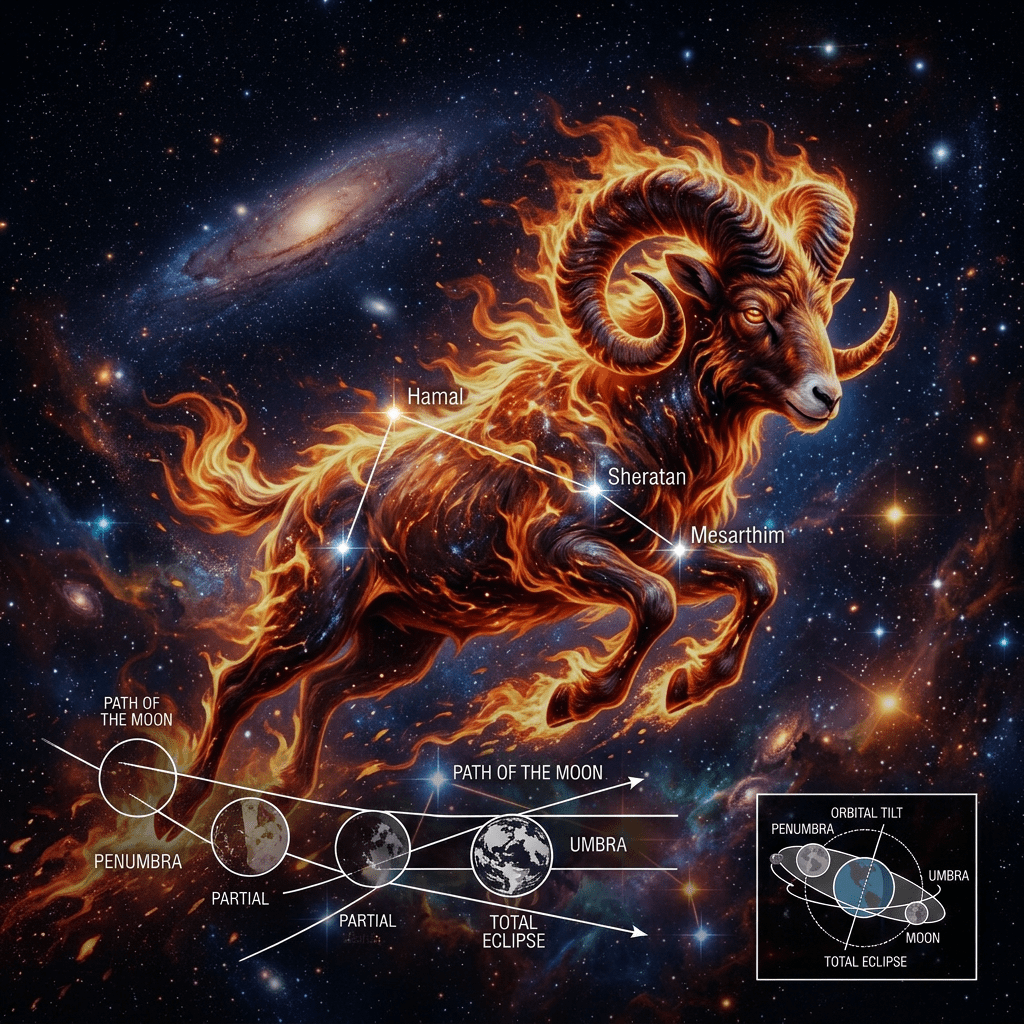
The Aries constellation depicted as a fiery ram alongside stages of a lunar eclipse
For Aries, the week of 3–9 August 2026 is one of growing anticipation rather than immediate action. Astronomically, the Sun continues its passage through Leo while the Moon moves through its monthly cycle towards the 12 August total solar eclipse, gradually increasing the gravitational and symbolic emphasis on the Sun–Moon–Earth alignment. Although the eclipse has not yet arrived, its influence begins to build, drawing attention to creativity, children, romance, personal projects and the courage to express your authentic self. Conversations and opportunities may hint at changes that will become clearer over the following fortnight.
Astrologically, this is a week to notice what inspires you rather than what drains you. Situations that have felt stalled may begin to show where fresh energy wants to flow, while relationships reveal who genuinely supports your ambitions. Resist the temptation to force outcomes or rush decisions simply because momentum is increasing. The approaching eclipse is preparing a new chapter, but the details are still unfolding.
Way through: Stay confident, finish what you have already started, and allow the right opportunities to reveal themselves before making your next bold move.
From 3–9 August 2026 the astrological atmosphere feels like the gathering of a tide before a major wave. The Sun continues its journey through Leo, emphasising leadership, identity and the creative expression of purpose, while Mercury’s movement encourages reassessment of plans rather than impulsive decisions. Although the total solar eclipse does not occur until 12 August, its influence is already building. Eclipses have long been regarded as periods when events accelerate and hidden situations move rapidly towards revelation, and many astrologers consider the days leading into an eclipse to be as significant as the eclipse itself. Collectively this week may bring increasing political tension, market uncertainty, environmental concerns and sudden announcements that have been developing behind the scenes for months. Individuals may experience a growing feeling that an important chapter is ending and another is preparing to begin. Rather than forcing outcomes, this is a week for careful observation, completing unfinished business and listening to intuition before decisive action becomes necessary.
From an astronomical perspective, the approaching eclipse is a precise alignment of the Sun, Moon and Earth, with the Moon moving directly between Earth and the Sun on 12 August. Totality will be seen best across Greenland, Iceland and northern Europe, with a small portion of Portugal also lying within the path of totality. Much of Europe, including the Netherlands, will experience a deep partial eclipse of around ninety per cent, while large parts of North America, Canada and north-west Africa will also witness a partial eclipse. As the Moon’s shadow races across Earth at thousands of kilometers per hour, scientists will study the Sun’s corona, atmospheric changes and subtle effects on Earth’s upper atmosphere, while sky-watchers experience one of nature’s rarest spectacles. Astrologically, eclipses symbolise moments when familiar patterns are interrupted, allowing new directions to emerge. Whether viewed through astronomy or astrology, this week invites us to recognise that change often begins quietly before it becomes unmistakably visible.
The Barbault Basket reaches its greatest precision between 19 and 21 July 2026, with its point of maximum symmetry occurring around 20 July. At that time Jupiter (4° Leo), Uranus (4° Gemini), Neptune (4° Aries) and Pluto (4° Aquarius) all occupy the fourth degree of their respective zodiac signs. The four planets simultaneously form a network of harmonious aspects: Jupiter opposes Pluto, Uranus trines Pluto, Neptune trines Jupiter, while Uranus and Neptune are linked by a sextile. We regard this as one of the most elegant planetary geometries of the decade and as a significant expression of the long-term Uranus–Neptune–Pluto cycle which corresponds with periods of major historical reorganisation according to the famous French astrologer André Barbault.
From an astronomical perspective, the planets themselves are widely separated in the Solar System, but when viewed from Earth they are projected onto different regions of the celestial sphere, as we all know. Jupiter, in early Leo, appears against the rich stellar fields bordering Cancer and Leo, looking outward through the Orion Spur of our Milky Way. Uranus, in early Gemini, lies in the direction of the Galactic anti-centre, beyond which are numerous open clusters including Messier 35. Neptune, in early Aries, is seen against comparatively sparse foreground stars in the direction of the Andromeda region, while Pluto, in early Aquarius, is projected towards the Pegasus–Aquarius field, beyond which modern surveys reveal immense numbers of distant galaxies. The stars and galaxies behind the planets provide the vast cosmic backdrop against which the configuration is observed.
The repeated emphasis on the fourth degree is one of the features that has attracted considerable astrological attention. Traditionally, the number four symbolises foundations, structure, manifestation and the establishment of lasting forms. Many astrologers therefore interpret the four planets occupying four degrees of their respective signs as indicating that the developments associated with this period are likely to become embedded in practical reality rather than remaining temporary or theoretical. Whether viewed symbolically or geometrically, the repeated fourth degree gives the configuration an unusual coherence and signifigance.
Comparable configurations are exceptionally rare. The exact combination occurring in July 2026 is unique within recorded historical times. Ephemeris studies identify 19–21 July 2026 as the period during which the Basket is exact, with the closest alignment around 20 July. Broader planetary arrangements involving the same outer planets have occurred at other periods, including the early 1920s, but they do not reproduce this same pattern of planetary degrees and aspect relationships. Because the orbital periods of Jupiter, Uranus, Neptune and Pluto differ so much.
Humanity now has an extraordinary scientific presence extending from interstellar space to the surface of the Sun. We also have unique technology and a wealth of historical knowledge to draw from – which has never been so before – Taken together, these observatories, spacecraft and intelligence technologies form a continuously operating system spread across the Solar System, each part contributing a different piece to our understanding of our origin, evolution and present activity.
This precise geometry does not repeat on any simple historical cycle, making the 2026 Basket a particularly rare event in planetary chronology. This time is unique – we are now able to change the pattern and put anything in the basket – this reset is our opportunity to create the beautiful world we all know is possible .
There was need of a pause – for me, personally – that is now over
We resume our work here with a feeling of new found peace The recipe remains the same – only the flavoring is a little different
Things change as we cycle through the universe in our endless spiral of learning and enlightenment. We are now in a tricky phase – where every choice matters – where the layers of truth and reality become one whole – and our choices really matter – all our choices matter – from the deeply personal to those that are most public. We are navigating a moment in space-time that is unique – the planets are in unique positions – we will never be in this exact position again – as our planet, our solar system, even our galaxy spirals through the universe towards the great attractor. For us, the flight into this change can feel deeply disturbing, or equally liberating, as if the cage is gone – and this is what is happening – we must learn to fly or fall – this is the fulcrum of our evolution
The cage is disintegrating before our eyes – there is nothing to stop us and nothing to protect us, from this point on – we are on our own.
Aries is at the centre of the current surge. Between 15–27 April, the Moon (15–17), Mercury (around 16–18), the Sun (19–20), Venus (already from 5 April), along with Chiron and Eris, all concentrate in your sign, culminating in the New Moon on 27 April. This creates a rare compression of identity, will, and action—everything becomes immediate. You may feel pushed to decide, to act, to move forward without the usual time to reflect. This is not a gentle reset; it is a forced ignition, where hesitation falls away and something in your life demands to begin, end, or be confronted directly.
The pressure is not random—it is precise. Old versions of yourself that no longer hold will surface sharply, especially around 19–22 April as the Sun locks into Aries and deeper structural shifts come into play. This can feel like urgency or even conflict, but it is fundamentally about alignment: where you have been out of step with yourself becomes impossible to ignore. By the time the New Moon arrives, the direction is clear, even if it feels stark.
Move cleanly and consciously—act, but only on what is true, and let everything else fall away. Be sure you have all the facts and are not being misled – you must remain calm and concise in your actions.
Do not be overwhelmed. Pisces is moving through one of the more internally corrective phases of this Aries concentration between 15–27 April, where the activation sequence—Moon in Aries (15–17 April), Mercury shifting after its post-conjunction phase around 16–18, Sun entering Aries on 19–20 April, Venus already in Aries, plus Chiron, Eris, and the New Moon on 27 April- the whole thing lands in your zone of resources, value, stability, and self-worth. This is where external acceleration meets internal grounding. The result is not chaos in the outer world so much as pressure to define what is actually sustainable for you – financially, emotionally, and energetically.
The most active window is 19–25 April, when Aries becomes fully charged and begins forming sharper structural aspects, including Sun–Pluto depth activation and Mars–Jupiter acceleration. For Pisces, this can bring sudden decisions around money, commitments, or practical responsibilities that can no longer remain vague. There is a tendency here to over-give or overextend in response to urgency around you, especially if others are moving quickly. The real challenge is distinguishing between what you are responsible for and what you are simply absorbing from your environment. Don’t let it keep you awake at night – it’s not all your responsibility – only you are – remember this.
This is a recalibration of value, not a test of endurance. What drains you without return becomes obvious under pressure. So be prepared to let go of that. The way through is to simplify commitments, define clear limits, and treat your energy as something measurable – not infinite – so that what remains is genuinely reciprocal and stable.
You, Aquarius are being pulled into a socially and structurally disruptive current during the Aries concentration between 15–27 April, where the activation sequence – Moon in Aries (15–17 April), Mercury shifting after its post-conjunction phase around 16–18, Sun entering Aries on 19–20 April, Venus already in Aries, plus Chiron, Eris, and the New Moon on 27 April – this all lands in your zone of communication, networks, immediate environment, and information flow. This is a high-speed mental and social corridor. Messages arrive quickly, decisions are made in conversation rather than planning, and connections can form or break without extended process.
The most intense phase sits between 19–25 April, when Aries becomes fully activated and begins forming sharper structural aspects, including Sun–Pluto depth pressure and Mars–Jupiter acceleration. For Aquarius, this often manifests as overload in communication systems, travel movement, digital activity, or group dynamics. There is a strong tendency for information to fragment or multiply faster than it can be processed. The challenge is not access to data, but filtering what is actually relevant versus what is simply noise moving at speed.
This is a reorganisation of perception and contact. What is unnecessary communication falls away quickly, while essential signals become clearer under pressure. You may need to ditch some social media and make your media usage more social. The way through is to reduce input, respond selectively, and only engage where clarity is immediate and mutual – let silence do more work than ‘reaction’.
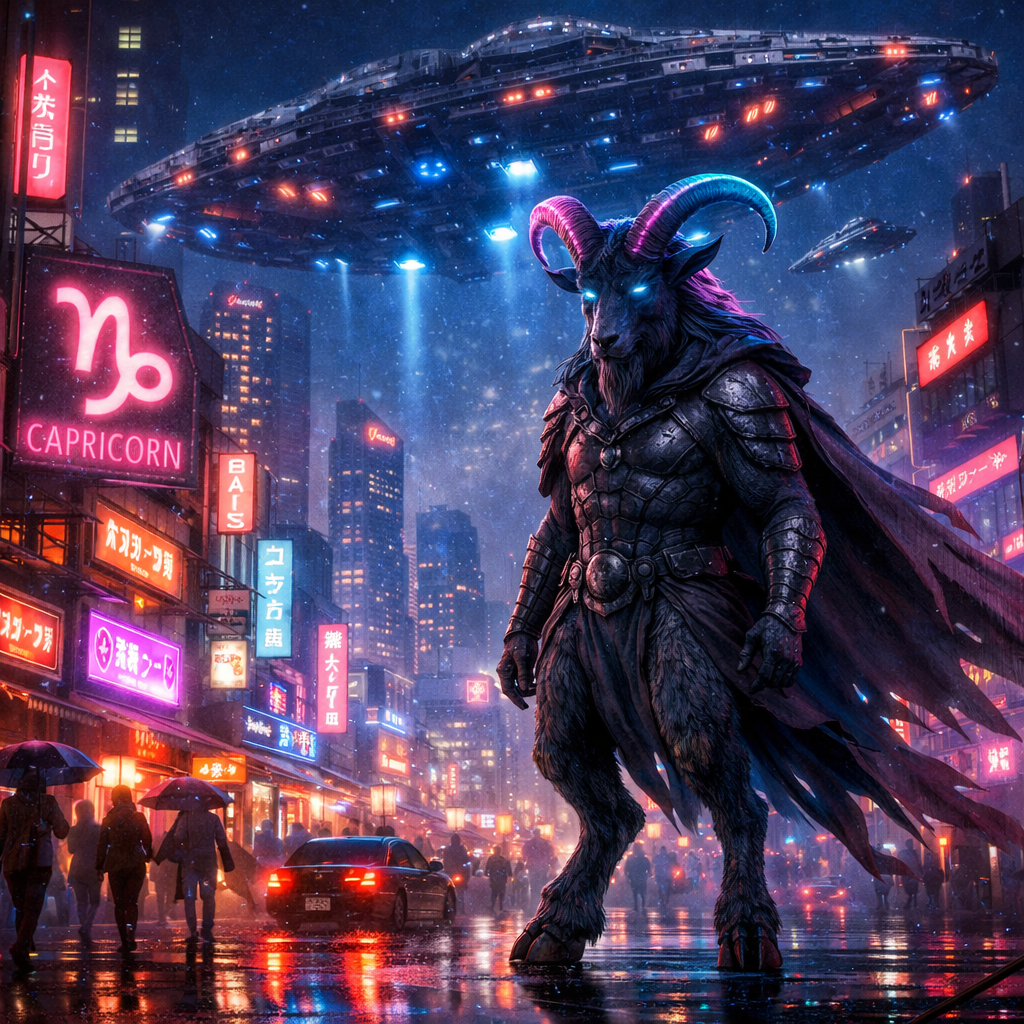
You dear Capricorn are drawn into a more foundational restructuring phase during the Aries concentration between 15–27 April, where activity is not direct – but pressures are felt at the base of your chart. The sequence – Moon in Aries (15–17 April), Mercury moving through its post-conjunction shift around 16–18, Sun entering Aries on 19–20 April, Venus already in Aries, plus Chiron, Eris, and the New Moon on 27 April – activates your zone of home, stability, long-term security, and internal structure. This tends to show up as pressure around living arrangements, family dynamics, or the underlying sense of stability in your life. Even if external change is minimal, internal recalibration is significant. Spring clean you home, do the paperwork, spring clean your mind – check your structures both outer and inner.
The most concentrated tension arrives between 19–25 April, when Aries is fully active and begins forming stronger structural aspects, including Sun–Pluto intensity and Mars–Jupiter acceleration. For Capricorn, this can feel like competing demands between external momentum and internal stability. Plans may shift quickly at home or within private foundations while external obligations continue to increase. The risk here is over-responsibility -trying to maintain control of everything while underlying conditions are already changing shape.
This is a grounding reset disguised as instability. What feels unsettled is actually being reorganised into a more workable structure. Work with it – by doing what you can in and around the home – safe ground – one hopes – become part of the change. The way through is to simplify your base, protect your private space, and allow change to happen in layers rather than forcing immediate resolution.
So, Sagittarius you are strongly stimulated by the Aries concentration between 15–27 April, forming a fire-to-fire amplification that feels both energising and destabilising all at the same time. The activation sequence -Moon in Aries (15–17 April), Mercury shifting after its post-conjunction phase around 16–18, Sun entering Aries on 19–20 April, Venus already in Aries, plus Chiron, Eris, and the New Moon on 27 April – lands in your zone of creativity, risk, pleasure, and personal expression. This is a highly charged period where inspiration rises quickly, but so does impatience. What begins as excitement can escalate into urgency if not paced. So, let your imagination run wild but do not act rashly – breaking more than you can mend.
The most active window is 19–25 April, when Aries becomes fully lit and begins forming sharper structural aspects, including Sun–Pluto pressure and Mars–Jupiter acceleration. For Sagittarius, this is expansive but volatile: new ideas, romantic developments, creative pushes, or speculative decisions can arrive all at once. Let them, think about them – weigh them in the balance and take your time with decisions. There is a strong temptation to overcommit or overshoot capacity because momentum feels like confirmation. The danger is not lack of opportunity, but excess of it arriving faster than judgment can stabilise.
This is a creative ignition phase, not a completion phase. What starts now has long reach but requires refinement later. The way through is to choose only what genuinely excites you without forcing scale – follow inspiration, but keep one anchor in realism so momentum does not outrun structure.
Scorpio is operating under a deeper internal pressure during the Aries surge, can you feel it? Between 15–27 April, where the activation sequence is – Moon in Aries (15–17 April), Mercury shifting around 16–18 after its post-conjunction phase, Sun entering Aries on 19–20 April, Venus already in Aries, plus Chiron, Eris, and the New Moon on 27 April – lands in your zone of routine, health, work systems, and structural stability. This is not dramatic on the surface, but it is cumulative. Small disruptions build quickly, and what seemed manageable begins to demand immediate attention. There is a feeling of systems tightening around you, requiring adjustment rather than expansion. Stay in command and do not lash out – there is nothing to be gained by annoyance at continued disruptions and interruptions.
The most concentrated pressure occurs between 19–25 April, when Aries becomes fully active and the Sun begins forming sharper structural aspects, while Mars–Jupiter dynamics accelerate external pace. For Scorpio, this often shows up as workload intensity, shifting responsibilities, or the need to respond to inefficiencies that can no longer be ignored. The risk is over-control – while trying to fix too many variables at once. Conditions are still changing – let them. Something in your environment is asking to be simplified, not perfected. So see what it is – and deal with that.
This is a correction cycle disguised as urgency. What breaks down now is what was already unsustainable in structure or rhythm. You already know this – now it begins to gain ‘form’. The way through is to reduce friction: remove excess tasks, focus only on what is essential, and allow systems to reorganise without forcing precision too early. Above all – don’t loose your temper – though you will be sorely tempted.
A golden scale balance sits on a control desk inside a space station with Earth and spacecraft visible outside the window.
Libra is directly opposed by this Aries concentration, so the period between 15–27 April is experienced as pressure through relationship dynamics, negotiation, and external demands – and feels exhausting. The sequence – Moon in Aries (15–17 April), Mercury shifting through its post-conjunction phase around 16–18, Sun entering Aries on 19–20 April, Venus already in Aries, plus Chiron, Eris, and the New Moon on 27 April -lands across your relational axis. This is not subtle. It brings clarity, confrontation, and acceleration in partnerships, contracts, and one-to-one dynamics. What has been balanced or deferred begins to tip decisively in one direction. Know what you want to keep and what you want to ditch – you hold the balance.
The critical window is 19–25 April, when the Sun stabilises in Aries and begins forming stronger structural aspects, including pressure points with Pluto and accelerated movement through Mars–Jupiter dynamics. For Libra, this feels like being asked to respond quickly where you would normally deliberate. Decisions may be made by others before you feel ready, or situations may reach conclusions without extended negotiation. The Full Moon earlier in your sign (13 April) sets the tone: something is already shifting toward resolution before the Aries peak even fully arrives. Do your best to wing it as this is not something you can change – just let it change and remain in your place of balance.
This is a truth-revealing cycle in relationships. What is balanced survives pressure; what is not becomes obvious quickly. The way through is to respond cleanly rather than react emotionally -speak clearly, choose simply, and do not extend situations that have already shown their direction.
As a Virgo you are drawn into a more structural and pressure-testing phase during the Aries concentration between 15–27 April. The sequence – Moon in Aries (15–17 April), Mercury moving through its post-conjunction shift around 16–18, Sun entering Aries on 19–20 April, Venus already in Aries, plus Chiron, Eris, and the New Moon on 27 April – activates your zone of shared resources, obligations, and deeper entanglements. This is not surface-level change. It shows up through financial decisions, emotional commitments, or situations where you are tied to other people’s momentum rather than your own.
The most intense period falls between 19–25 April, when Aries becomes fully active and begins forming tighter aspects, especially as the Sun engages Pluto and Mars aligns with Jupiter. For Virgo, this can feel like pressure through systems, all your systems: paperwork, responsibility, contracts, or emotional obligations – all these things that can no longer be managed casually. Things that were previously flexible become fixed. The risk here is over-managing what cannot be controlled, or attempting to stabilise something that is already in motion. Watch it happen, take notes, but allow it to happen as you cannot control it anyway.
This is a release point disguised as pressure. What no longer has clean structure will show its faults clearly. The way through is to simplify, reduce exposure, and only commit where the return is clear and the burden is shared fairly. You don’t have to hold up the sky for everyone – take care of yourself.
As a Leo you are now being pulled into the pressure of visibility and consequence during this Aries surge between 15–27 April. The activation sequence – Moon (15–17 April), Mercury (around 16–18), Sun entering Aries on 19–20 April, Venus already in Aries, plus Chiron, Eris, and the New Moon on 27 April – lands in your zone of expansion and direction. This creates a strong push toward decisions involving your future path, your belief systems, travel, education, or long-term purpose. Things that were theoretical become immediate. You are asked to commit to a specific direction rather than keep options open. Make the right choice.
The most active window is 19–25 April, when the Sun locks into Aries and begins forming sharper structural aspects, while Mars and Jupiter accelerate momentum. This can feel like pressure to move, declare, or choose before everything is fully comfortable. There is a tendency for overconfidence or overreach during this phase, especially as external demands increase faster than internal processing. The New Moon on 27 April acts as a directional reset point—what you commit to now sets the trajectory for months ahead. It is imperative that you choose well.
Do not confuse urgency with truth. Step back just enough to see whether what you are being pulled toward is aligned or merely loud. The way through is simple: choose slowly and carefully under this kind of pressure, and only move fully when the direction still feels correct after the noise settles. Do not let this April planet stack force your hand.






 ASTROLOGY CRUCIBLE