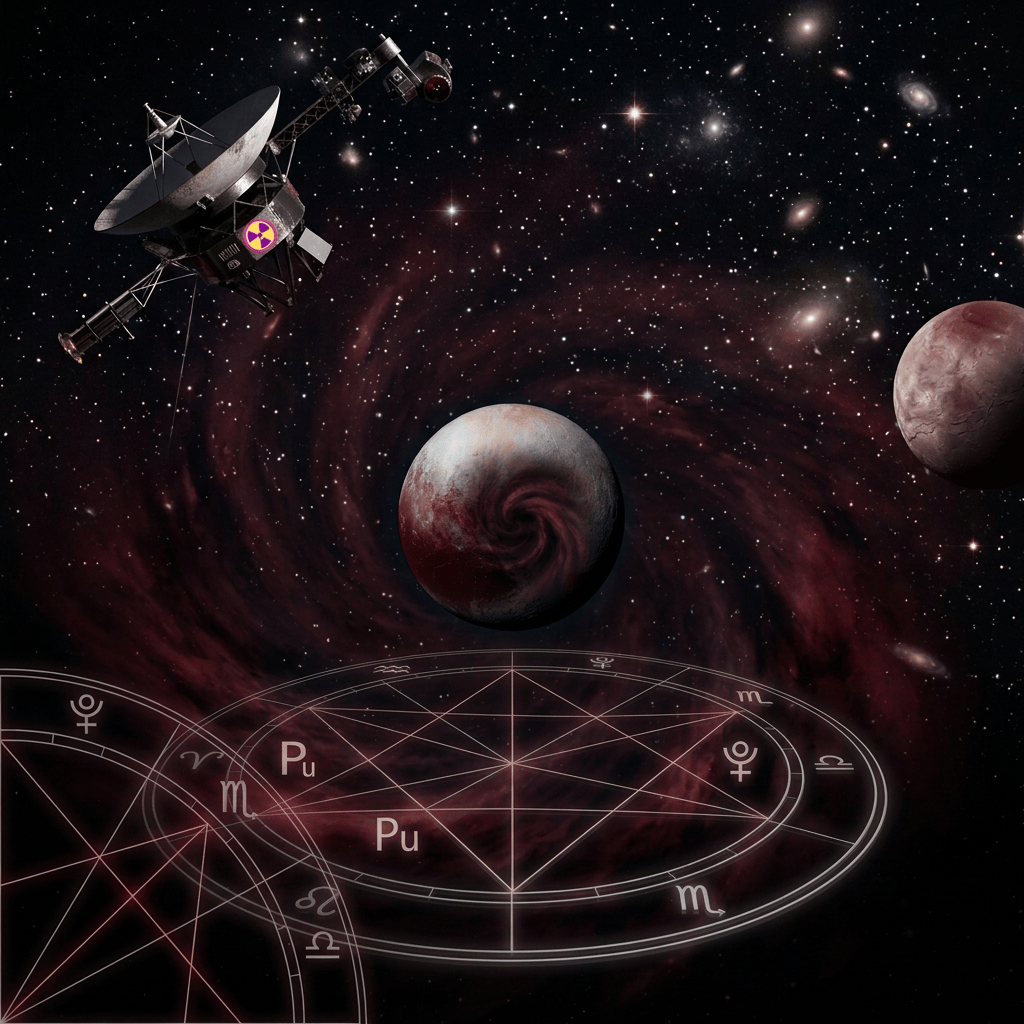
Pluto carries the name of the Roman god of the Underworld, the Roman equivalent of Greek Hades, but Pluto was also associated with hidden wealth: what lies buried beneath the surface, unseen yet immensely powerful. That symbolism fits the astronomical body remarkably well. Discovered by Clyde Tombaugh at Lowell Observatory in 1930, Pluto was initially celebrated as the ninth planet; in 2006 the IAU classified it as a dwarf planet within the Kuiper Belt. Even its moons continue the underworld theme: Charon, Styx, Nix and Kerberos all draw their names from the mythology of death and the Underworld.
The Pluto–plutonium connection is particularly striking. In 1940–41, Glenn Seaborg, Edwin McMillan and colleagues created and identified element 94, following element 93, neptunium, in the same planetary naming sequence. Seaborg named it plutonium after Pluto. Plutonium is an intensely radioactive transuranium element, and its discovery opened a new chapter in nuclear science, including the development of nuclear energy and weapons. Symbolically, the namesake relationship creates an extraordinary bridge between the astronomical Pluto, the mythological Underworld and humanity’s ability to release immense hidden energy from matter.
Astrologically, Pluto is currently retrograde at about 3° Aquarius, moving back through the early degrees of the sign before stationing direct on 16 October at roughly 3° Aquarius. This makes the present moment particularly Plutonic: Mars in Leo reaches an exact opposition to Pluto on 3 October, while Mercury in Scorpio squares Pluto, bringing the symbolism of power, exposure, buried information, confrontation and transformation into a tightly concentrated configuration. From a Geo-Zenith perspective, Pluto in Aquarius is less about destruction for its own sake than the excavation of systems: exposing what has been hidden, dismantling structures that have exhausted their purpose, and forcing deeper questions about technology, collective power, humanity and the future. The Underworld becomes the place we go to retrieve what has been buried — and bring it back transformed.
The way through a volatile Mars–Pluto period is not to meet force with force. Mars in Leo opposite Pluto in Aquarius can describe a struggle over power, pride, territory or control, and Mercury in Scorpio adds the possibility of words becoming weapons; these aspects are exact around 2–3 October. At the collective level, this is a period in which restraint, diplomacy and the refusal to escalate become active choices rather than passive ones. We can acknowledge the anger and pressure without feeding them, question before reacting, and keep looking for the exit from confrontation rather than the victory within it. In the larger Geo-Zenith picture, the hope is that Pluto’s deep transformational pressure becomes a force for exposing and dismantling what no longer works rather than destruction through conflict. Let us hope that wars already underway do not escalate, and that those with real power choose negotiation over another turn of the wheel.

